
Teacher Portal
Ecosystems and Changes
Investigation 2

Ecosystems and Changes: Investigation 2
Food Webs
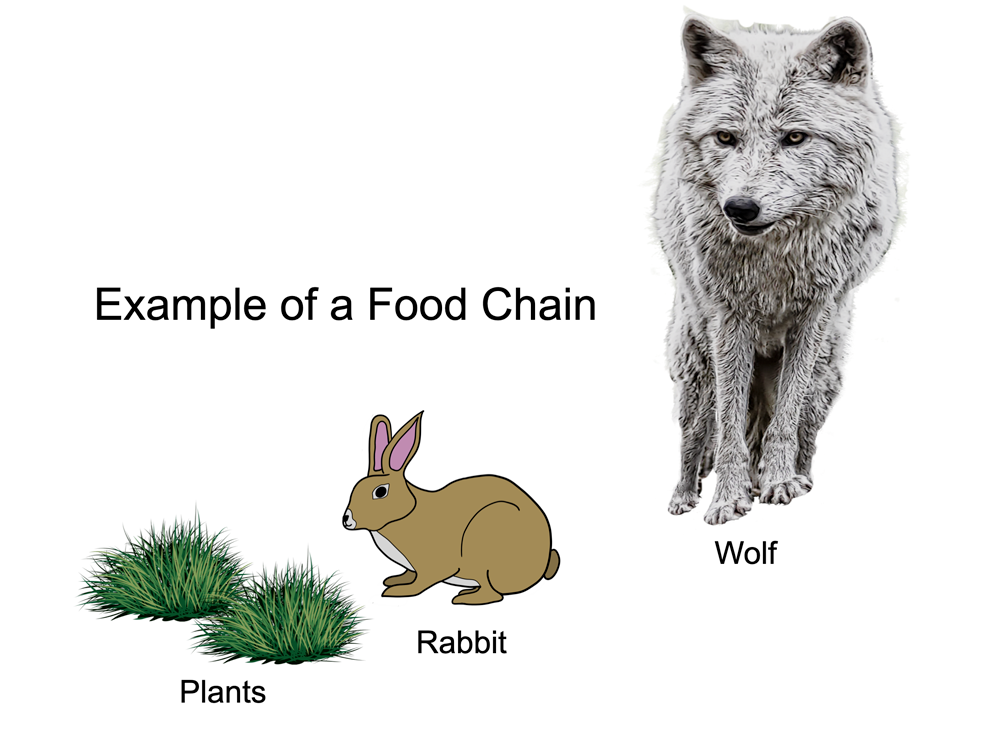
In Investigation One, students learned that an ecosystem is defined as a community of organisms and its non-living environment and that every ecosystem contains patterns of feeding and being fed upon, a pattern known as a food chain. The simple plants, rabbit, and wolf food chain from the first Investigation is shown again below.
All animals eat other living things. Some animals eat only other animals (carnivores), some eat only plants (herbivores), and some eat both (omnivores). Every ecosystem supports many food chains, most of which consist of three to four levels. These three groups of animals are shown again below for review. Once again, notice that in these examples, animals that no longer exist on Earth (dinosaurs in this case) are also included in the graphic. Animals like dinosaurs are now extinct.

Food Webs
When food chains overlap, that is, when there are interactions between plants and animals from different food chains, a food web results. In every ecosystem, there are numerous food webs and food chains. Rarely does an animal eat only one type of plant or animal. In the illustration below, the simple plant, rabbit, and wolf food chain we have already studied is expanded to become a food web.
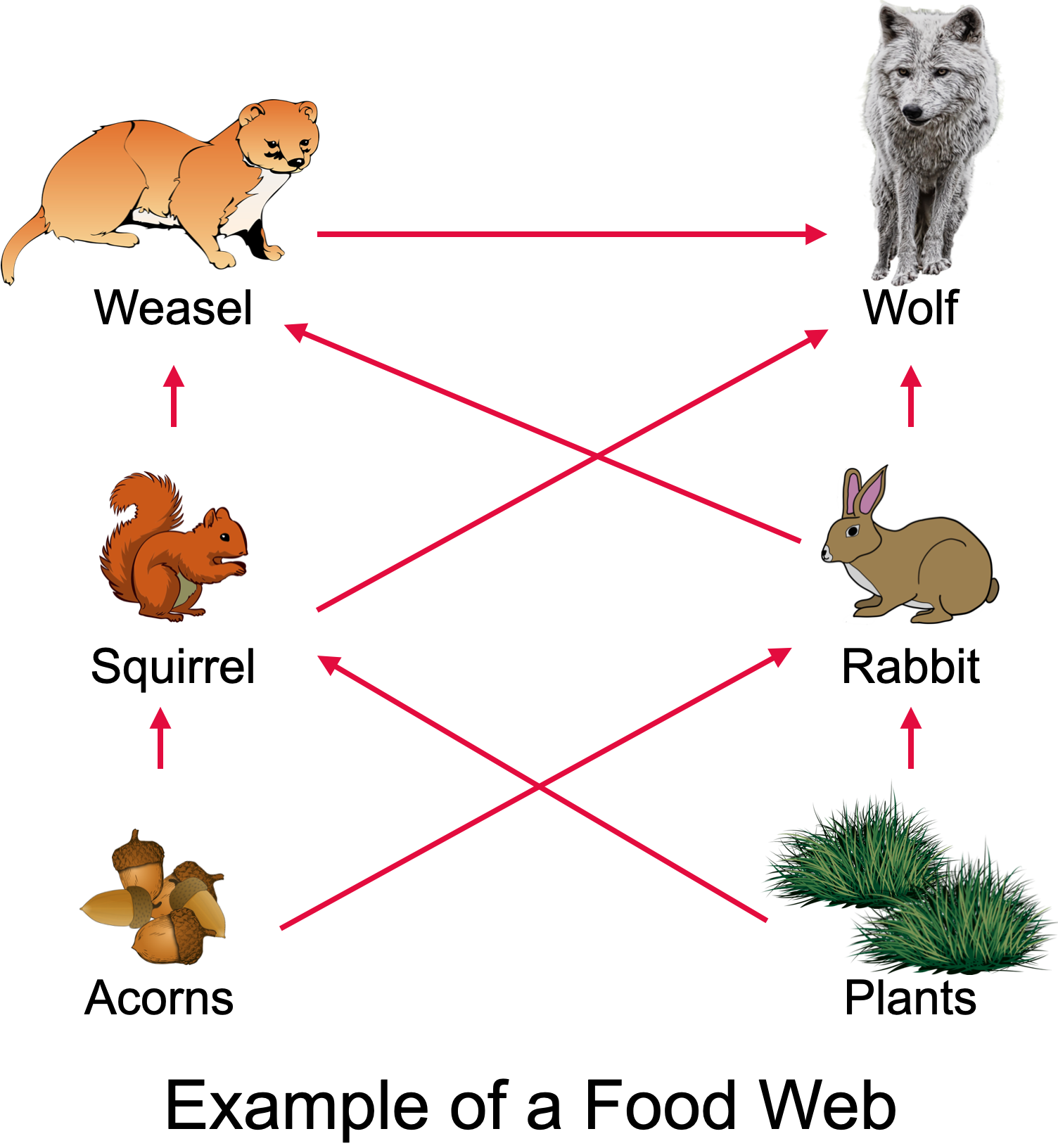
Food webs are intricately related within ecosystems. The multitude of interactions between organisms and their environment is expressed in a relationship known as interdependence. The interdependence between elements of an ecosystem results in a rippling effect of a disturbance in any one area of the system to the system as a whole. The study of the complex interdependencies and interrelationships between organisms and the environment is known as Ecology. Therefore, Ecology is a very important science, for it not only seeks to answer questions about the wonderful complexity of the world we live in, but it also has very practical applications to human beings, as we shall see throughout this CELL.
Math Concepts
Ecosystems and Changes
Investigation 2
Prelab
- comparing (non)measurable characteristics
- data table
- grouping/classifying
Lab
- volume in mL
- length in cm
- problem-solving
Postlab
- comparing (non)measurable characteristics
- diameter/length in cm
- greater than/less than/equal to
- problem-solving
Ecosystems and Changes:
Investigation 2 Quiz

