
Teacher Portal:
The Earth’s Surface
Investigation 3 CAP
 ZERO-IN
 ZERO-IN
Italicized font represents information to be shared orally or physically completed with the students at this time.
The non-italicized font represents additional information included to support the teacher’s understanding of the content being introduced within the CELL.
BRANCH OUT
Explain to students that both plant and animal life depends on water and soil. Soil provides the nutrients and conditions for plants to sprout and grow. Much of the organic material in the soil is from plant sources. It is not uncommon to find many seeds in soil samples and students may have already found seeds playing in the soil outside.
PRINT IT
Use your browser to download a printable PDF as a help during the slide presentation and to make additional notes. In your browser, go to File > Print and then choose to save as PDF.
NAVIGATE IT
Once the slide presentation is launched
- use your left and right arrows to advance or go back in the slide presentation, and
- hover your mouse over the left edge of the presentation to get a view of the thumbnails for all the slides so that you can quickly move anywhere in the presentation.
- Click HERE to launch the slide presentation for the CELL.
SHARE IT
SLIDE EARTH-3-1
In this CAP we will address the issue of how animals are involved in assisting plants by spreading their seeds. As we are currently studying soil in the lab, it is important to let students know how important soil is for plant life. Terrestrial plant seeds must return to the soil in order to sprout and form a new plant. Most plants are not mobile, that is they cannot move about their environment like many animals can. Therefore, one problem that plants have had to overcome is the ability to reproduce and spread their species across great areas without themselves being capable of movement. Animals, of course, can simply walk, fly, swim or crawl from one location to another. Plants cannot do this so they have developed special systems to spread their seeds far from where they were produced.
Some plants produce seeds that are very light-weight and are spread great distances by the wind. On the other hand, many plants use animals to help them pollinate and to spread their seeds far and wide. The ability to spread seeds widely is very important for plants as it helps assure the survival of their species.
SLIDE EARTH-3-2
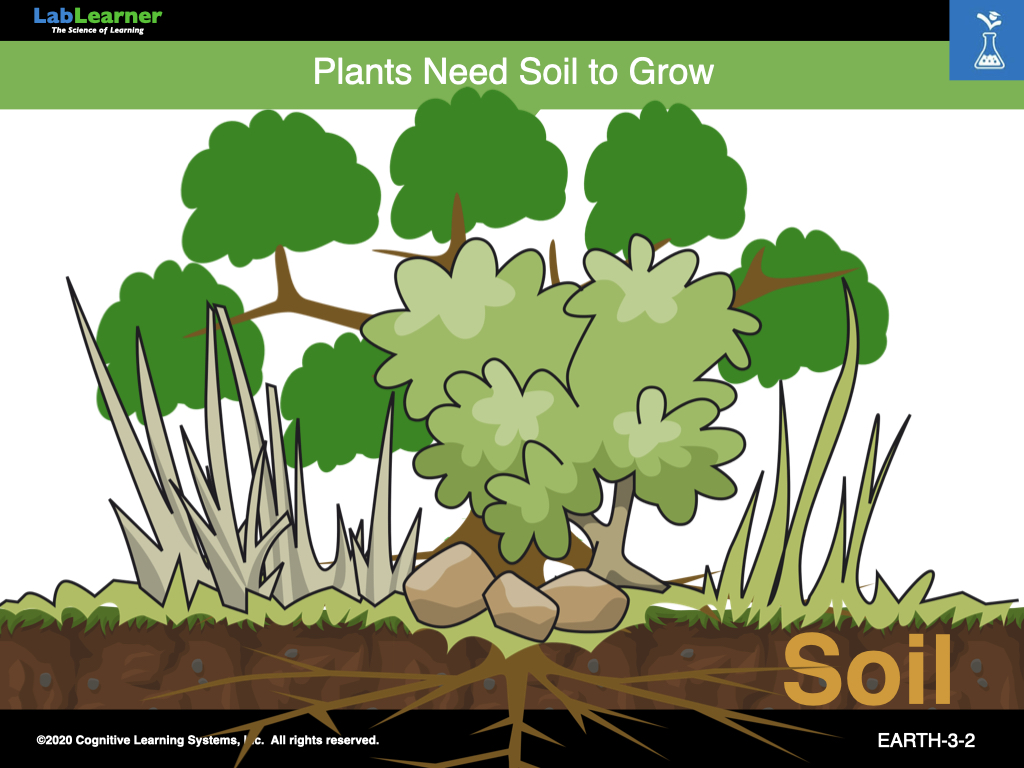
This introductory slide presents a typical side view cartoon drawing of soil and plants with roots spreading in all directions. It is worth discussing this picture for a moment so that students can understand the perspective of the drawing. We will see this representation in later slides as well.
SLIDE EARTH-3-3
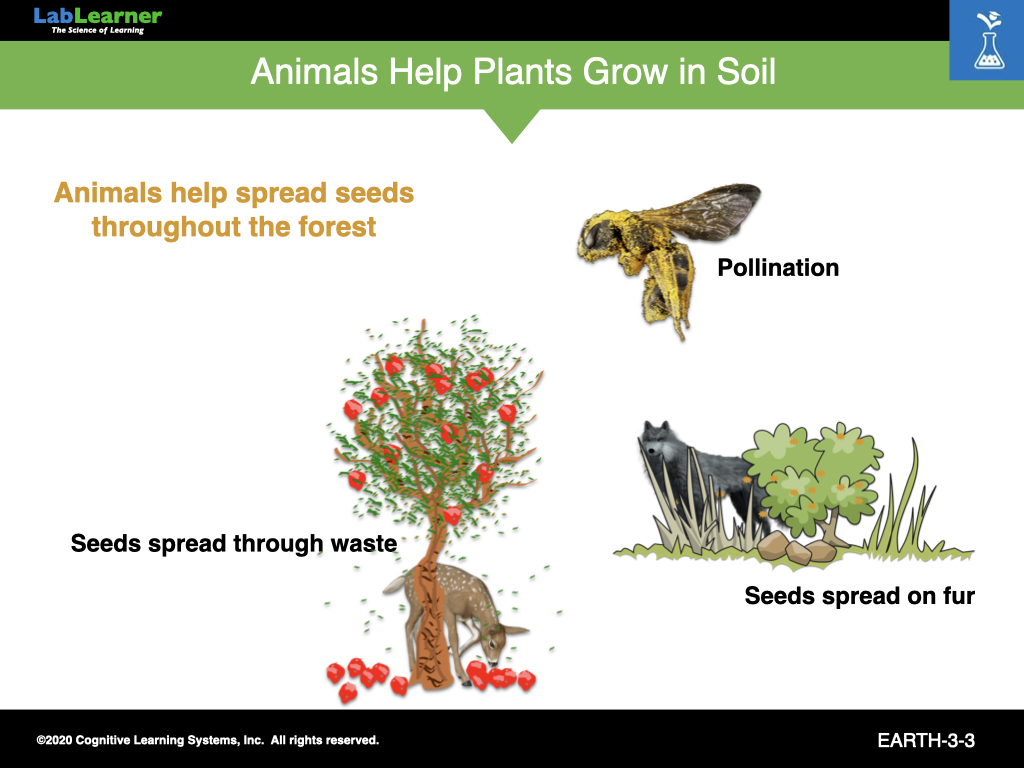
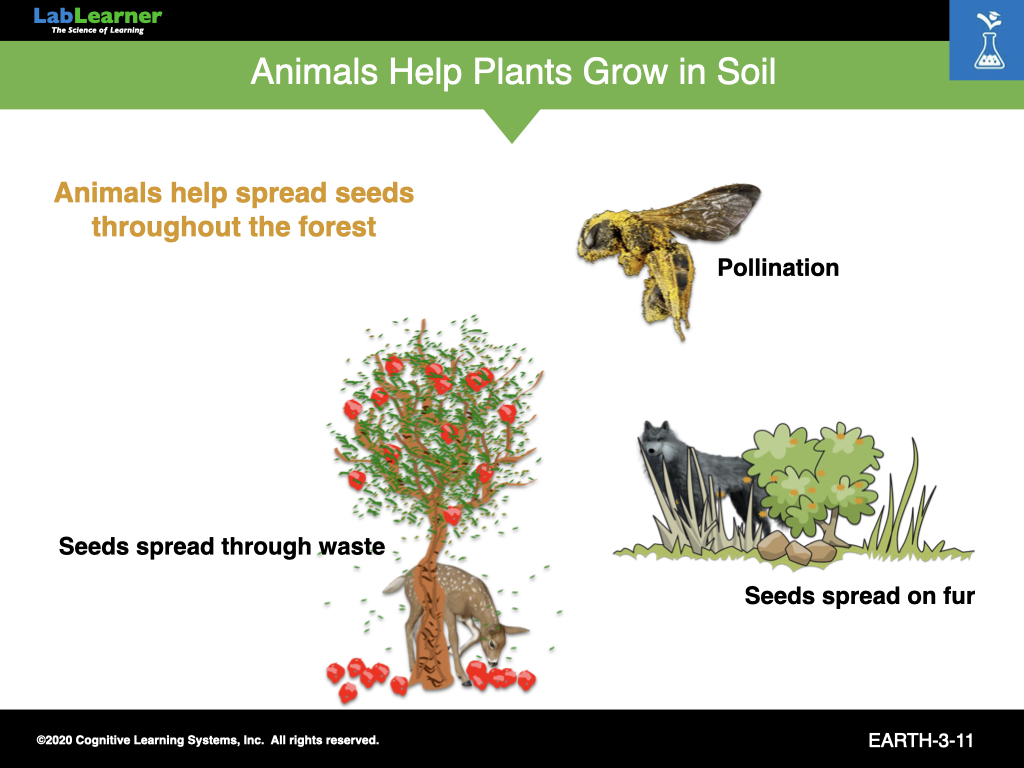
This slide can be discussed in terms of the three mechanisms we will address that animals help plants pollinate and to spread their seeds. We will discuss each of these mechanisms separately in the next several slides. Thus, we will discuss pollination of plants by bees, the spread of seeds through animal ingestion and waste, and the spreading of seeds by attachment to fur. Can you think of other ways that plants spread their seeds? (how about coconuts floating across vast stretches of the ocean before washing up on a beach and taking root?)
SLIDE EARTH-3-4
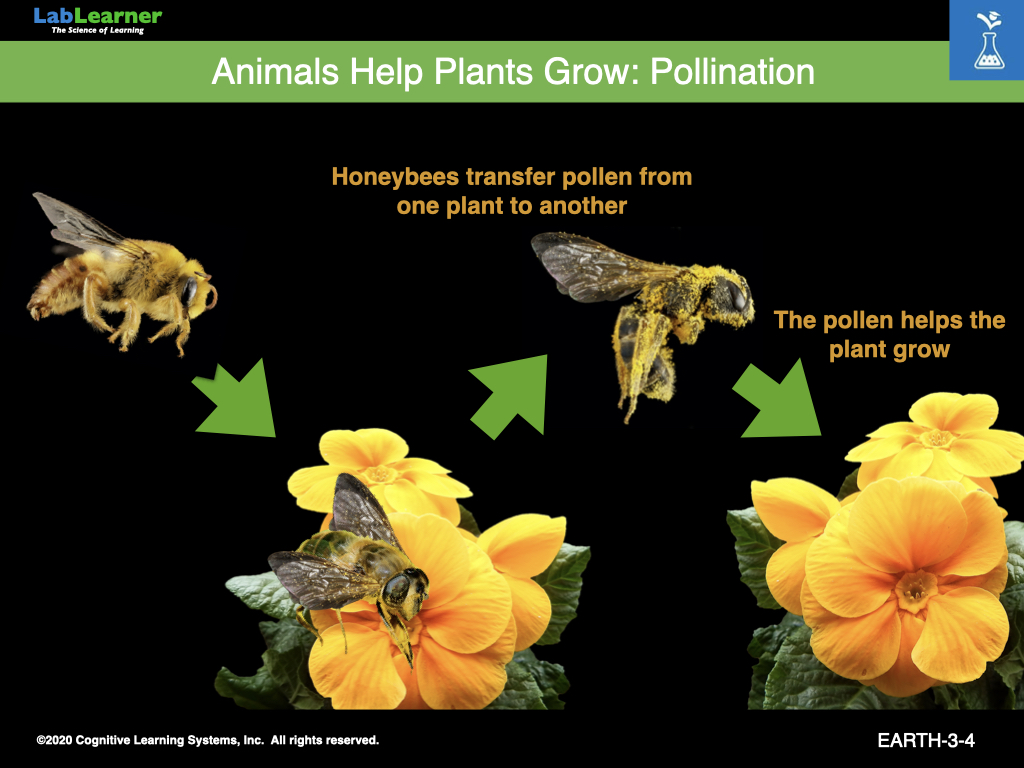
This slide illustrates the process of pollination by bees. Pollen grains are the male part of a plant’s reproductive system, essentially the sperm when compared to animals. The pollen, when coming in contact with the female part of the plant, the ovary, can develop into a seed and a new plant can grow from it. Bees help transfer pollen from one plant to another, thereby increasing the genetic diversity of new seeds.
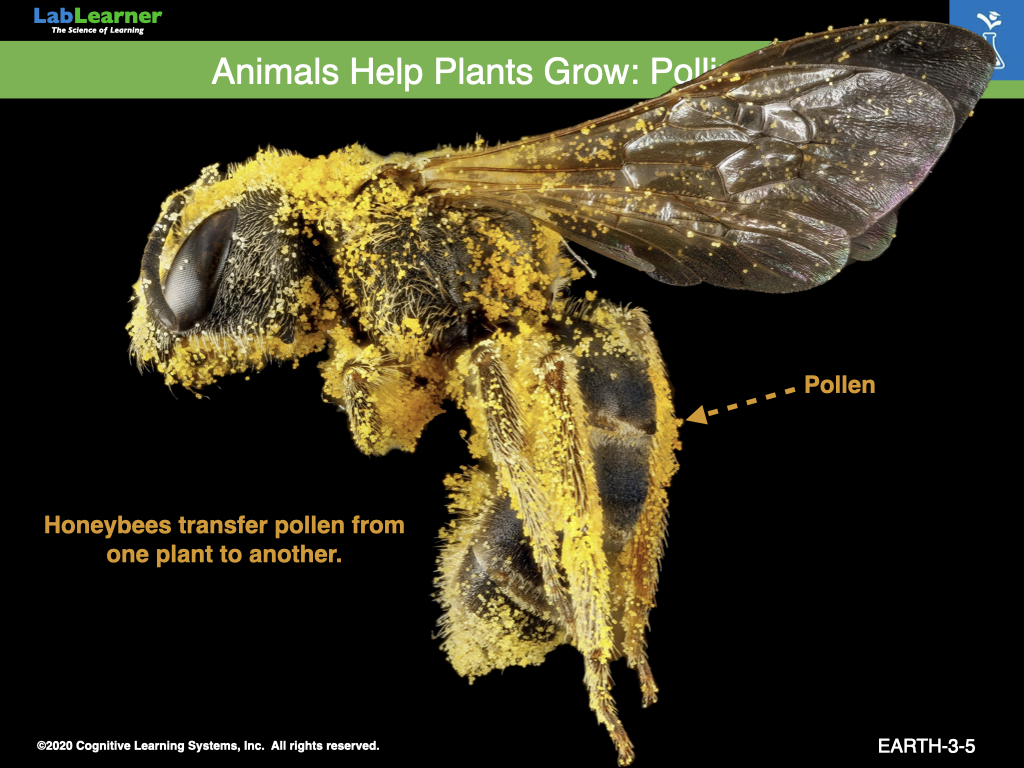
When a honeybee visits a flower for nectar, it inevitably becomes covered by fine sticky grains of pollen. As can be seen in these pictures, pollen is often yellow in color. When a bee leaves on a flower covered in pollen grains and then flies to another flower, some of the pollen from the first plant is transferred to the new flower. The mixing of pollen from one plant with the ovaries of a second plant is a form of sexual reproduction.
SLIDE EARTH-3-5
This slide simply shows a high-resolution view of pollen attached to a honeybee. By viewing this picture, students should be able to see that there are often hundreds of pollen grains carried by bees from one flower to another.
SLIDE EARTH-3-6
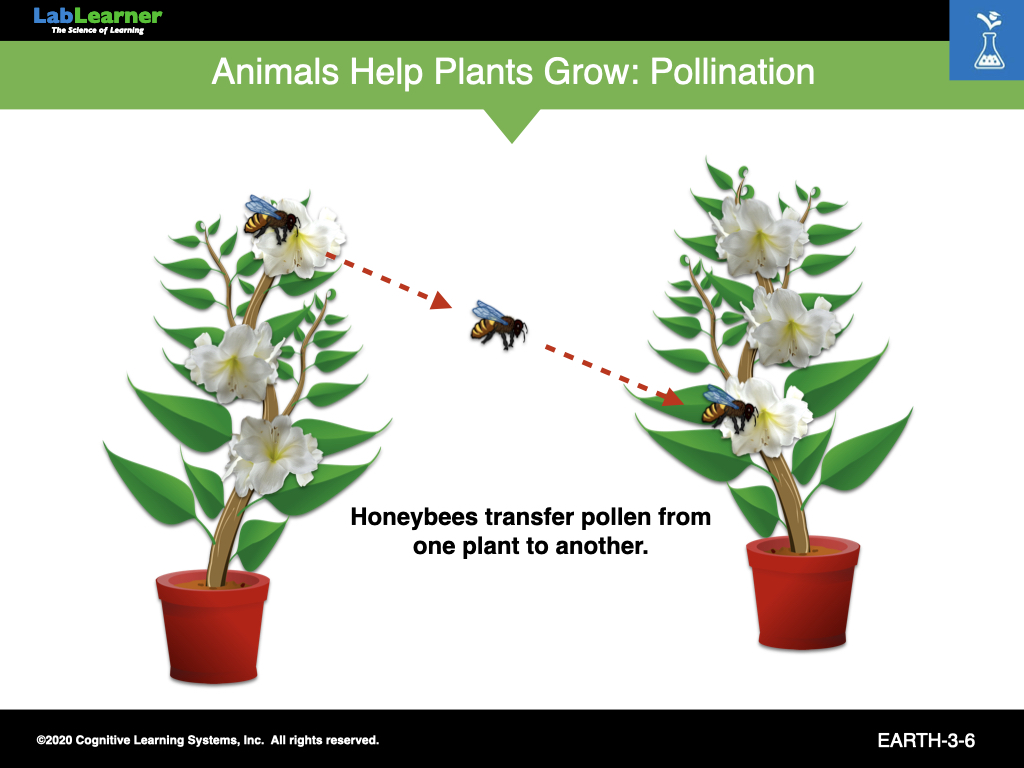
This slide is a much more schematic illustration of the process of pollination. The beauty and fragrance of flowers, while traditionally appreciated by humans, is mainly the plant’s way of attracting insects like bees for cross-pollination and reproduction.
SLIDE EARTH-3-7
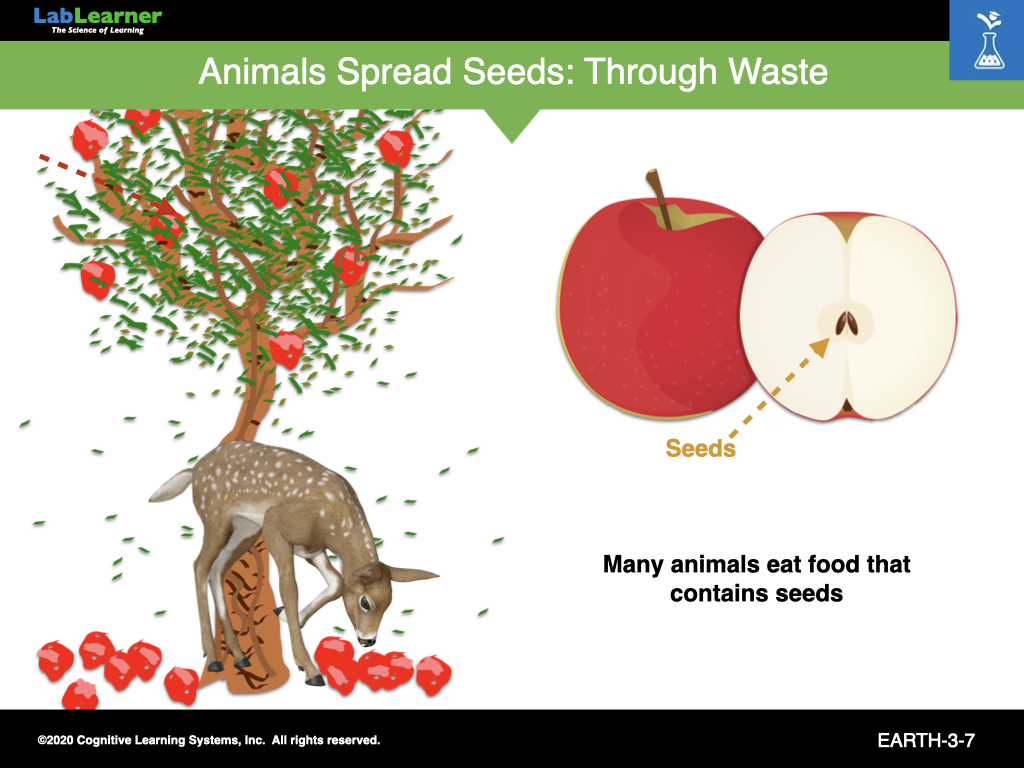
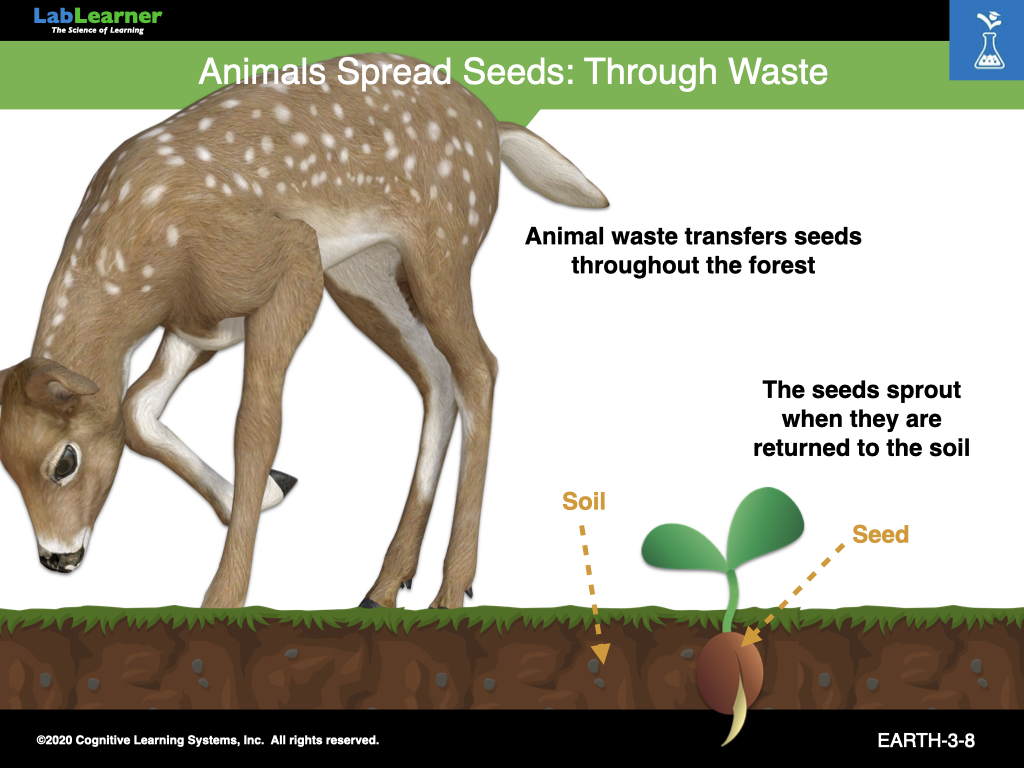
This is the first slide of two that introduces one way in which animals help plants spread their seeds. Many plants produce their seeds within a fruit that is desired by animals. Animals ingest plant seeds while consuming the fruit. The seeds have a strong protective coat that survives decomposition in the animal’s digestive tract. Thus, when the animal produces waste, the ingested seeds can be deposited on the forest floor and enter the topsoil. There, if conditions are right, the seed will sprout and grow into a new plant, perhaps very far from the plant that produced the original fruit and seeds.
SLIDE EARTH-3-8
This is simply the second slide in the set that describes how animals can help plants spread their seeds through their waste products.
SLIDE EARTH-3-9
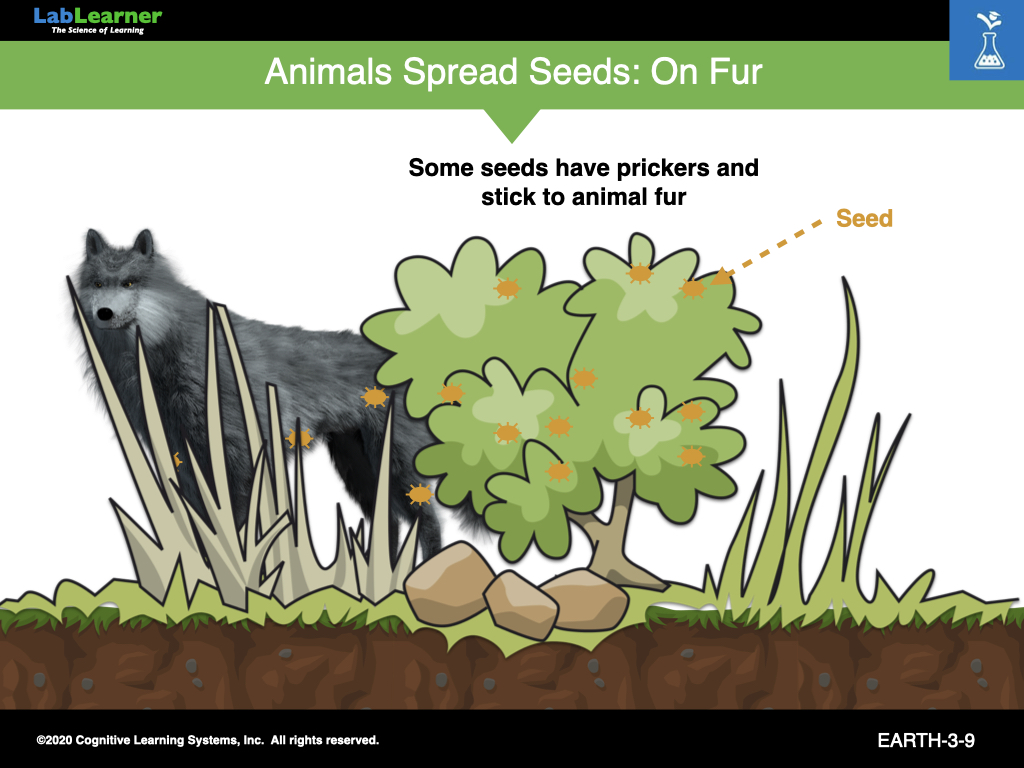
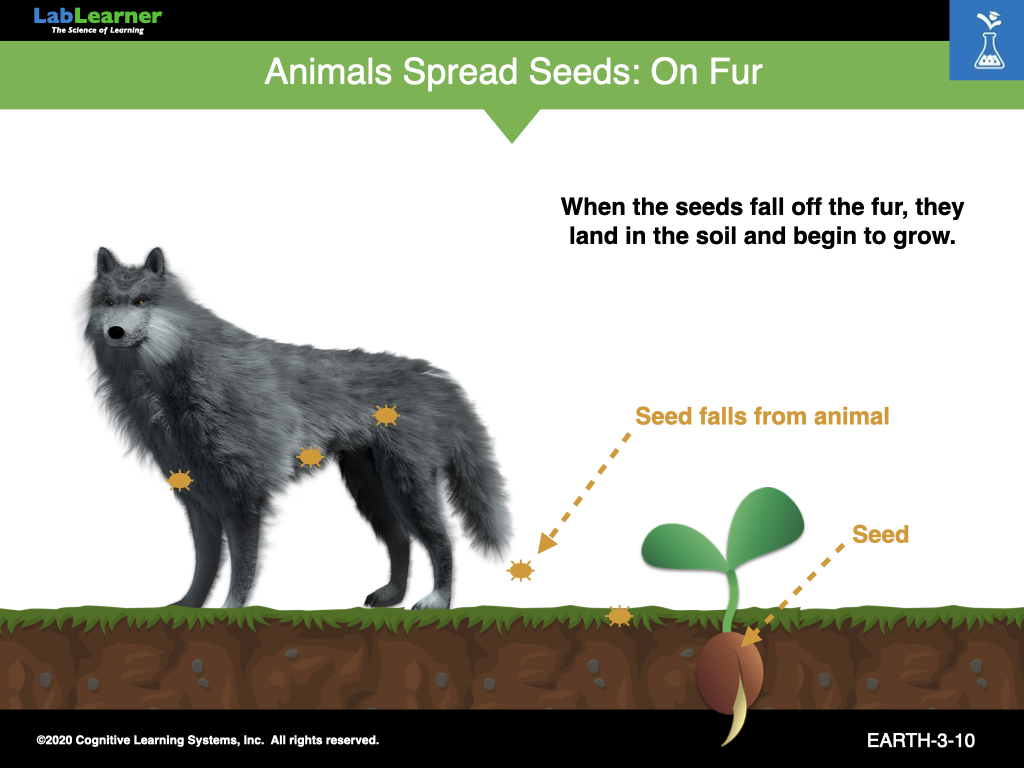
This is the first slide of two that depicts another way in which animals help plants spread their seeds. Many plants enclose their seeds in capsules that are covered with hundreds of small, pointy barbs. These are also called burrs. Students may have experience with burrs during their outdoor play. They may become tightly knotted in woolen socks, for example. The same thing happens in nature when fur-covered animals (a wolf in this example) come in contact with such seeds. The burrs/seeds are then transported, perhaps great distances, by the animal until they eventually fall off or are picked off. They may then enter the soil and germinate into a new plant!
SLIDE EARTH-3-10
This is simply the second slide in the set that describes how animals can help plants spread their seeds by entrapping them in their fur. Children with dogs are often familiar with burrs and fur. Taking a dog for a walk in the wrong area can result in a great deal of effort in pulling the burrs out of their fur.
SLIDE EARTH-3-11
This slide is inserted simply as a review of the three mechanisms by which animals help plants reproduce and spread.