
Teacher Portal:
The Human Body
Investigation 5 – PreLab
ASK WHY
The human body is organized into systems that are made up of many parts and these systems each perform both individual and complementary functions that occur at the same time in the body.
BRANCH OUT
Physicians help people take care of their bodies. They find ways to make the body work better and to treat it when it gets sick.
PRINT IT
Use your browser to download a printable PDF as help during the slide presentation and to make additional notes. In your browser, go to File > Print and then choose to save as PDF.
MINDSET
This Investigation is designed to:
- introduce the body as a whole unit made up of systems that are comprised of smaller parts.
- promote the understanding of systems as a group of related parts which work together for a common function.
- encourage exploration of the functions, main parts, and pathways of the digestive system.
- help students to see the different body systems working together to sustain life.
- promote the use of models as a way to visualize how the digestive system is folded in order to fit into the human body.
SCIENTIST’S GLOSSARY
- Digestion: The physical (mechanical) and chemical breakdown of food into nutrients.
- Digestive system: A system of the body that breaks down food so that it can be transported to the rest of the body.
- Esophagus: A muscular tube that connects the throat to the stomach. It pushes food into the stomach by contracting its muscles.
- Function: The role or job of an object or a part of an object.
- Gall bladder: The organ that receives bile from the liver and sends it to the small intestine to aid in digestion.
- Large intestine: The organ that aids in digestion by absorbing water and preparing and compacting waste to exit the body.
- Liver: The organ that sends bile to the gall bladder to aid in digestion and filters substances from the blood.
- Mouth: The beginning of the digestive tract. It contains the teeth and the tongue that chew food. The tongue also aids in swallowing food.
- Organ: One of the parts of the body which makes up a system.
- Pancreas: The organ that aids in digestion by sending digestive juices (enzymes) to the small intestine.
BE PREPARED
Watch the Investigation One Teacher Video below to prepare for the PreLab.
SET FOR SUCCESS
- Tell students that they will continue to study The Human Body CELL.
- Ask students to share the kinds of things they might learn in these Investigations.
- Tell students they will think about the body, its parts, and how it functions.
Begin the PreLab Concept Slides to start students on their learning journey. Then watch the Pre-Lab Student Video as a class.
NAVIGATE IT
Once the slide presentation is launched
- use your left and right arrows to advance or go back in the slide presentation, and
- hover your mouse over the left edge of the presentation to get a view of the thumbnails for all the slides so that you can quickly move anywhere in the presentation.
- Click HERE to launch the slide presentation for the CELL.
SHARE IT
SLIDE BODY-5pre-1
With this slide, we begin the last of the human body systems that we will discuss in this CELL, the digestive system.
______________________________________________
SLIDE BODY-5pre-2
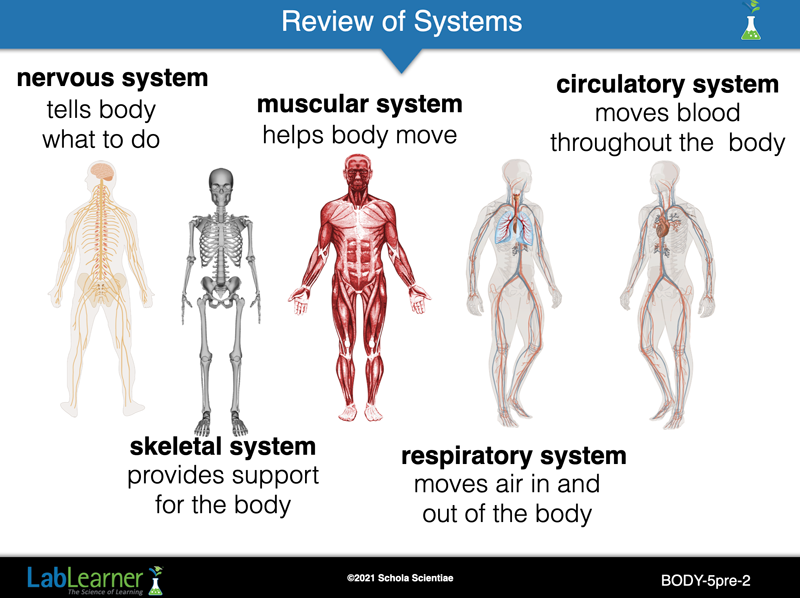
Begin the investigation by reviewing some of the concepts that the students have encountered in the CELL thus far.
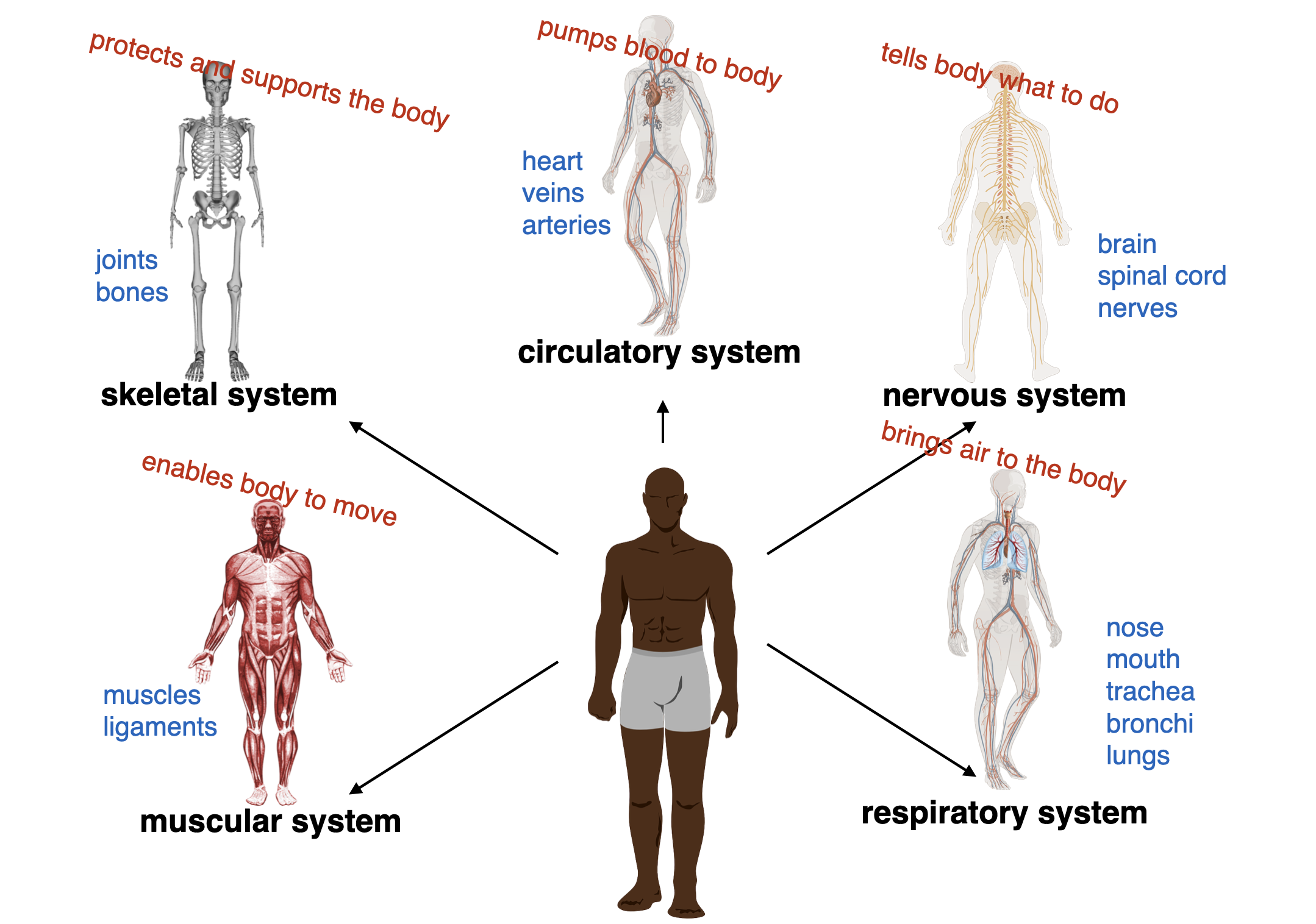
What are the body systems that you have investigated? Students have investigated the nervous, skeletal, muscular, respiratory systems, and circulatory systems.
What is the function of the nervous system? Skeletal system? Muscular system? Respiratory system? Circulatory system? Students should indicate that the nervous system controls the actions of the body, helps us to interpret and understand the world around us, and helps us to think about and remember information. The skeletal system provides structure, protection, and support for the body. The muscular system enables the body to move. The respiratory system moves fresh air containing oxygen into the body and exhales carbon dioxide from the body. The circulatory system moves blood throughout the body. It delivers oxygen (O2) to body tissues and cells and removes waste such as carbon dioxide (CO2).
How is the heart affected by exercise? Students should indicate that during exercise the heart rate increases.
What is the function of the heart? Students should indicate that the heart is a part of the circulatory system and that it is made up of muscle. It pumps the blood through the veins and arteries to the rest of the body.
Ask students: What are the parts of the digestive system? The digestive system consists of the mouth, esophagus, stomach, pancreas, liver, gall bladder, small intestine, and large intestine.
______________________________________________
SLIDE BODY-5pre-3
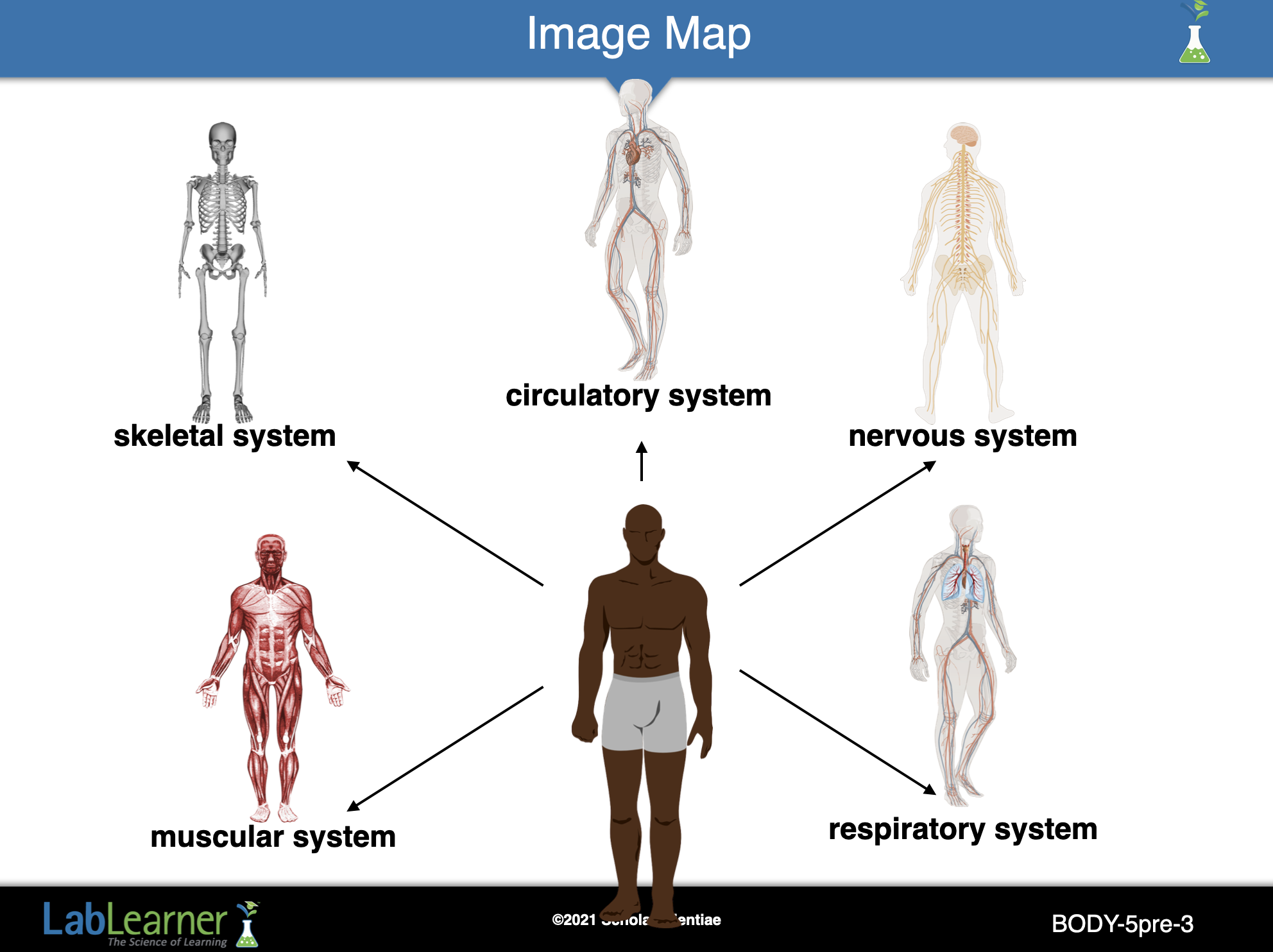
This slide can be used to create an image map of the body systems we have covered up to this point. A hypothetical image map may look like this:
______________________________________________
SLIDE BODY-5pre-4
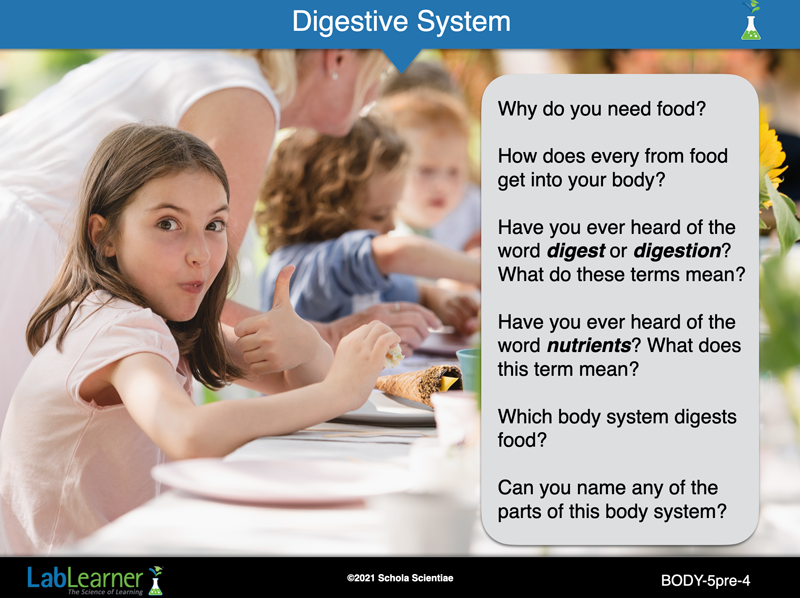
This slide asks a number of basic questions about the digestive system:
Ask students: Why do you need food? Student answers may vary. Students may indicate that the body gets hungry and needs food for energy and to stay alive.
Ask students: How does the energy from food get into your body? Student answers may vary. Students may indicate that food is put into the mouth and chewed and swallowed. The food is then broken down into smaller parts and the energy is sent to the rest of the body.
Ask students: Have you ever heard of the word digest or digestion? What do these terms mean? Student answers may vary. Students may or may not have heard of the terms before. Encourage students to review the term in their Scientist’s Glossary.
Ask students: Have you ever heard of the word nutrients? What does this term mean? Student answers may vary. Help students to understand that nutrients are substances found in foods that the body can use for energy and function.
______________________________________________
SLIDE BODY-5pre-5
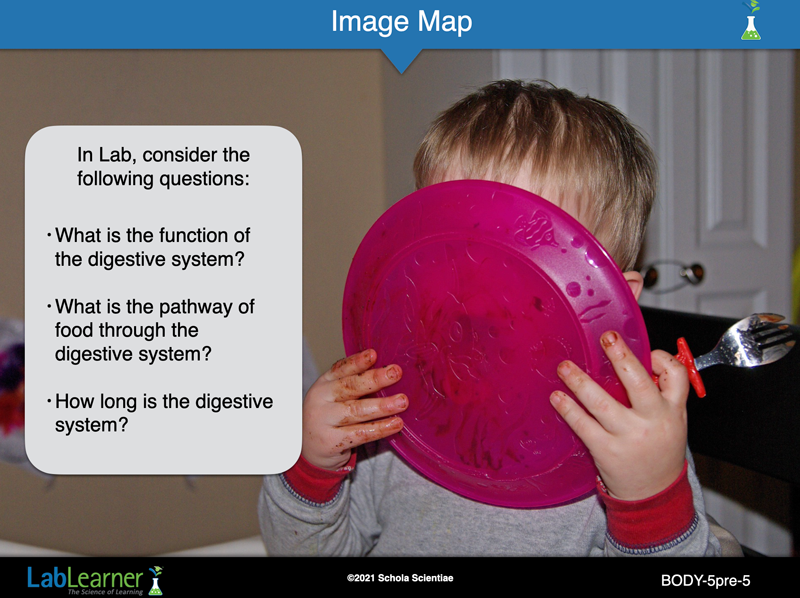
This final slide gives students three questions to consider as they perform the Investigation 5 lab:
- What is the function of the digestive system?
- What is the pathway of food through the digestive system?
- How long is the digestive system?
______________________________________________
WATCH IT
Play the following Student Video in preparation for the lab. Discuss as necessary to answer student questions.