
Teacher Portal:
The Human Body
Investigation 5 – Lab
ASK WHY
The human body is organized into systems that are made up of many parts and that these systems each perform both individual and complementary functions that occur at the same time in the body.
BRANCH OUT
Athletic trainers and sports medicine doctors help athletes perform at the highest levels they can. In addition, they help athletes to recover from injuries so that they can once again perform at their maximum potential.
BE PREPARED
Materials
Class materials:
- 1 human torso
- 1 human body flip chart
- 1 ball of string
- 1 metric ruler
- scissors
Group materials:
- 5 hand lenses
- 1 meter stick
- 5 metric rulers
- 1 marker
- 1 10 cm piece of masking tape
- scissors
 Teacher Preparation
- Measure and cut five pieces of string that are 8 m in length.
- Place the human torso and flip chart at a central location in the lab.
- Organize the required materials at a distribution point.
- Separate the class into five (5) groups.
Direct each student group to obtain the following necessary materials from the distribution point: one (1) 8 m piece of string, five (5) hand lenses, one (1) meter stick, five (5) metric rulers, one (1) ball of string, one (1) marker, one (1) 10 cm piece of masking tape, and one (1) pair of scissors.
GET FOCUSED
 1. To begin the experiment, review the structures of the digestive system and the pathway of food through the digestive system, using the human torso and the flip chart as needed. As students review this system, they should consider the following questions:
What is the function of the digestive system?
What is the pathway of food through the digestive system?
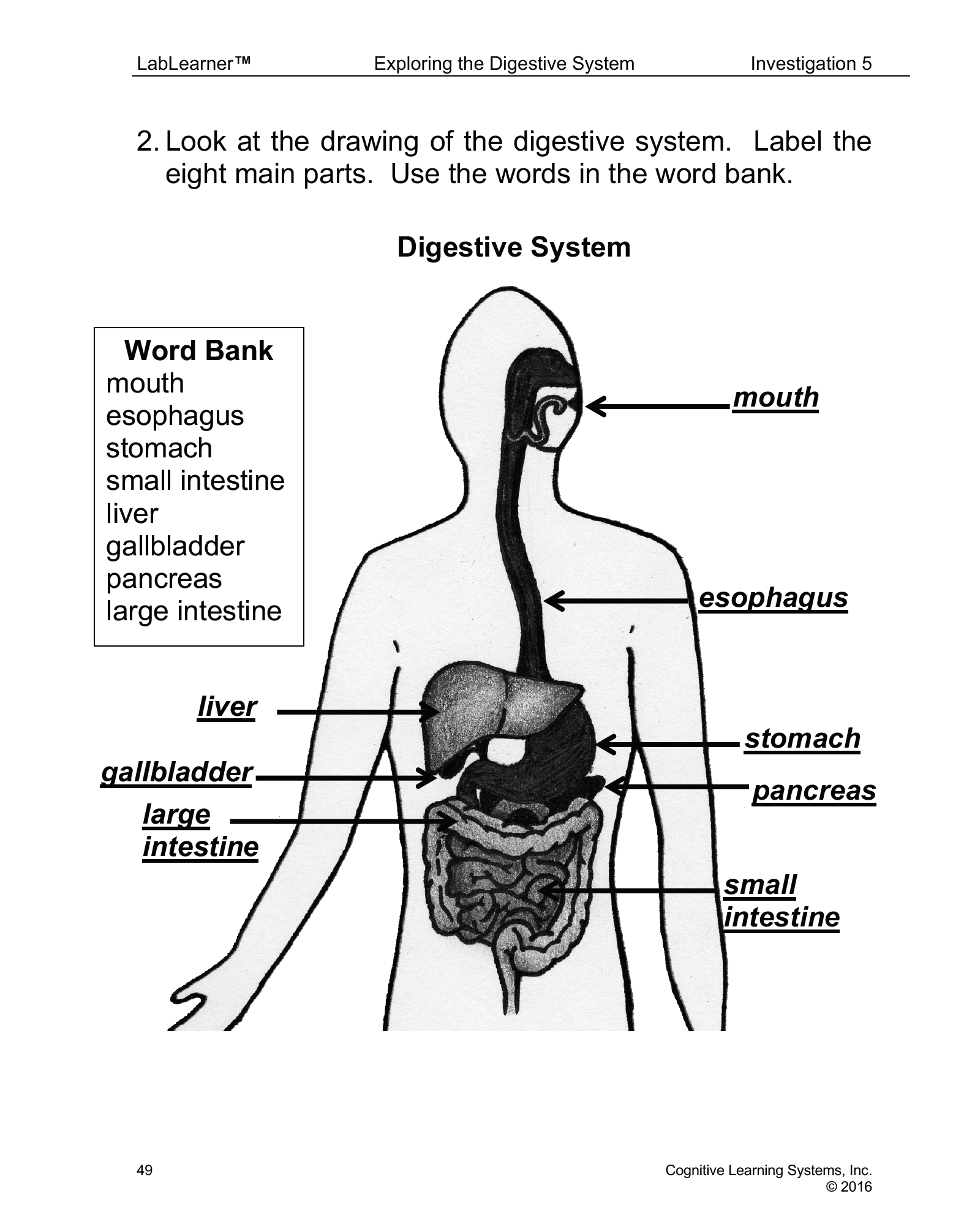
a. Review the main components of the digestive system: mouth, esophagus, stomach, small intestine, large intestine, liver, pancreas, and gall bladder.
b. Ask students to look at the diagram of the digestive system in problem 2 of their Scientist Data Record. Using this diagram, students should label the parts of this system.
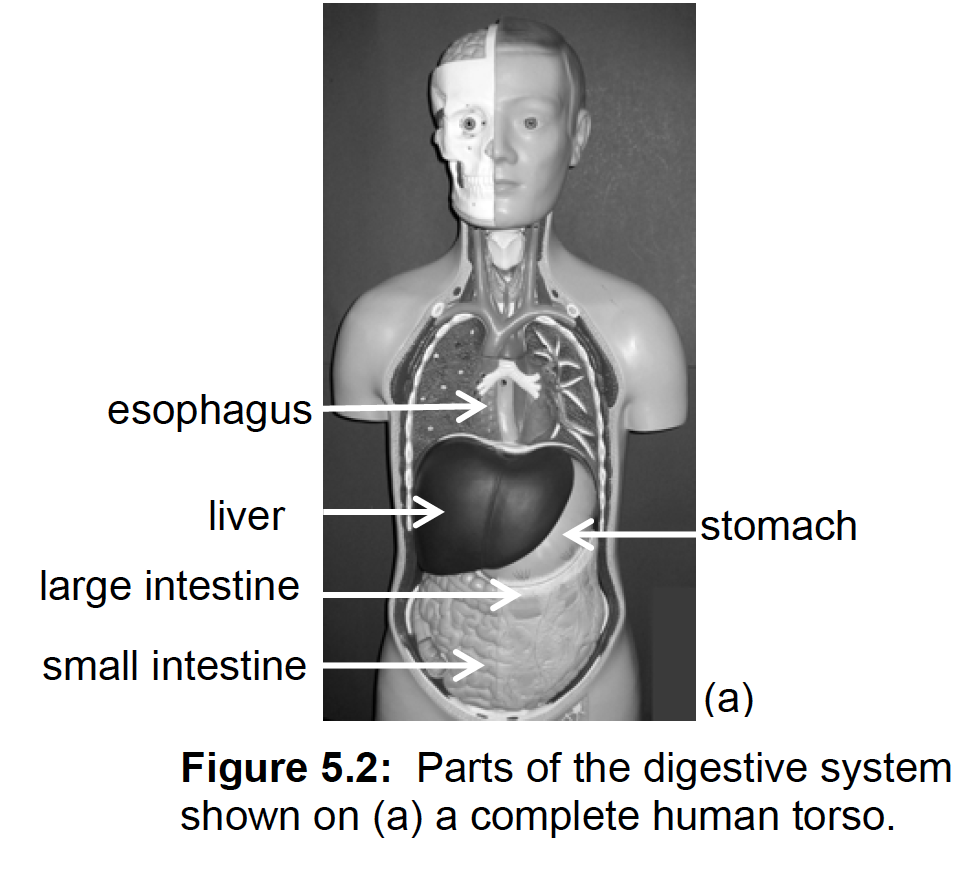
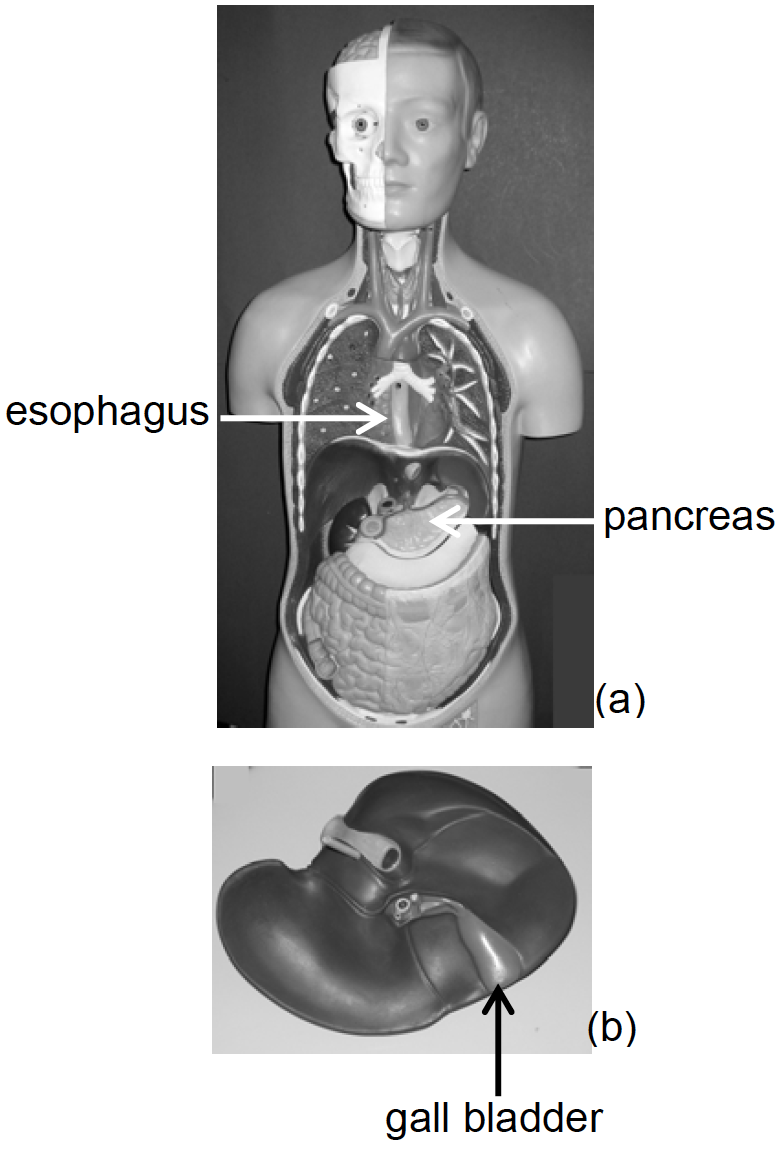
c. Use the human torso and the flip chart to aid students in labeling the diagram. Ask a student volunteer to point to the different parts on the torso (Figure 5.2 and Figure 5.3) and the flip chart as students are labeling their diagram.
d. Explain to students that you are going to review the path that food takes as it moves through this system. As you discuss this pathway, point out the different parts on the human torso and/or flip chart. Encourage students to trace the pathway on the diagram in probl2 with their fingers as it is discussed.
- Food is placed in your mouth and chewed with your teeth.
- You use your tongue to swallow the chewed food.
- Once it is swallowed, the food moves through the throat and into the esophagus.
- The esophagus is a muscular tube that connects the throat to the stomach. It pushes food into the stomach by rhythmically contracting its muscles.
- The food enters the stomach where it is moved around until it gains a soup-like consistency.
- From the stomach, the food moves into the small intestine, where it is digested further.
- The nutrients in the food are absorbed through the walls of the small intestine and are transported to the rest of the body through the blood.
-
- The liver sends bile to the gallbladder. Bile is a liquid that helps digestion. The gallbladder sends the bile to the small intestine.
- The pancreas sends digestive juices (enzymes) that help digestion to the small intestine.
- The bile and enzymes mix with the food in the small intestine and help with digestion.
- The food moves into the large intestine where water and some vitamins are absorbed.
- Any undigested food is compacted in the large intestine and is passed out of the body.
-
INVESTIGATE
In Trial 1, students will observe the beginning of the digestive tract by examining the mouth, teeth, and tongue. In order to enhance and magnify what they see in their mouth, they will be using a tool from the Procedural Toolbox, the hand lens. Students will then examine swallowing and observe what occurs in the neck and the throat. As students perform this trial, they should consider the following questions:
- What is the function of the digestive system?
- What role do the mouth, teeth, and tongue play in digestion?
- What happens in your esophagus when you swallow?
NOTE: DURING THE COVID19 PANDEMIC, THIS TRIAL SHOULD BE SKIPPED.
Trial 1:
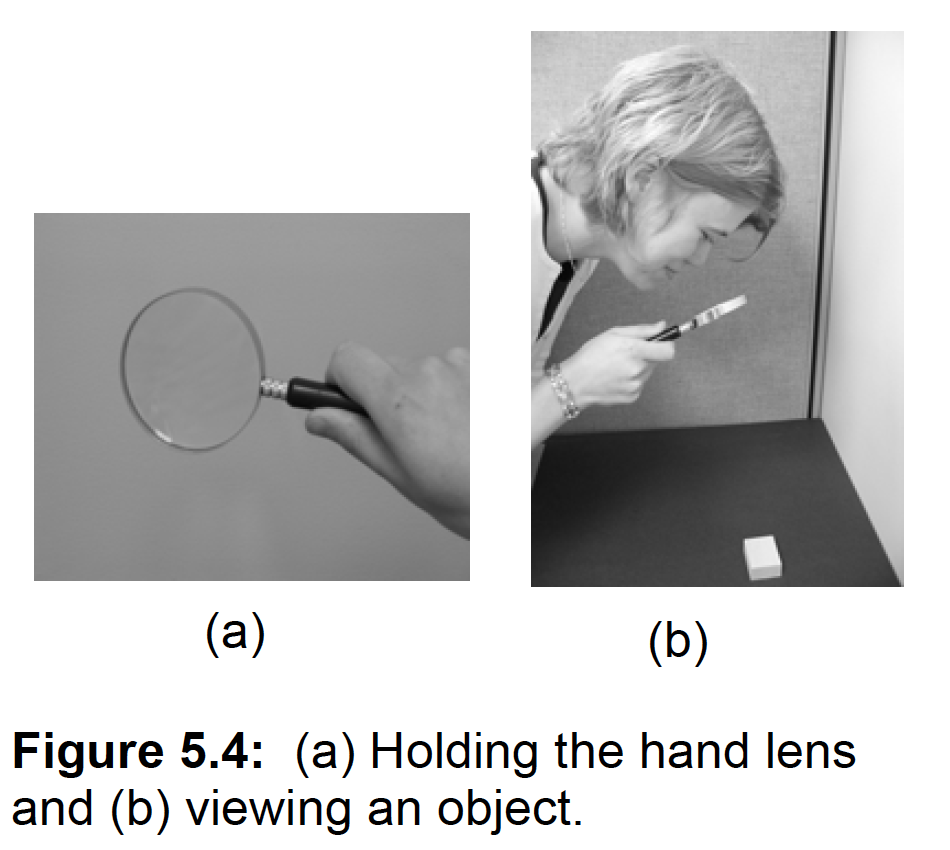 a. Use the following steps to guide students through the use of the hand lens.
- Hold the hand lens by the handle (Figure 5.4a).
- Place the hand lens between your face and the object being viewed (Figure 5.4b).
- Move the hand lens back and forth between your eye and the object until the image is in focus.
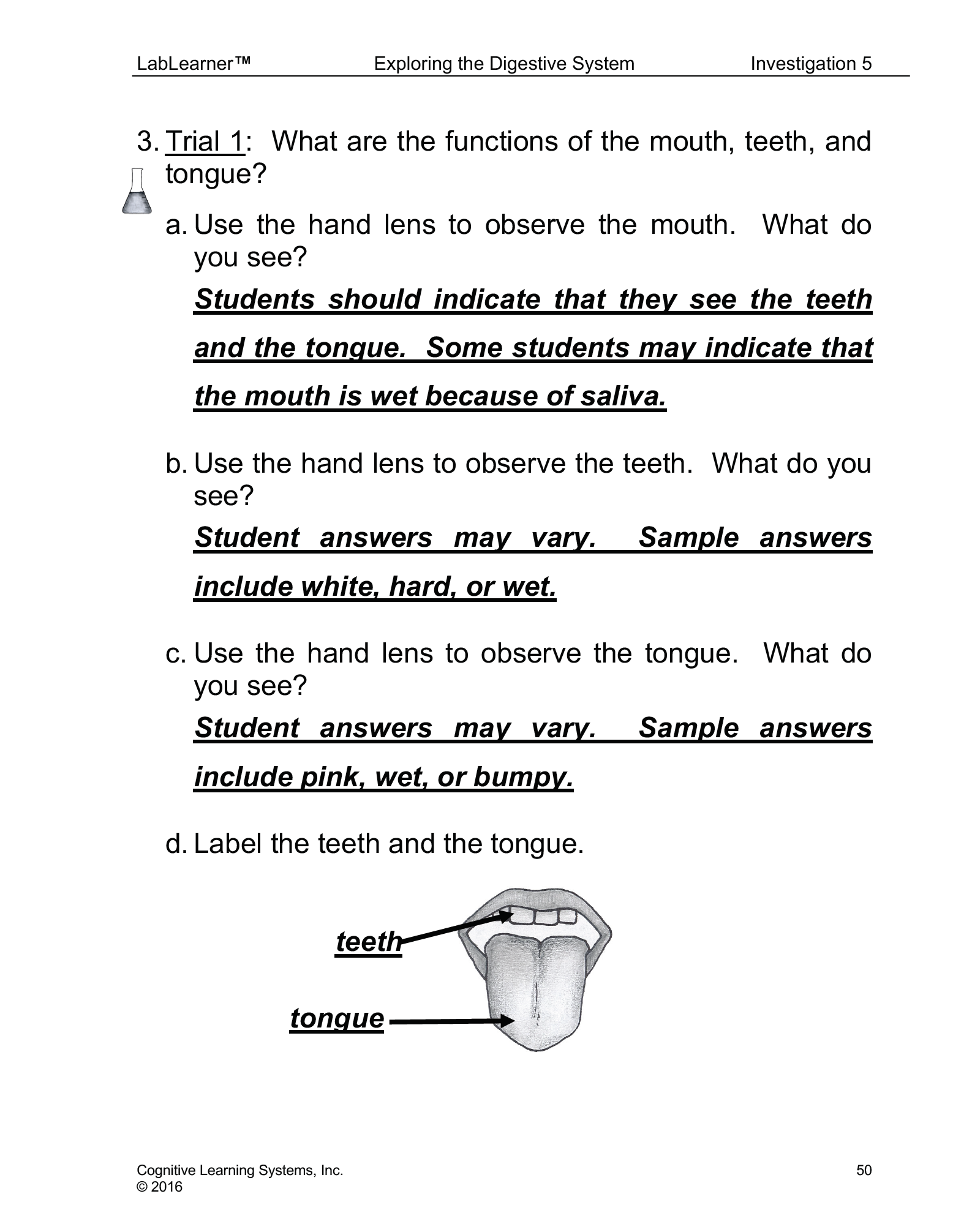
b. Instruct students to observe their partner’s mouth using the hand lens. Encourage students to record their observations in problem 3a of their Scientist Data Record.
c. Ask students: What structures did you see in the mouth? Students should indicate that they saw the teeth and the tongue. Some students may also indicate that they saw saliva.
d. Instruct students to use the hand lens to observe their partner’s teeth. Encourage students to record their observations in problem 3b of their Scientist Data Record.
e. Instruct students to use the hand lens to observe their partner’s tongue. Encourage students to record their observations in problem 3c and label the diagram in problem 3d of their Scientist Data Record.
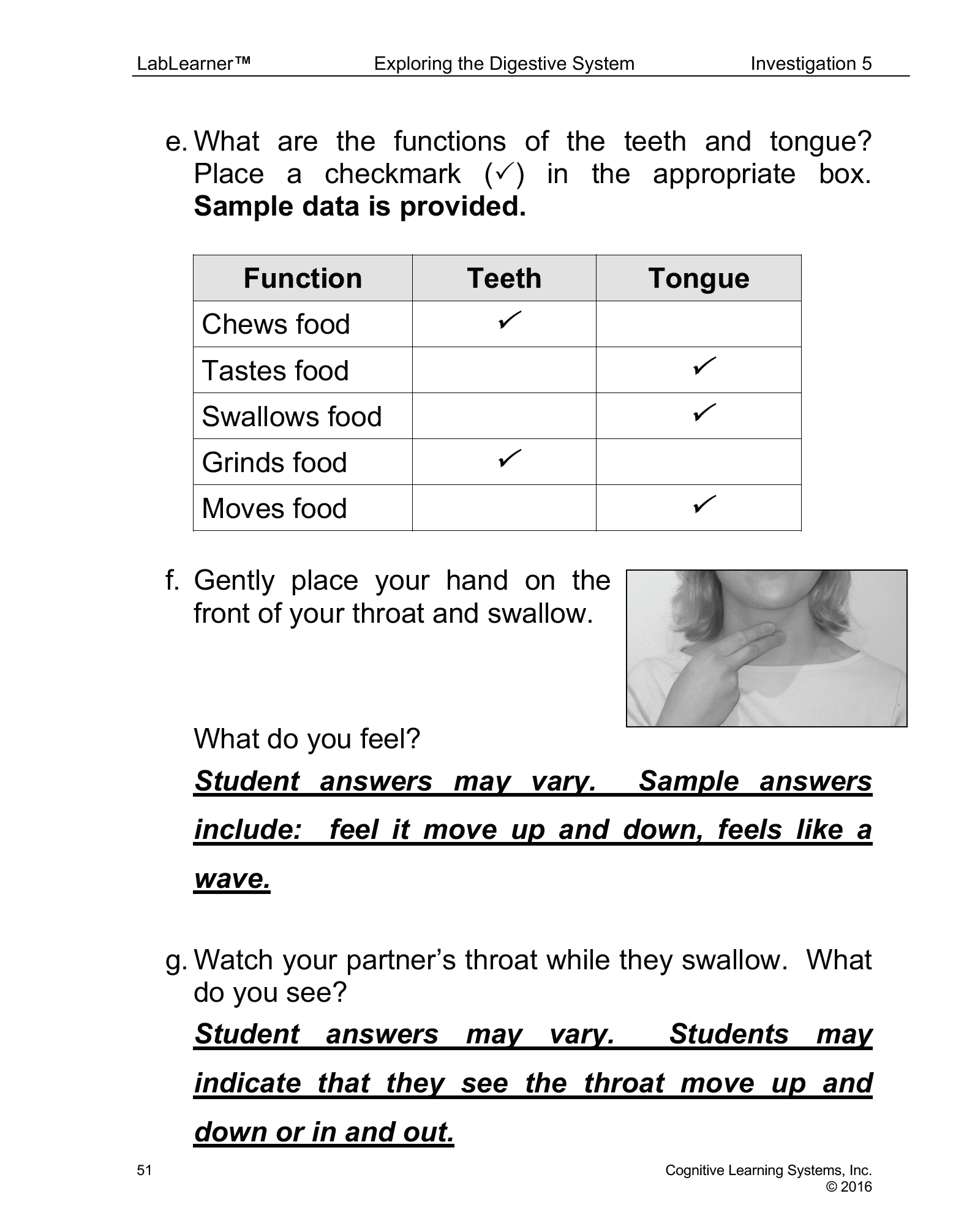
f. Ask students: What is the function of the teeth in digestion? The tongue? Students should indicate that the teeth are used to chew and grind the food into smaller pieces. The tongue is used for tasting and moving the food, as well as, swallowing the food. Encourage students to record their answers in problem 3e of their Scientist Data Record.
g. Ask students: After the food leaves your mouth, where does it enter? Students should indicate that the food enters the esophagus.
h. Ask students: Where is your esophagus located? Can you point to it? Student answers may vary. Encourage students to realize that the esophagus runs through the throat or neck. It is a muscular tube that sits 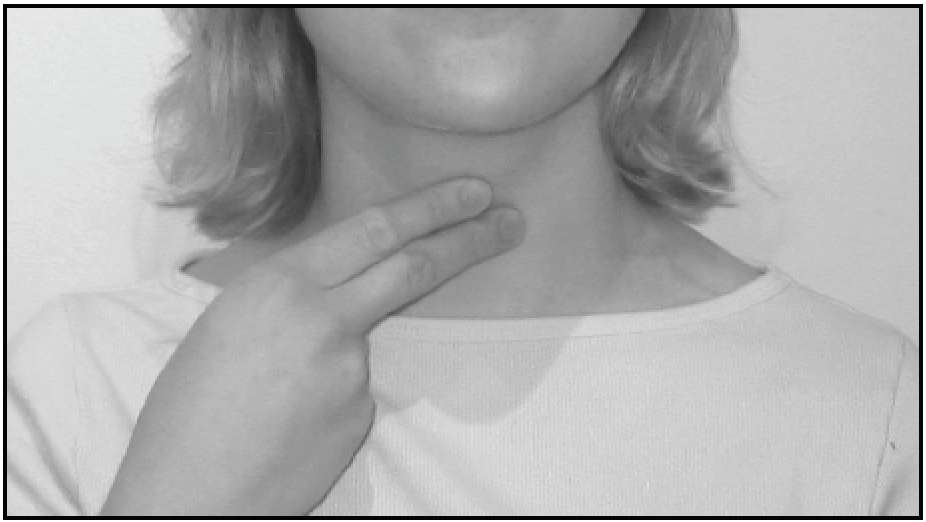 behind the trachea in the neck.
i. Tell students that they will now examine what happens when they swallow by observing and feeling the front of their throat when they swallow.
- Instruct students to place their hands on the front of their throats.
- Tell students to swallow several times.
- Encourage students to record their observations in problem 3f of their Scientist Data Record.
- Instruct student pairs to face each other. Ask one student to swallow several times and have their partner observe their throat. Direct students to switch roles.
- Encourage students to record their observations in problem 3g of their Scientist Data Record.
Trial 2:
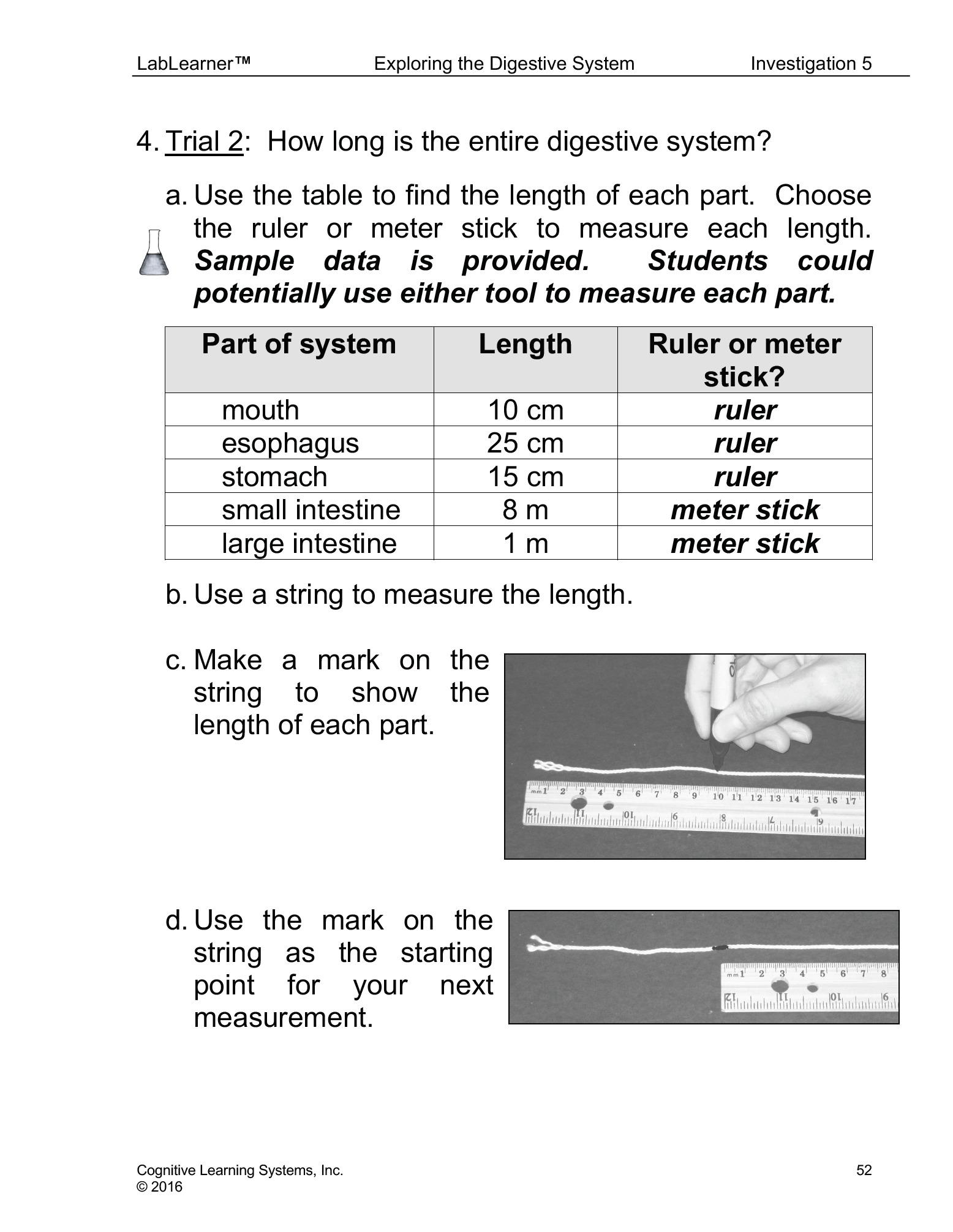
In this trial, students will use a meter stick, metric ruler, and ball of string to measure the total length of the digestive system, from mouth to large intestine. Through this trial, students will discern that an adult digestive tract, from start to finish, is approximately 9.5 meters long. As students perform this trial, they should consider the following questions:
What is the function of the digestive system?
How long is the digestive system from the mouth to the large intestine?
a. Explain to students that they are going to measure the total length of the digestive system using string, a
meter stick, and a metric ruler.
b. Tell students they will measure the length of one organ of the digestive system at a time.
- Direct students to locate problem 4a of their Scientist Data Record.
- Ask students: How long is the mouth? Students should indicate that the mouth is 10 cm long.
- Ask students: Would you use the metric ruler or meter stick to measure this length? Student answers may vary. Students may potentially use either the metric ruler or meter stick to measure each length. However, it is more appropriate to use the metric ruler to measure centimeters and the meter stick to measure meters. Encourage students to record their choice in the last column of the table in problem 4a of their Scientist Data Record.
- Instruct one student in the group to hold one end of the string. A second student should use a metric ruler or meter stick to measure 10 cm of string.
- Direct a third student from the group to use a marker to place a mark at the 10 cm mark on the string.
- Ask students: How long is the esophagus? Students should indicate that the esophagus is 25 cm long.
- Ask students: Would you use the metric ruler or meter stick to measure this length? Student answers may vary. Students may potentially use either the metric ruler or meter stick to measure each length. However, it is more appropriate to use the metric ruler to measure centimeters and the meter stick to measure meters. Encourage students to record their choice in the last column of the table in problem 4a of their Scientist Data Record.
- Using the black mark on the string as the starting point, direct students to measure the length of the esophagus using the same procedure as used for the mouth.
- Continue this procedure for measuring the length of the stomach, small intestine, and large intestine. Encourage students to use the meter stick to measure the length of the small and large intestines.
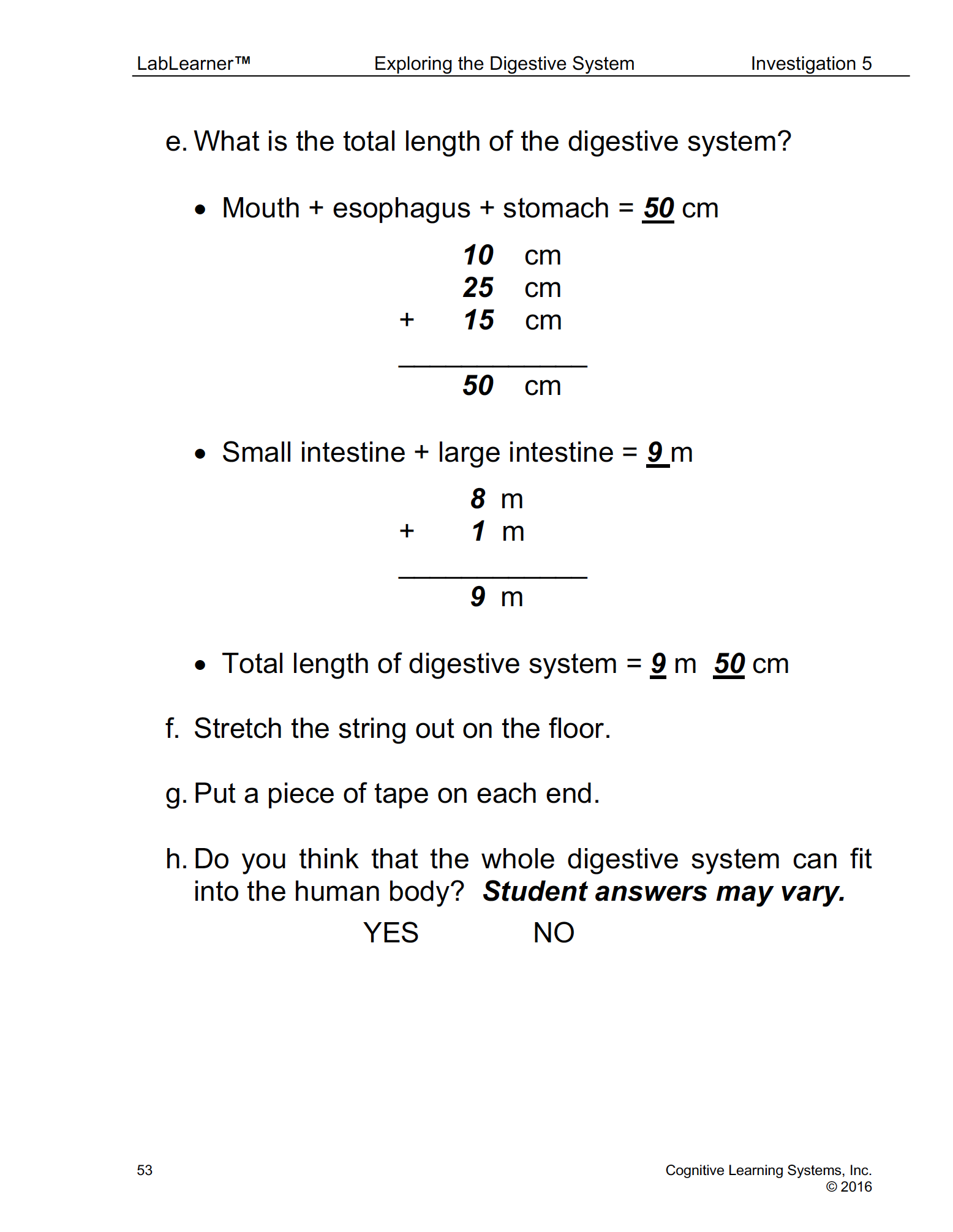
c. Ask students: How can you find the total length of the digestive tract? What is the total length of the digestive tract? Students should indicate that by adding all of the numbers together, they can find the total length. The total length of the digestive tract is 9 m 50 cm. Encourage students to record their answers in problem 4e of their Scientist Data Record.
d. Direct students to stretch out their string on the floor in the classroom or in the hallway. Encourage students to answer problem 4h in their Scientist Data Record.
e. Ask students: How does the entire digestive system fit into the human body? Student answers may vary. Students will be able to answer this question after performing Trial 3.
Trial 3:
Using the small intestine as an example, students will observe how the digestive tract is folded in order to fit inside of the body. Students will also examine the intestines and determine that although the small intestine is longer 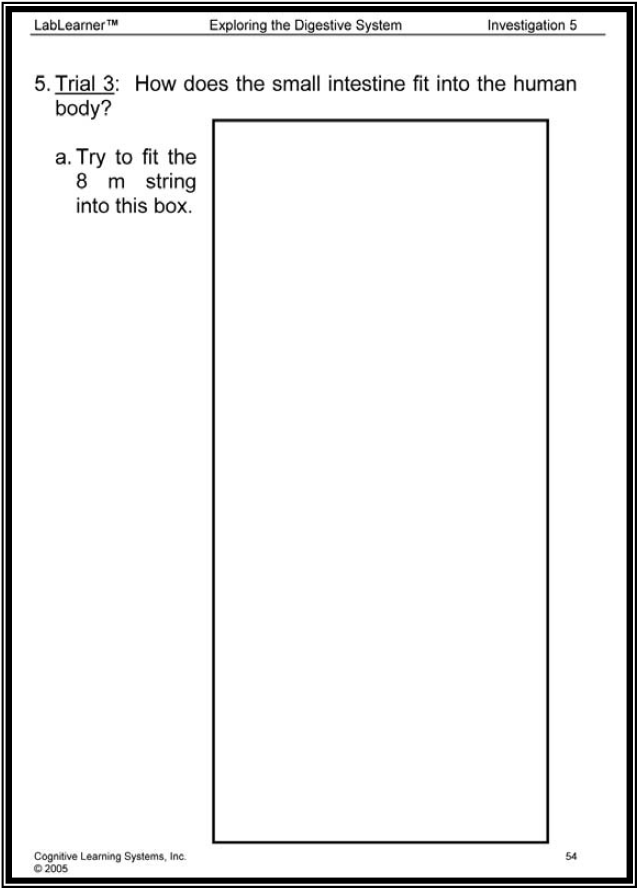 than the larger intestine, it has a smaller diameter. Therefore, the intestines are named small and large based upon diameter. As students perform this trial, they should consider the following questions:
What is the function of the digestive system?
How does the digestive tract fit into the human body?
Why are the intestines named “small” and “large?”
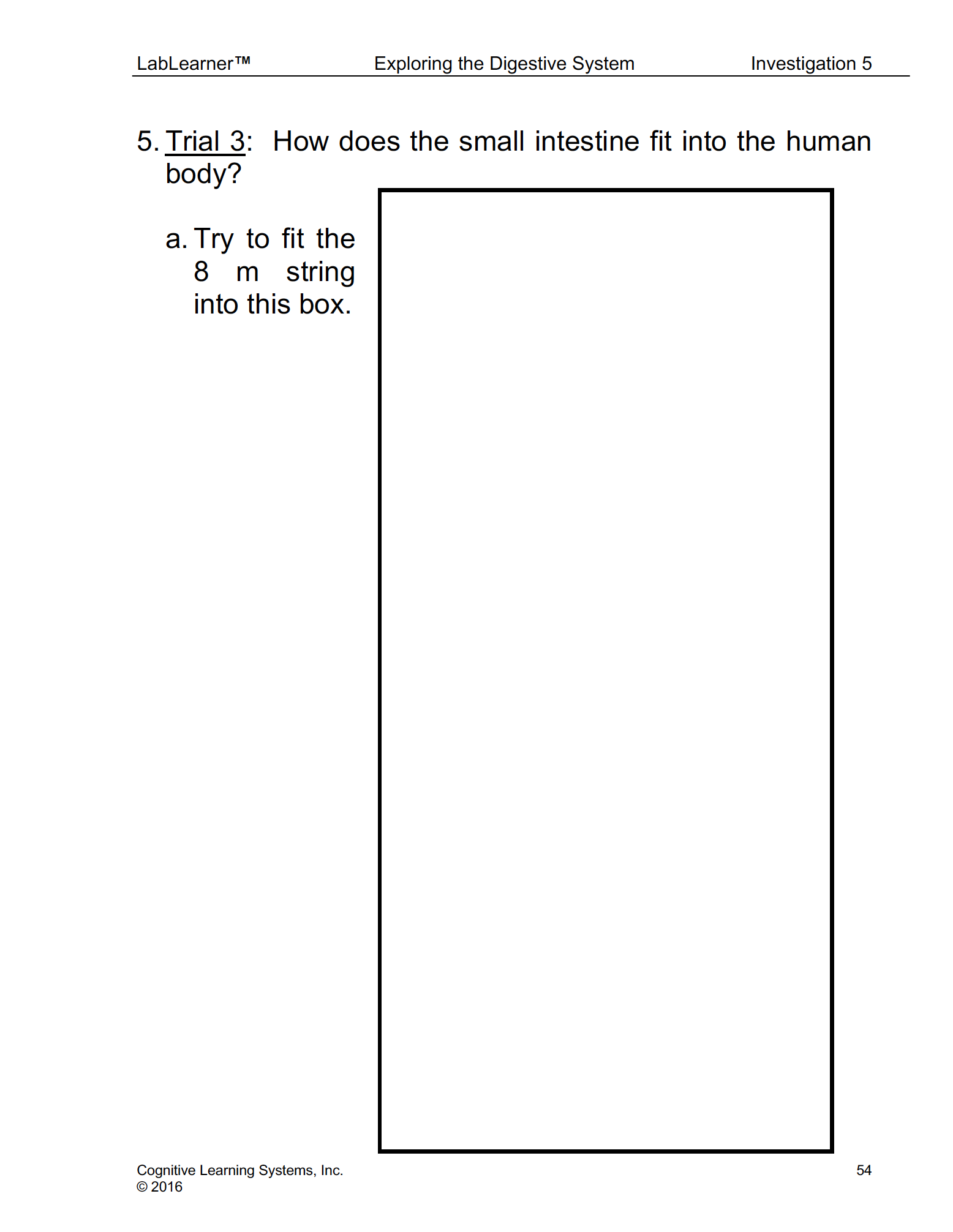
f. Direct students to locate the box in problem 5a of their Scientist Data Record. Explain that the box models the space a person’s small intestine takes up in the body.
g. Ask students to locate a piece of string that is 8 m in length. Explain that the length of the string is equal
to the length of the small intestine.
h. Tell students that in this trial, they are going to try to fit the 8 m string into the box in problem 5a in their SDRs. Explain to students that the entire string must fit into the lines of the box. The string may not fall outside of those lines. Allow sufficient time for students to complete this activity.
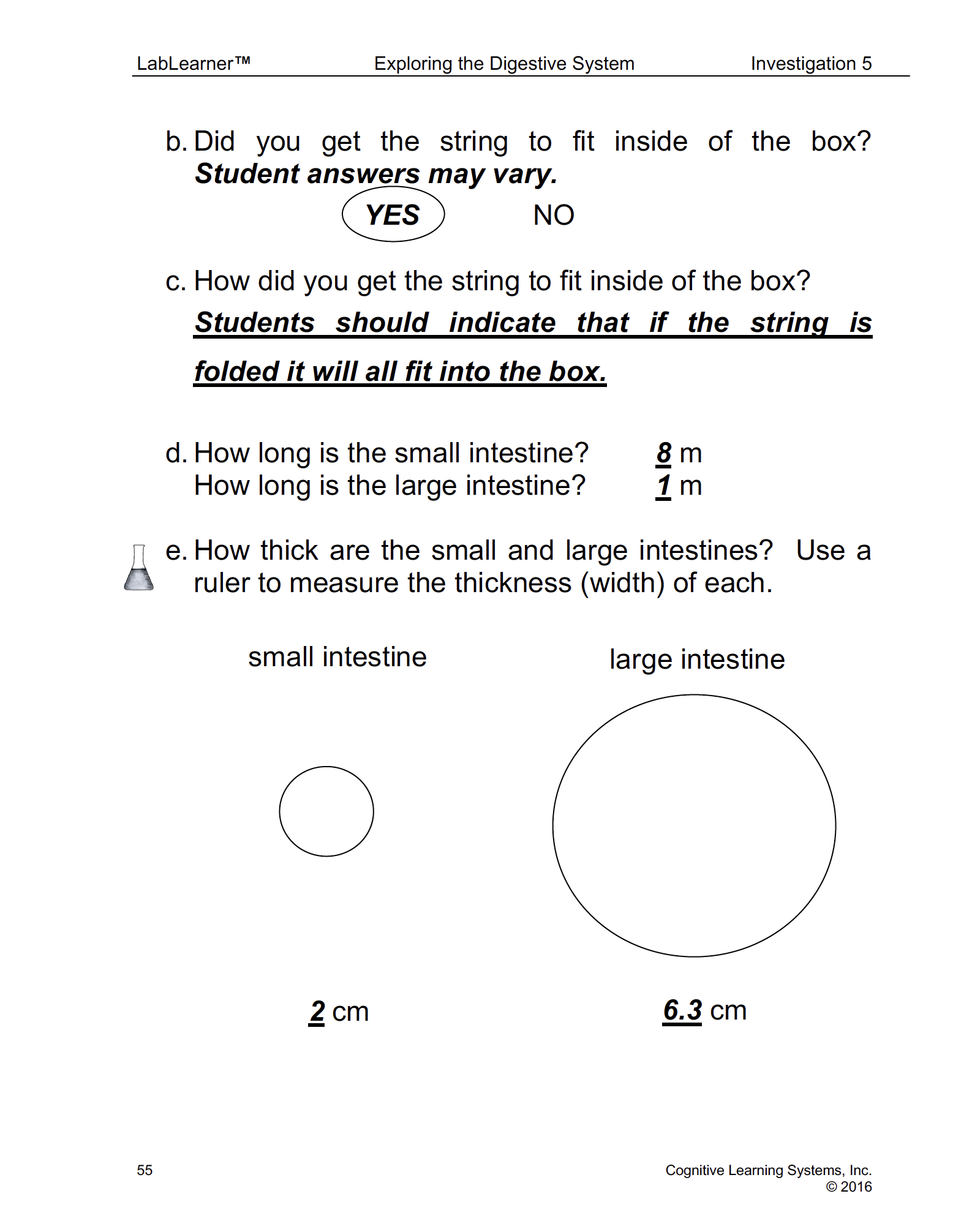
i. Ask students: Did you get the string to fit inside of the box? How? Encourage students to record their answers in problems 5b and 5c of their Scientist Data Record. Students should indicate that they did get the sting to fit inside of the box by folding it.
j. Direct students’ attention to the small intestine on the human torso and the flip chart. Ask students: Is the small intestine folded in the human body? Students should indicate that the small intestine is folded.
k. Ask students: Look at the human torso and the flip chart. Are there any other parts of the digestive system that appear to be folded? Student answers may vary. Encourage students to realize that the large intestine is also folded or bent in order to fit into the body. The stomach also lays horizontal, instead of vertical, in the body.
l. Ask students: How long is the small intestine? How long is the large intestine?
Refer students to the table in problem 4a to locate this answer. Students should indicate that the small intestine is 8 m long and the large intestine is 1 m long. Encourage students to record their answers in problem 5d of their Scientist Data Record.
m. Tell students to locate the two circles in problem 5e of their Scientist Data Record. Tell students that the circle on the left shows the thickness of the small intestine or its diameter. The circle on the right shows the thickness of the large intestine or its diameter.
n. Direct students to use the metric ruler to measure the thickness, or diameter, of each. Encourage students to record their answers in problem 5e of their Scientist Data Record.
KEYS
CLEAN UP
Let students know your expectations for clean-up. Ask them to clean up.