Teacher Portal:
The Human Body
Investigation 4 – PreLab
ASK WHY
The human body is organized into systems that are made up of many parts and these systems each perform both individual and complementary functions that occur at the same time in the body.
BRANCH OUT
Radiologists are physicians that specialize in seeing inside a patient’s body from the outside. Techniques such as X-rays, MRIs, CAT Scans, and other procedures allow physicians to diagnose illnesses. They can even find tumors that surgeons can later remove by surgery.
PRINT IT
Use your browser to download a printable PDF as help during the slide presentation and to make additional notes. In your browser, go to File > Print and then choose to save as PDF.
MINDSET
This Investigation is designed to:
- introduce the body as a whole unit made up of systems that are comprised of smaller parts
- promote understanding of systems as a group of related parts which work together for a common function
- encourage explorations of the function of the circulatory system
- help students to see the different body systems work together to sustain life.
- provide an opportunity to discover the effect exercise has on heart rate.
SCIENTIST’S GLOSSARY
- Arteries: Vessels composed of layers of cells and smooth muscle that carry blood away from the heart.
- Blood vessels: A tube such as an artery or vein that transports blood.
- Circulatory system: A system of the body that moves blood throughout the body. The circulatory system includes the heart, veins, and arteries. The circulatory system is also referred to as the cardiovascular system.
- Contraction: The ability of muscles to tighten.
- Function: The role or job of an object or a part of an object.
- Heart: A muscular organ that pumps blood through the entire body.
- Organ: One of the parts of the body which makes up a system. The brain, the heart, and the stomach are examples of organs.
- Relax: The ability of muscles to loosen. Opposite of contract.
- Veins: Thin-walled vessels composed of cells that move blood toward the heart.
BE PREPARED
Watch the Investigation 4 Teacher Video below to prepare for the PreLab.
SET FOR SUCCESS
- Tell students that they are about to begin The Human Body CELL.
- Ask students to share the kinds of things they might learn in these Investigations.
- Tell students they will think about the body, its parts, and how it functions.
Begin the PreLab Concept Slides to start students on their learning journey. Then watch the Pre-Lab Student Video as a class.
NAVIGATE IT
Once the slide presentation is launched
- use your left and right arrows to advance or go back in the slide presentation, and
- hover your mouse over the left edge of the presentation to get a view of the thumbnails for all the slides so that you can quickly move anywhere in the presentation.
- Click HERE to launch the slide presentation for the CELL.
SHARE IT
SLIDE BODY-4pre-1
In this Investigation, we will continue our study of the human body by focusing on another of the body’s systems, the circulatory system.
______________________________________________
SLIDE BODY-4pre-2
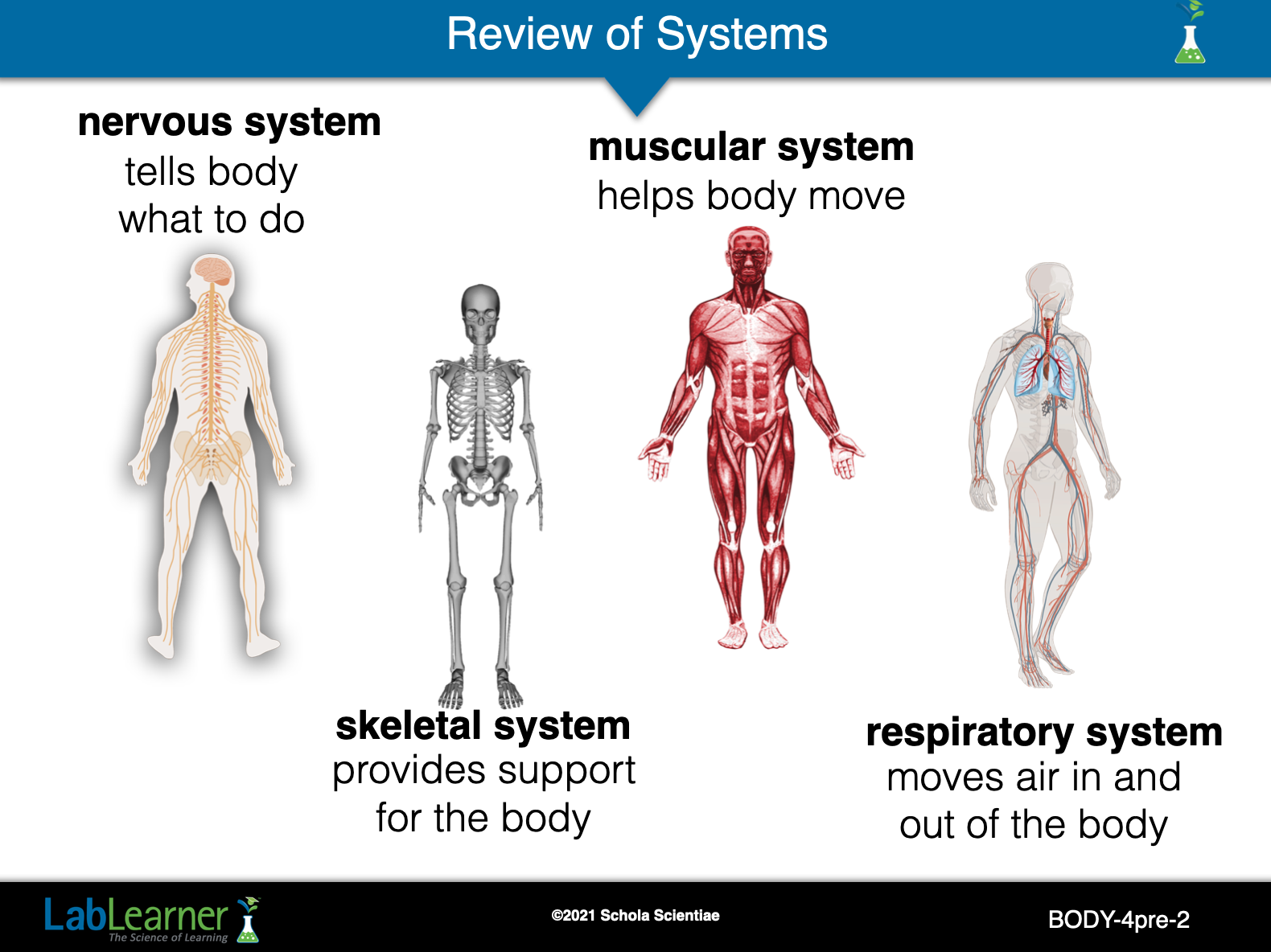
Begin the Investigation by reviewing some of the concepts that the students have encountered in the CELL thus far.
- What are the body systems that you have investigated? Students have investigated the nervous, skeletal, muscular, and respiratory systems.
- Diagrams of the four body systems are presented on the slide.
- What is the function of the nervous system? Skeletal system? Muscular system? Respiratory system? Students should indicate that the nervous system controls the actions of the body, helps us to interpret and understand the world around us, and helps us to think about and remember information. The skeletal system provides structure, protection, and support for the body. The muscular system enables the body to move. The respiratory system moves fresh air containing oxygen into the body and exhales carbon dioxide from the body.
- Ask students: What are the parts of the respiratory system? The respiratory system consists of the nose, mouth, trachea, bronchi, and lungs.
______________________________________________
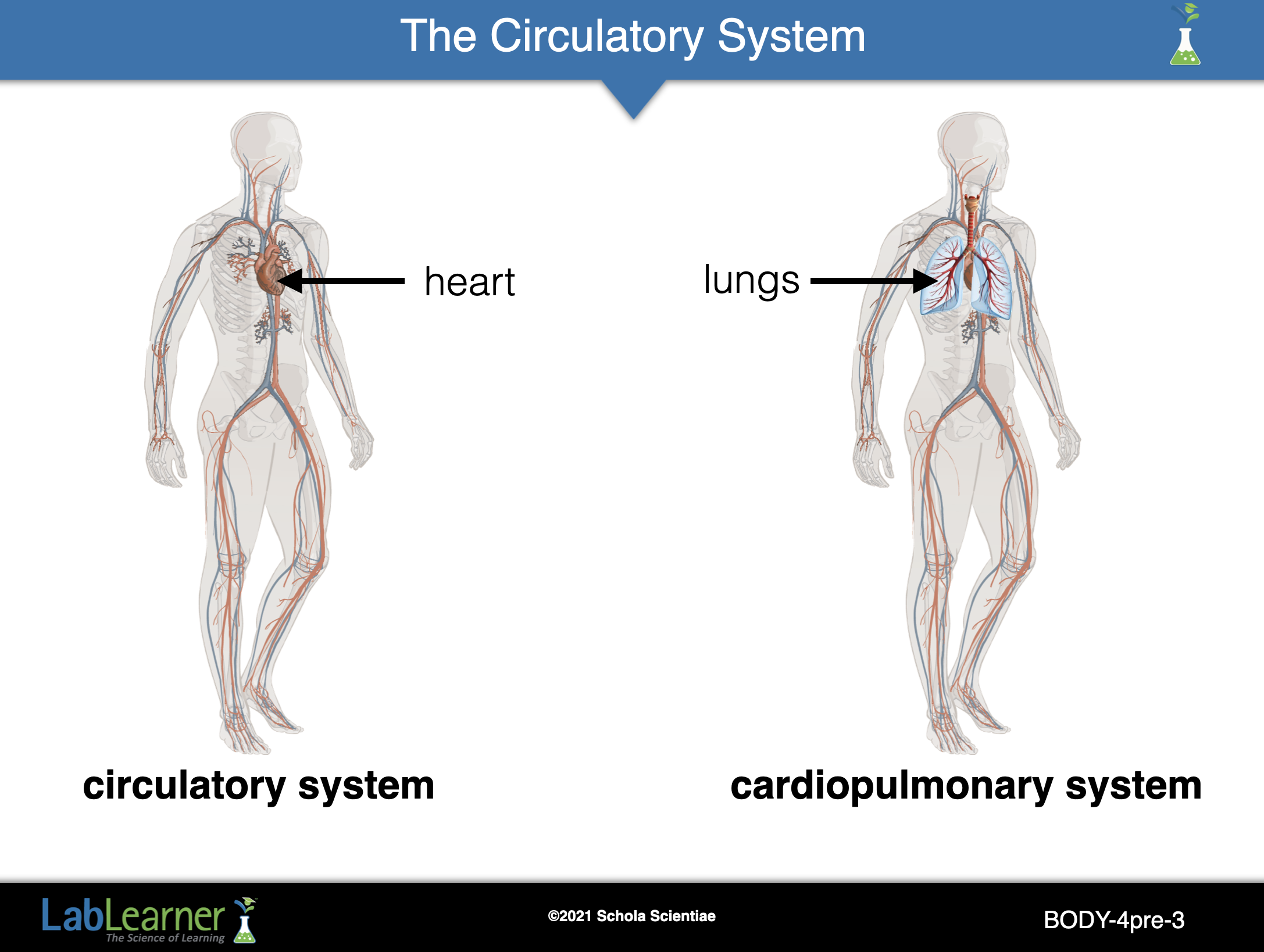
SLIDE BODY-4pre-3
In this Investigation, we will study the circulatory system. The circulatory system moves blood throughout the body.
- The importance of moving blood is that blood supplies all of the billions of body cells with oxygen and nutrients and removes waste materials released from cells as they perform all of their functions.
- The lungs are responsible for bringing oxygen into close contact with circulating blood. It is also in the lungs that carbon dioxide gas is removed from the blood and exhaled from the body.
- Therefore, the circulatory and respiratory systems work very closely together. In fact, the system that contains the components of both the circulatory system and the respiratory system is often called the cardiopulmonary system.
______________________________________________
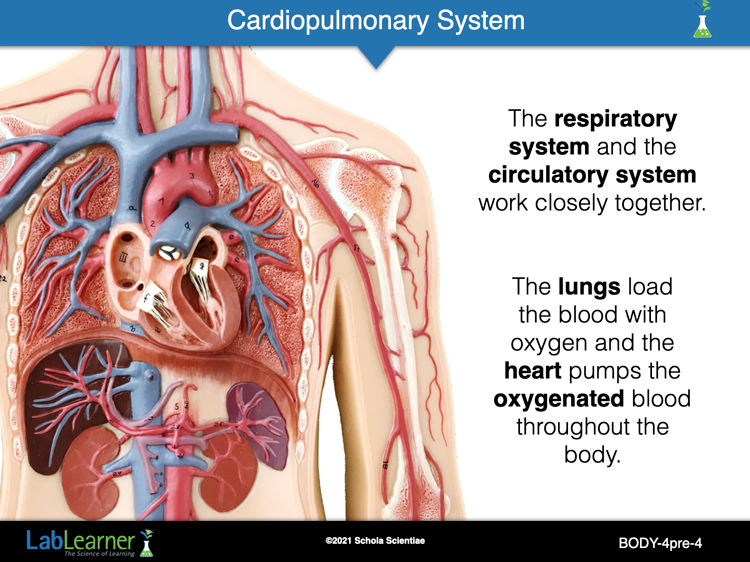
SLIDE BODY-4pre-4
A major purpose of the circulatory system is to transport oxygen (O2) throughout the body. At the same time, it collects a waste product from the cells called carbon dioxide (CO2). The specific type of blood cells that carries oxygen and carbon dioxide are the erythrocytes also called red blood cells (RBCs).
______________________________________________
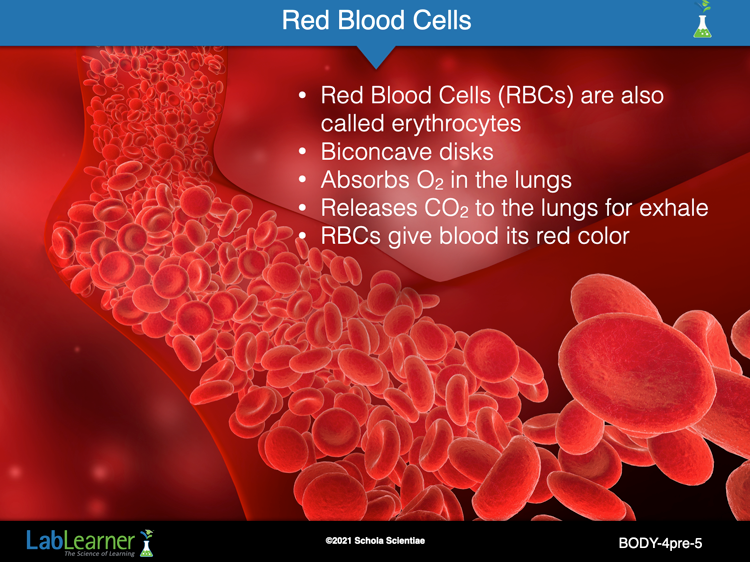
SLIDE BODY-4pre-5
There are a number of different types of blood cells. White blood cells (leukocytes) are important for fighting infections. Platelets circulate in the blood and are important in forming blood clots.

In terms of our discussion of the blood carrying oxygen throughout the body, however, the most abundant blood cell is the red blood cell, also called an erythrocyte. The video above illustrates red blood cells rushing through a blood vessel.
______________________________________________
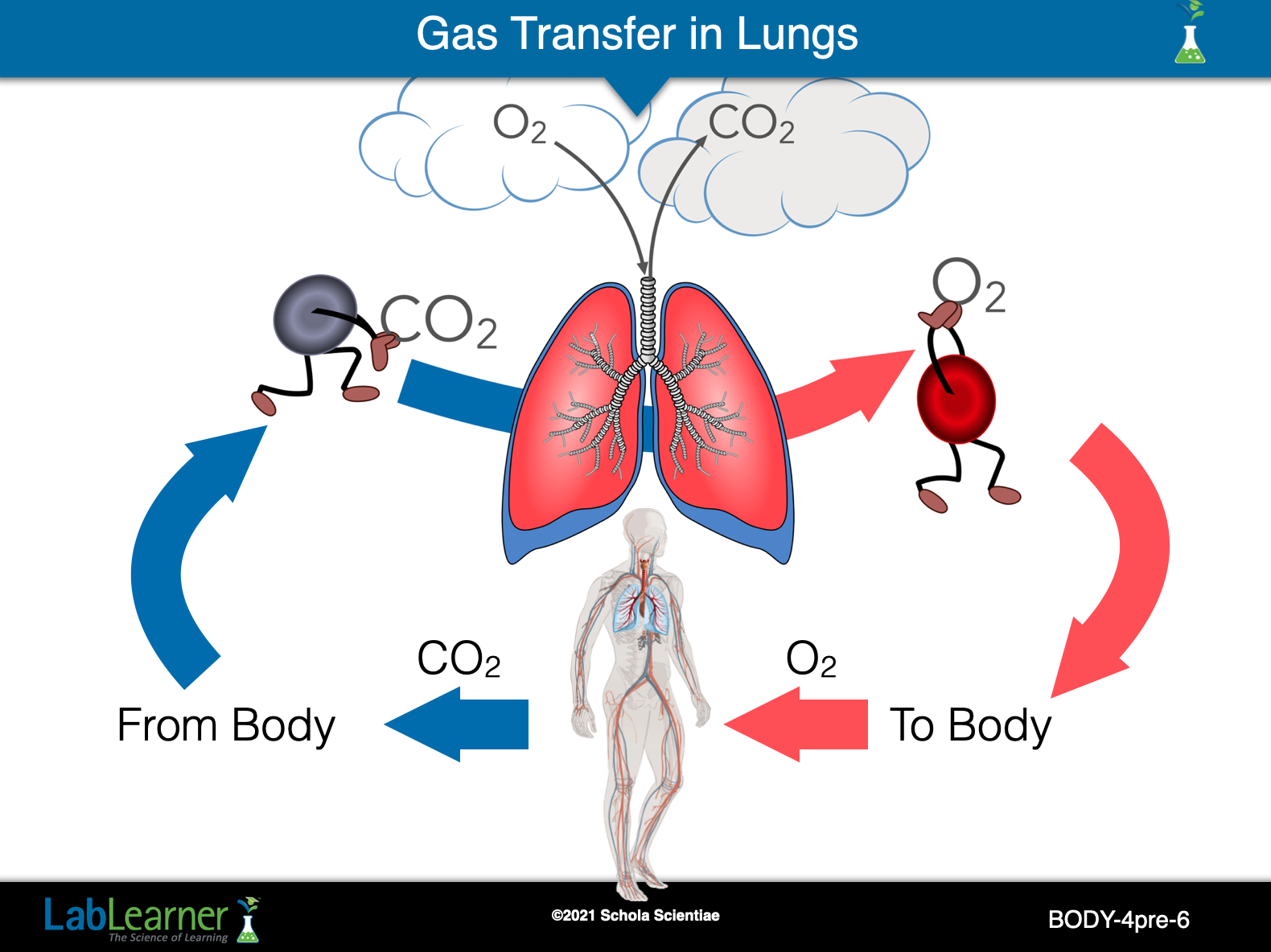
SLIDE BODY-4pre-6
RBCs carrying CO2 waste from the body’s cells enter the lungs after circulating throughout the body. In the lung, the CO2 is released by the RBCs and is exhaled by the lung. Next, the RBC binds to an oxygen molecule (O2) breathed in through inhalation by the lungs.
This process is repeated by the RBCs over and over until they are worn out and replaced. Normal RBCs last about 121 days before they are replaced.
______________________________________________
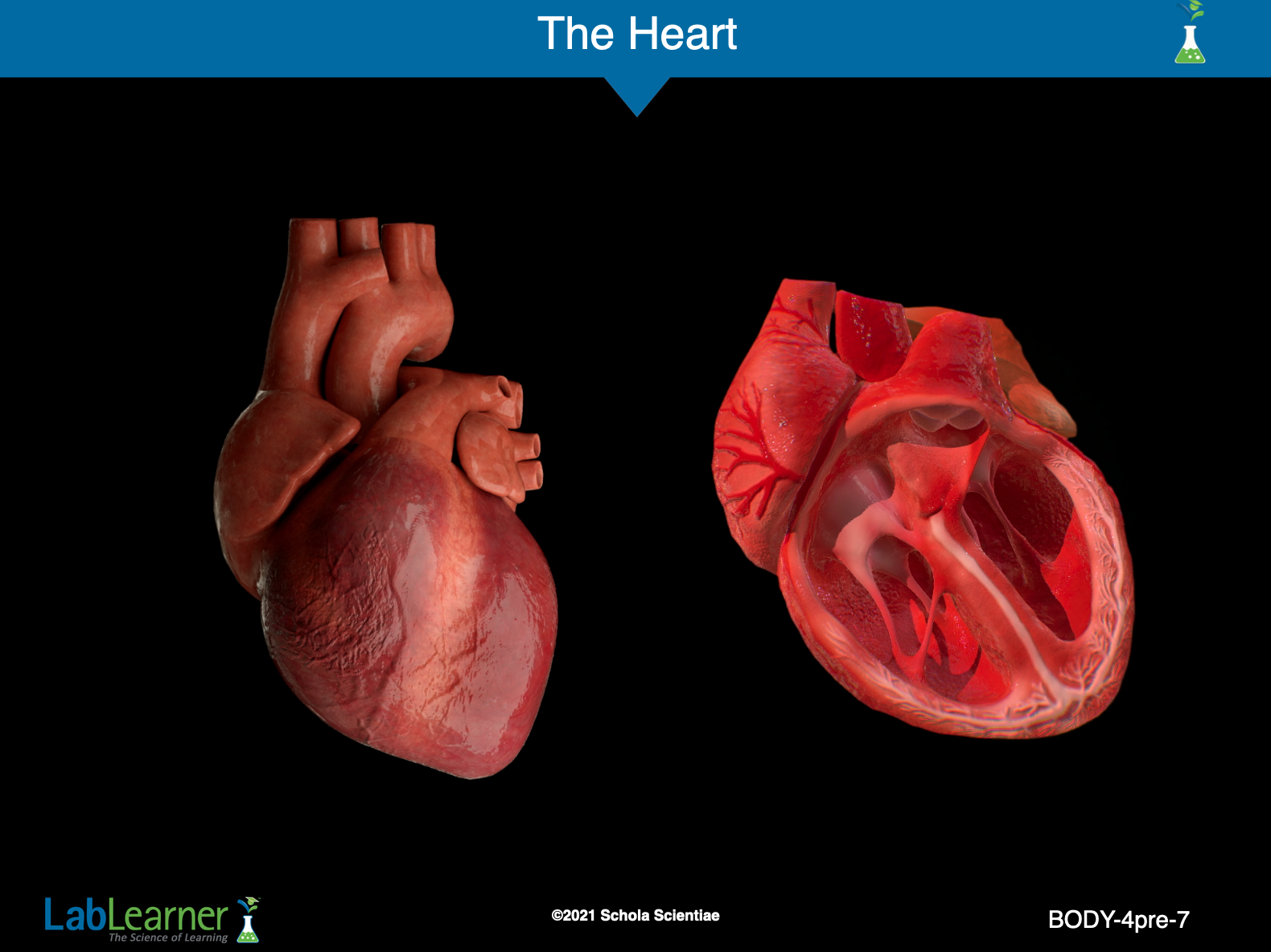
SLIDE BODY-4pre-7
While this slide is up, ask the questions that follow to prompt students to Recall and share their previous knowledge on this topic.
1. Ask students: What do you know about the heart? Student answers may vary. Allow time for students to share their ideas.
2. Tell students that the heart is the size of a fist. Encourage students to make a fist and place it on their chest, over their heart. The heart is located just to the left of the center of the chest.
3. Ask students: What do you think the heart does? Student answers may vary. Encourage students to realize that the heart constantly pumps blood throughout the body.
4. Ask students: How does the blood get from the heart to the rest of the body? Student answers may vary. This question leads to the next slide about arteries and veins.
______________________________________________
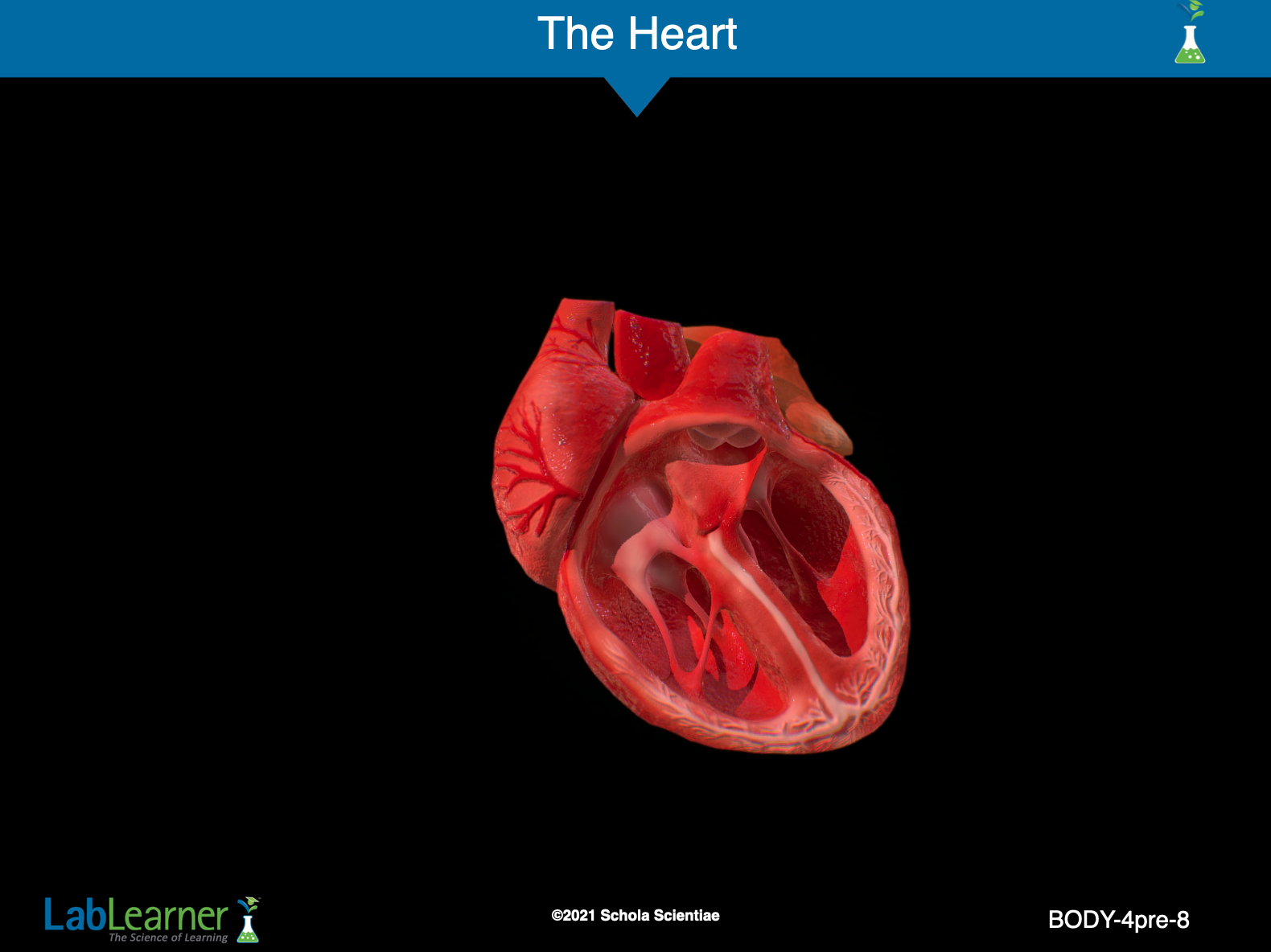
SLIDE BODY-4pre-8
Point out to students that blood enters the heart from the body through a major blood vessel called the Superior Vena Cava. After returning to the heart from the lungs, oxygenated blood leaves the heart through the Aorta and circulates through the body before returning to the heart through the Superior Vena Cava once again.
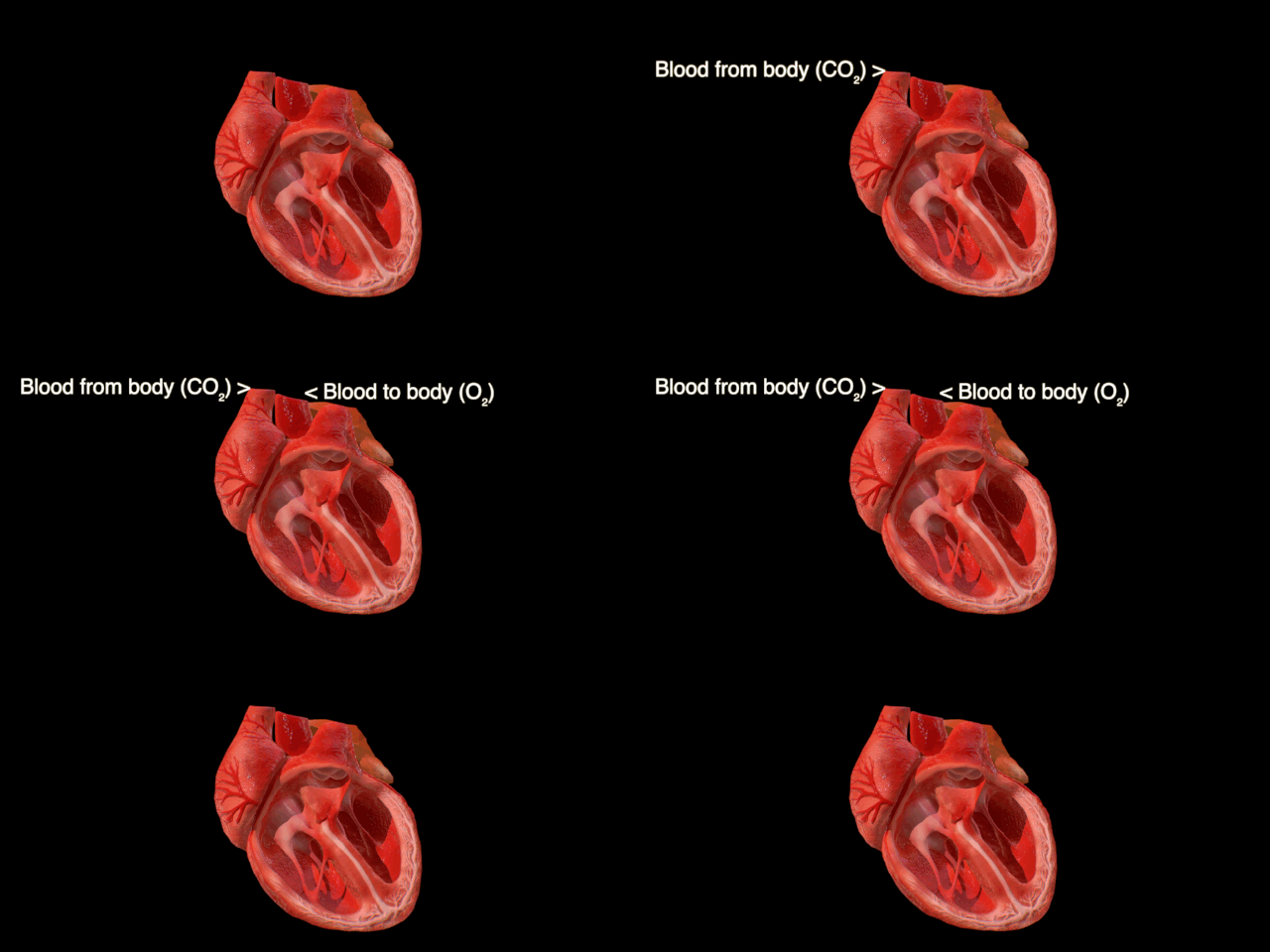
The heart beats close to 100,000 times a day and about 35 million times per year. That is well over 2.4 billion beats in a typical lifetime!
______________________________________________
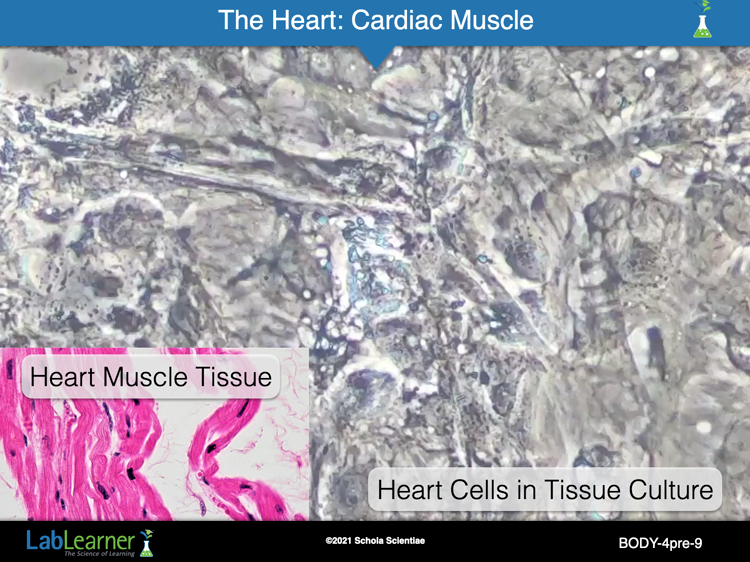
SLIDE BODY-4pre-9
In the lower-left of this slide is a section of heart tissue. It is a form of muscle tissue unique to the heart and called cardiac muscle.
The background of the slide shows a video of heart cells grown in a lab as tissue culture. When heart cells are grown in the lab, they spontaneously contract in a very regular, rhythmic manner. It is awesome to observe!
______________________________________________
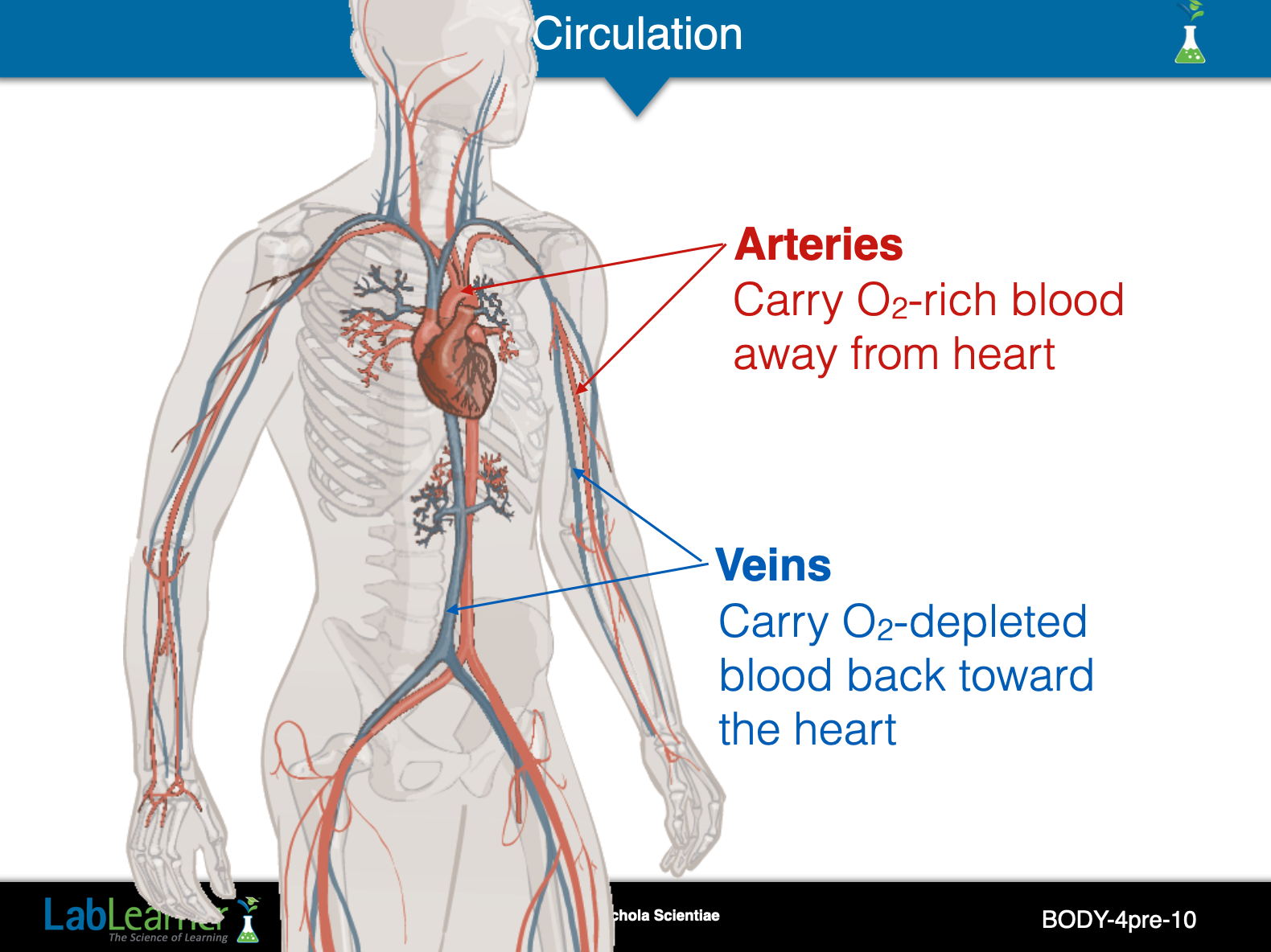
SLIDE BODY-4pre-10
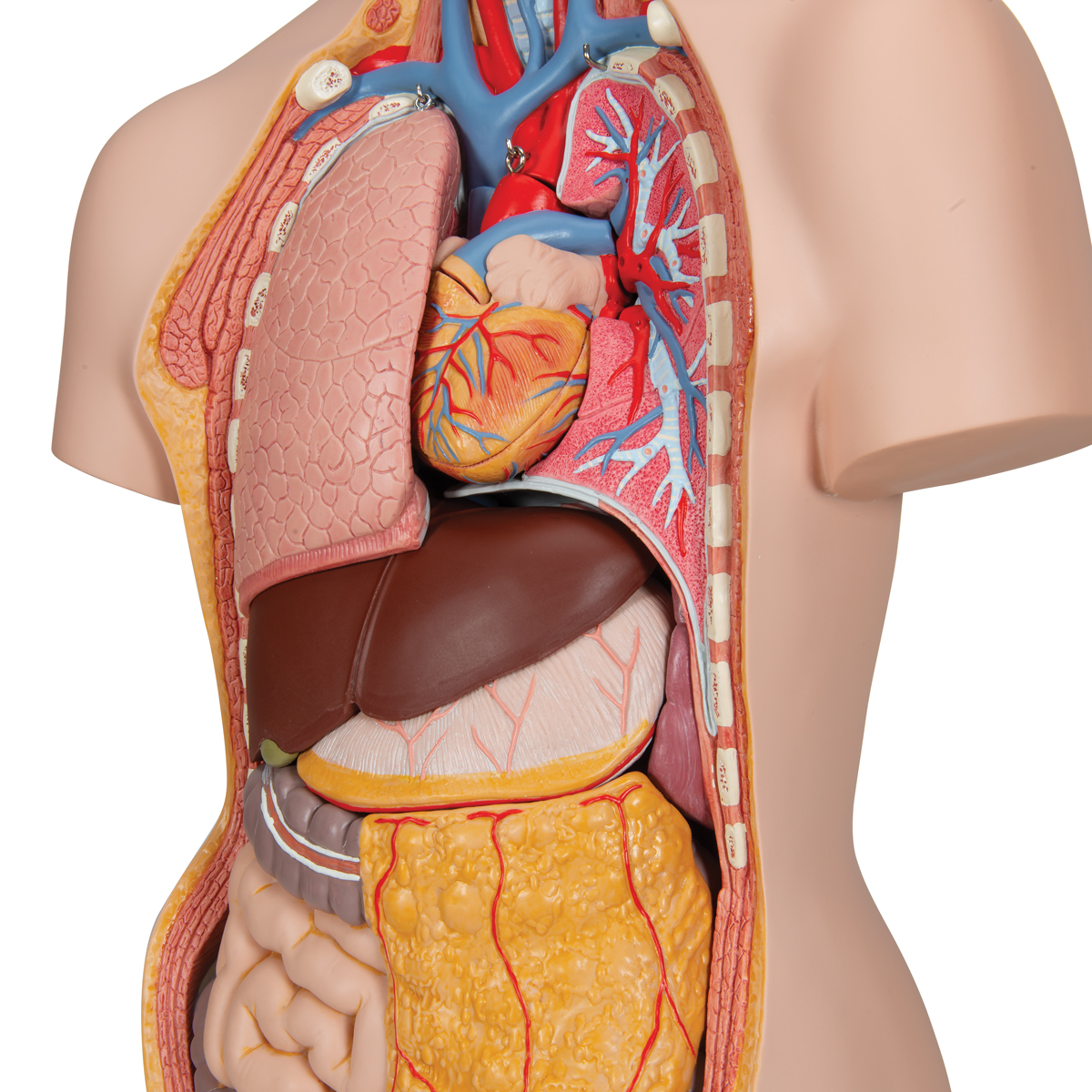 1. Explain to students that the blood moves away from the heart to the rest of the body through blood vessels called arteries. Once the blood reaches the other parts of the body, it moves back toward the heart through blood vessels called veins.
2. When in the lab, use the human torso model to point out the heart, veins, and arteries to the students.
______________________________________________
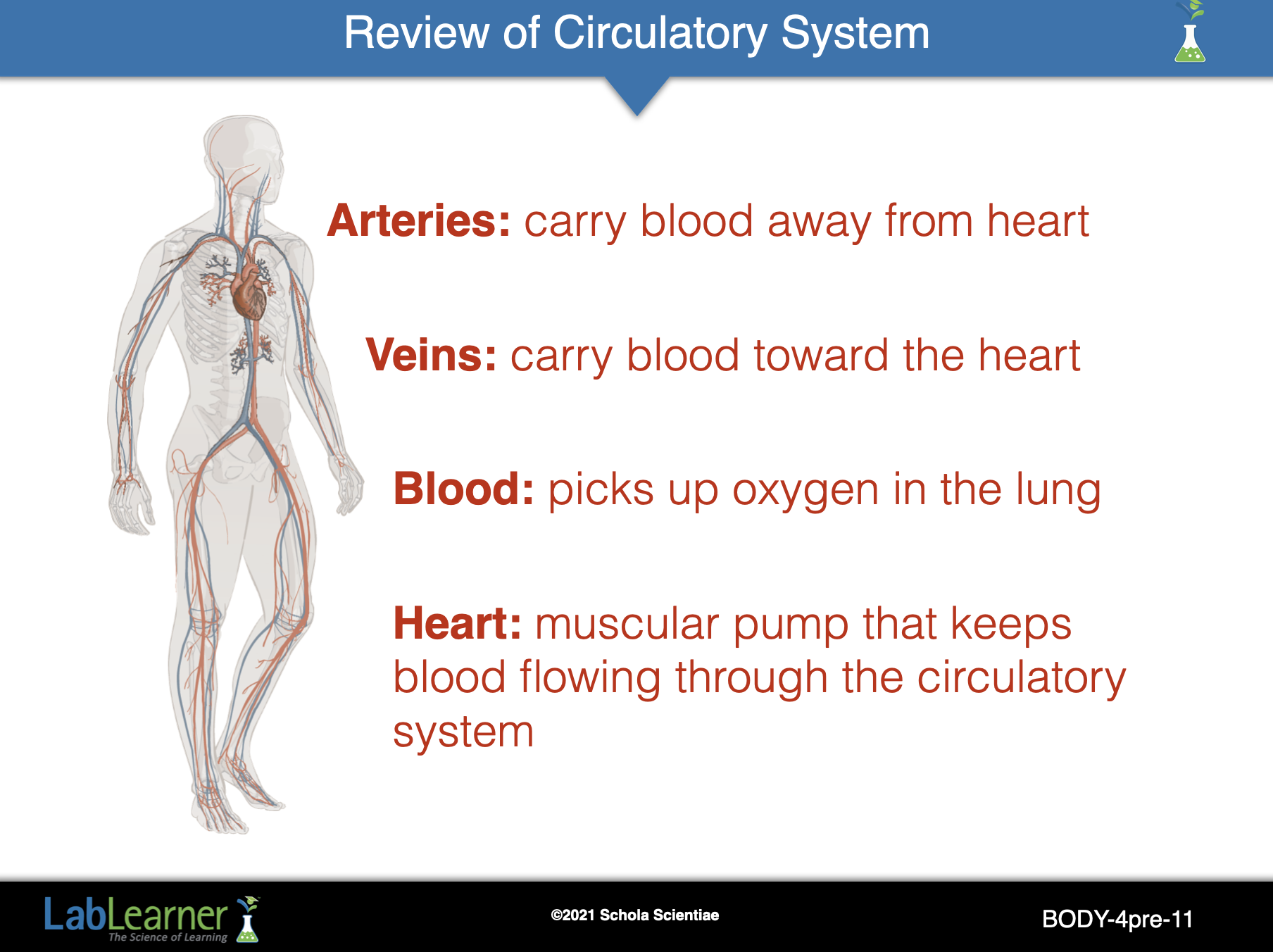
SLIDE BODY-4pre-11
This summary slide reviews several key points. It is important to remember that the entire function of the circulatory system is to assure that every cell in the body receives an adequate supply of blood.
WATCH IT
Play the following Student Video in preparation for the lab. Discuss as necessary to answer student questions.