
Teacher Portal:
The Human Body
Investigation 3 – PostLab
ASK WHY
The human body is organized into systems that are made up of many parts and that these systems each perform both individual and complementary functions that occur at the same time in the body.
BRANCH OUT
Pulmonologists are physicians who specialized in the respiratory system. They treat conditions that affect the respiratory system, especially the lungs, such as asthma.
PRINT IT
Use your browser to download a printable PDF as help during the slide presentation and to make additional notes. In your browser, go to File > Print and then choose to save as PDF.
NAVIGATE IT
Once the slide presentation is launched
- use your left and right arrows to advance or go back in the slide presentation, and
- hover your mouse over the left edge of the presentation to get a view of the thumbnails for all the slides so that you can quickly move anywhere in the presentation.
- Click HERE to launch the slide presentation for the CELL.
SHARE IT
SLIDE BODY-3post-1
In this PostLab session, we will go over the experiences and results from the Lab for Investigation 3 and incorporate a more detailed discussion of the respiratory system.
______________________________________________
SLIDE BODY-3post-2
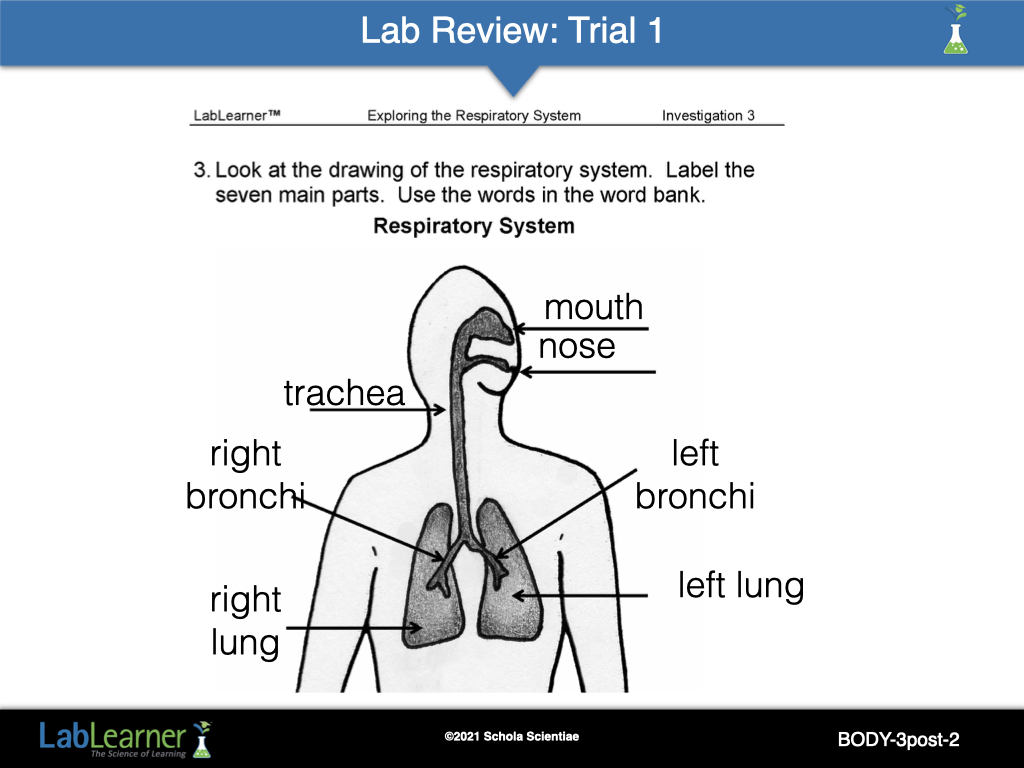
Begin the PostLab by asking students to describe one experiment performed in the lab of this investigation. Student answers may vary. Students may describe the respiratory rate experiment where they measured their respiratory rate at rest and after exercise. Students may also recall the construction and use of the lung model where they observed inhalation and exhalation. The students also measured the volume of air they exhaled in one breath by finding the circumference of a balloon.
Begin analysis of each trial performed in the lab. Ask students to recall Trial 1.
Remind students that at the beginning of the experiment, they looked at the pathway of the respiratory system. Instruct students to look at problem 3 on their Student Data Record to help them recall the parts of the system.
Ask students to recall the parts of the respiratory system.
______________________________________________
SLIDE BODY-3post-3
Note: This slide is animated. The teacher may wish to practice prior to presenting to the class.
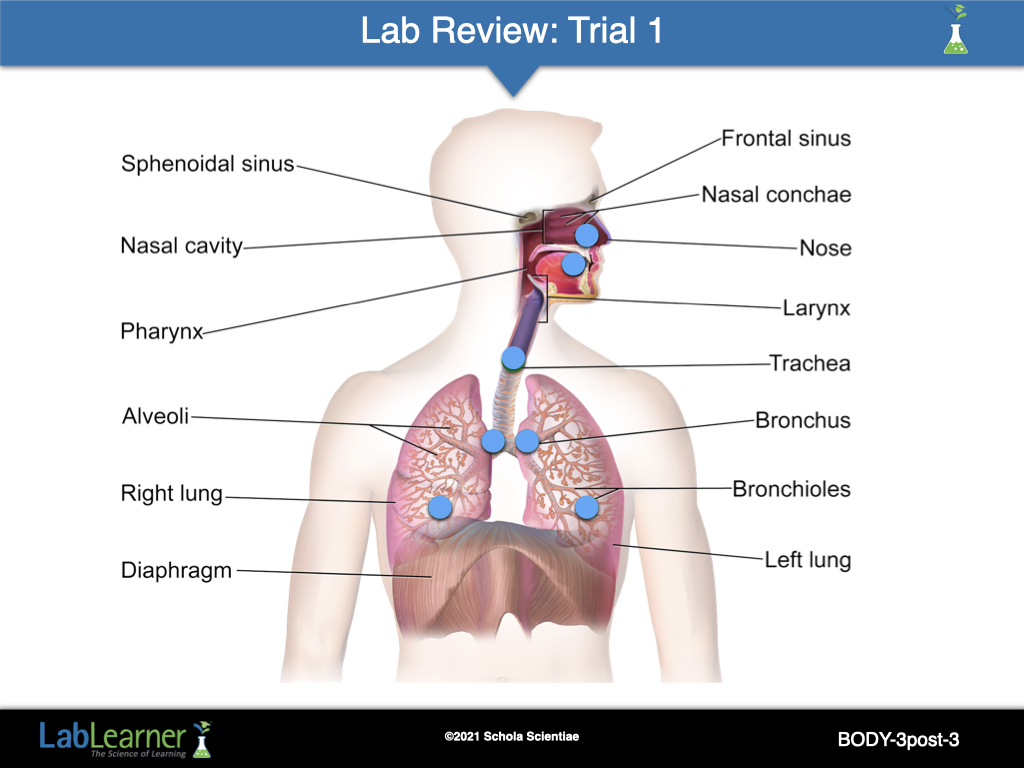
Ask students: What happens to the air in the lungs when a person inhales? Students should indicate that the air is drawn into the nose and mouth from the atmosphere. It passes through the trachea into the left and right bronchi and then inflates the left and right lung.
Review the path that air takes through the respiratory system as a person inhales. The green dots represent the path of inhalation.
Ask students: What happens to the air in the lungs when a person exhales? The lungs relax and become smaller forcing the air back through the bronchi and trachea. The air will exit the body through the nose and the mouth.
Review the path that air takes through the respiratory system as a person exhales. The blue dots represent the path of inhalation.
Note: The blue dots are superimposed on the green dots to illustrate that air takes the same pathway for inhalation and exhalation, but in opposite directions.
Tell students to think about what they are breathing into their lungs. What does your respiratory system take out of the air? The respiratory system is using the oxygen that is present in the air to breath. The oxygen is sent from the respiratory system to the rest of the body.
Rehearse Tool: Remind students that they need to remember the path that air takes as a person inhales and exhales. Emphasize that Rehearsing or retracing the pathway with their finger will help them remember in the future. Encourage students to trace the pathway of inhalation. As they trace, ask them to chant: “nose,” “mouth,” “trachea,” “bronchi,” “lungs.” Now encourage student to trace the pathway of exhalation. As they trace, ask them to chant: “lungs,” “bronchi,” “trachea,” “mouth,” “nose.”
Allow students to rehearse these pathways several times.
______________________________________________
SLIDE BODY-3post-4
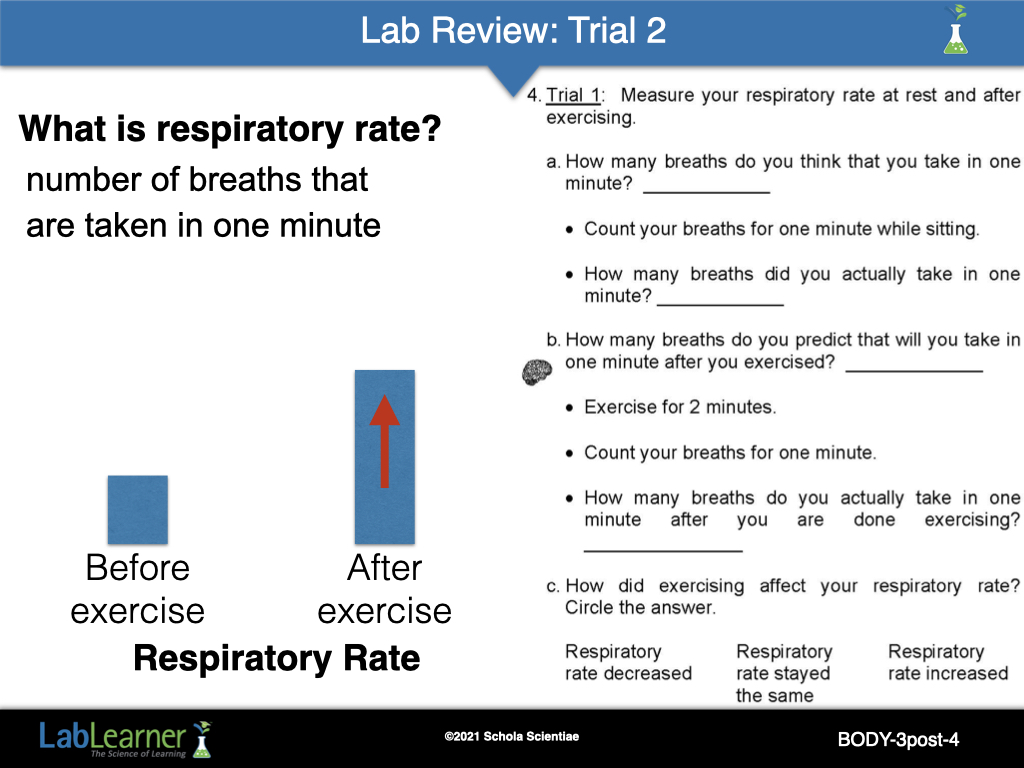
Ask students to recall the respiratory rate experiment in Trial 1.
Ask students: What is respiratory rate? Students should indicate that respiratory rate is the number of breaths that are taken in one minute.
Describe your respiratory rate before you exercised. Students should indicate that before exercising their respiratory rate was slow and steady.
What happened to your respiratory rate after you exercised? After exercising for two minutes, student respiratory rates increased, becoming more rapid.
______________________________________________
SLIDE BODY-3post-5
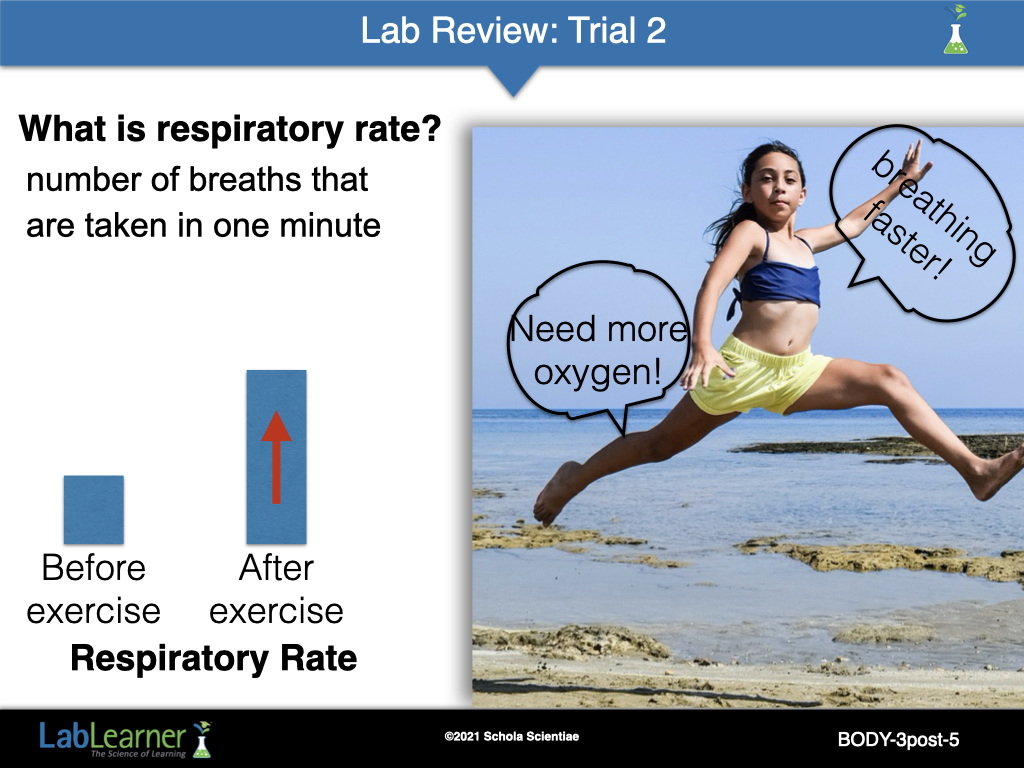
Encourage students to realize that while exercising, muscles of the body were signaling that they needed a greater amount of oxygen. The respiratory system responded to that signal by inhaling and exhaling at a faster rate and drawing more oxygen into the body.
______________________________________________
SLIDE BODY-3post-6
Note: This slide is animated. The teacher may wish to practice prior to showing students.
Continue analysis of students’ experiments by referring students to the model that they created in Trial 2 of the lab.
Why do we use models? Why was it used in this investigation? Models are used to represent something that can not be directly observed. In this case, students were not able to view an actual working respiratory system, so a model was constructed for their observation.
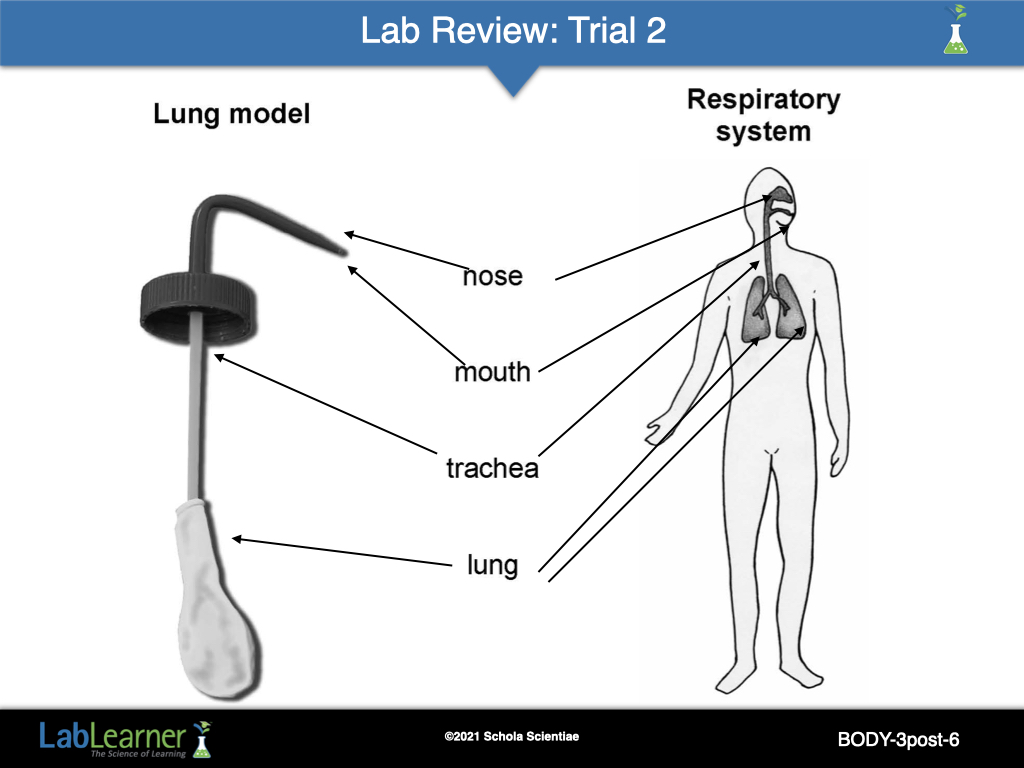
What body parts did the model represent? The model represented the nose/mouth, trachea, and one lung.
Tell students to locate problem 7 in their Student Data Record. Explain that there is a photograph of the lung model on the left and a drawing of the respiratory system on the right. There are four body parts (nose, mouth, trachea, and lung) listed between the two pictures.
Remind students that each part of lung model has a corresponding part on the real body system.
Ask students: On this model, what did the pointed plastic tube represent? The clear plastic cube? The balloon? The pointed plastic tube represented the nose and mouth, the clear plastic tube represented the trachea, and the balloon represented a lung.
Instruct students to draw a line from the word “nose” to the part on the model that represents the nose. Students should then draw a second line from the word “nose” to that part on the actual system.
Label the remaining body parts.
Ask students: Were there differences between the model you constructed and the actual respiratory system?
Students should indicate that the model consisted of only one lung, while the real respiratory system has two lungs. The model was also missing the left and right bronchi.
______________________________________________
SLIDE BODY-3post-7
Note: This slide is animated. The teacher may wish to practice prior to showing students.
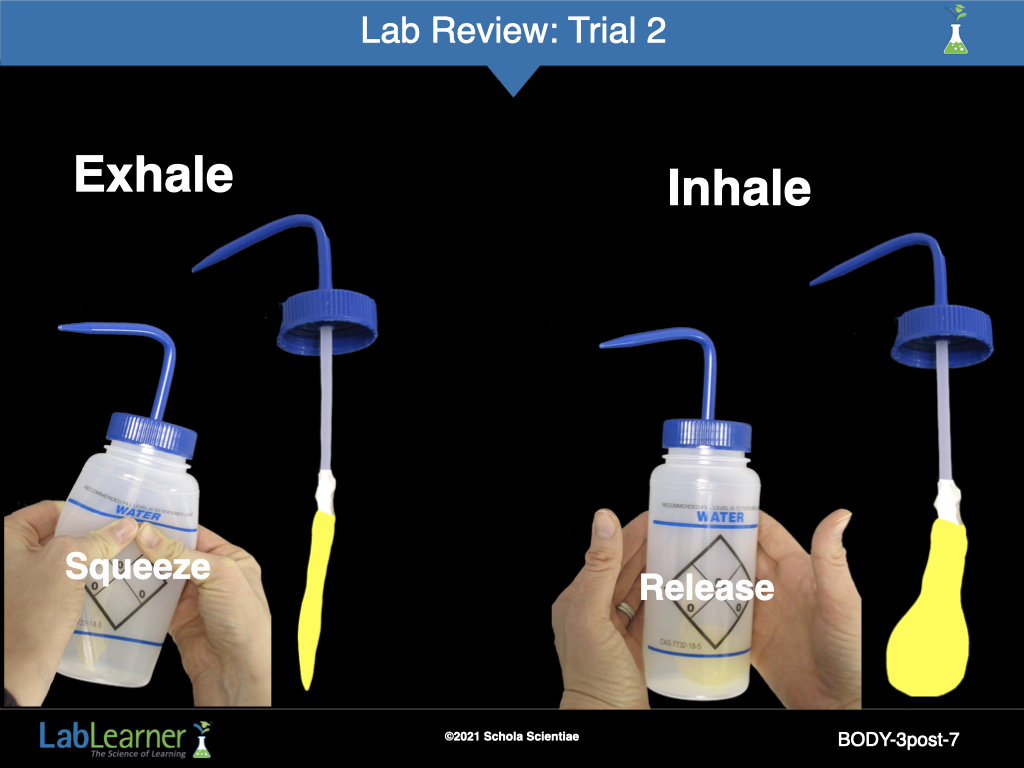
What happened to the balloon when you squeezed the water bottle? When you released the water bottle? Students should indicate that the balloon became smaller when the water bottle was squeezed and the balloon expanded when the water bottle was released.
How did this model represent breathing? The squeezing of the bottle and the decrease in size of the balloon represented exhaling. When the respiratory system exhales, the lungs push the air out of the system and decrease in size. The releasing of the bottle and the expansion of the balloon represented inhaling. When the respiratory system inhales, the air is pulled into the system by the lungs and expand, or increase in size.
______________________________________________
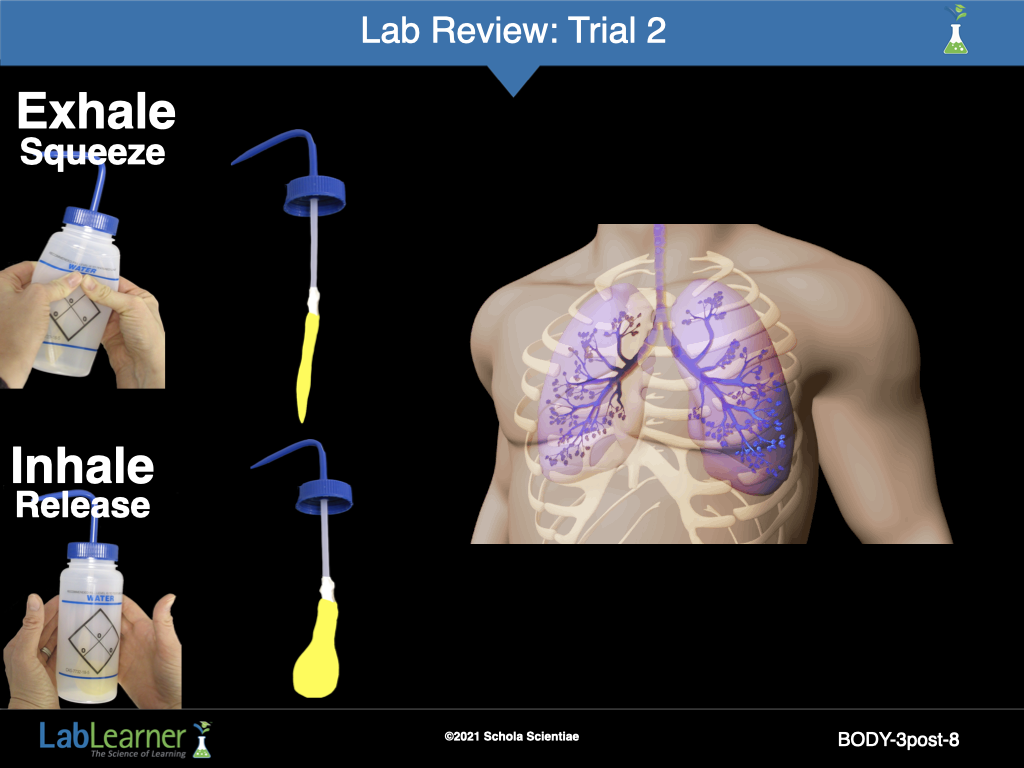
SLIDE BODY-3post-8
Note: This slide is animated. The teacher may wish to practice prior to showing students.
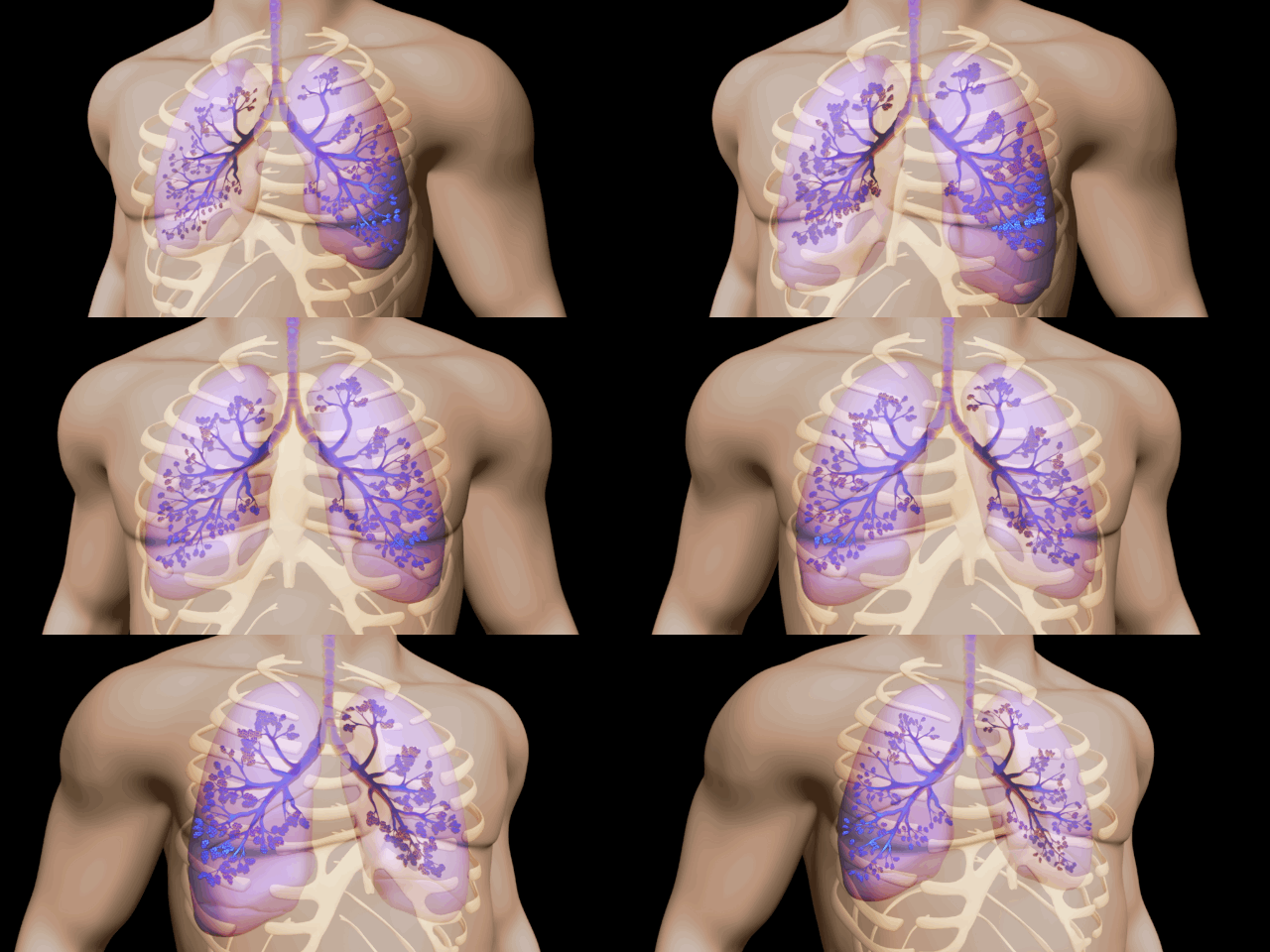
This slide presents an opportunity for students to match the actions of their models with what happens to the lungs during inhalation and exhalation.
______________________________________________
SLIDE BODY-3post-9
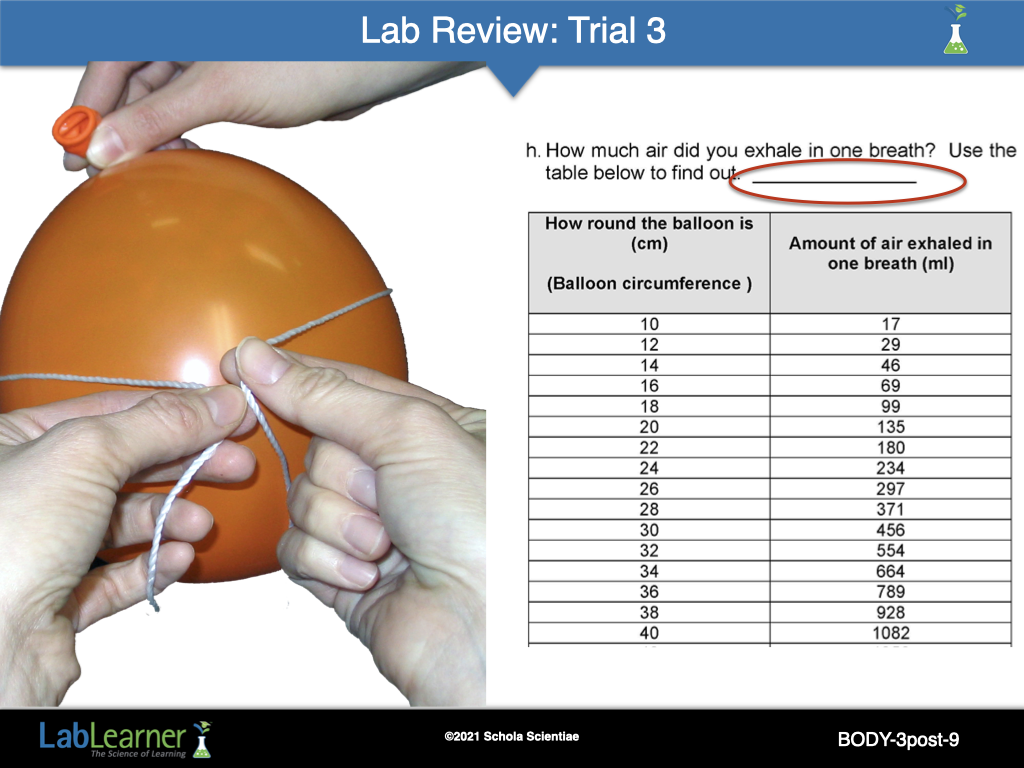
Ask students: What experiment did you perform in Trial 3? During Trial 3, students took a deep breath and exhaled as much air as possible into a balloon.
Ask students: What did you measure when you held the string around the balloon?
Students should indicate that they were measuring how round or full the balloon was. This is the balloon’s circumference. Students measured the circumference to find the volume of air blown into the balloon in one breath.
Ask students to refer to problem 6h of their Student Data Record and have them locate the space where they recorded how round their balloon was.
______________________________________________
SLIDE BODY-3post-10
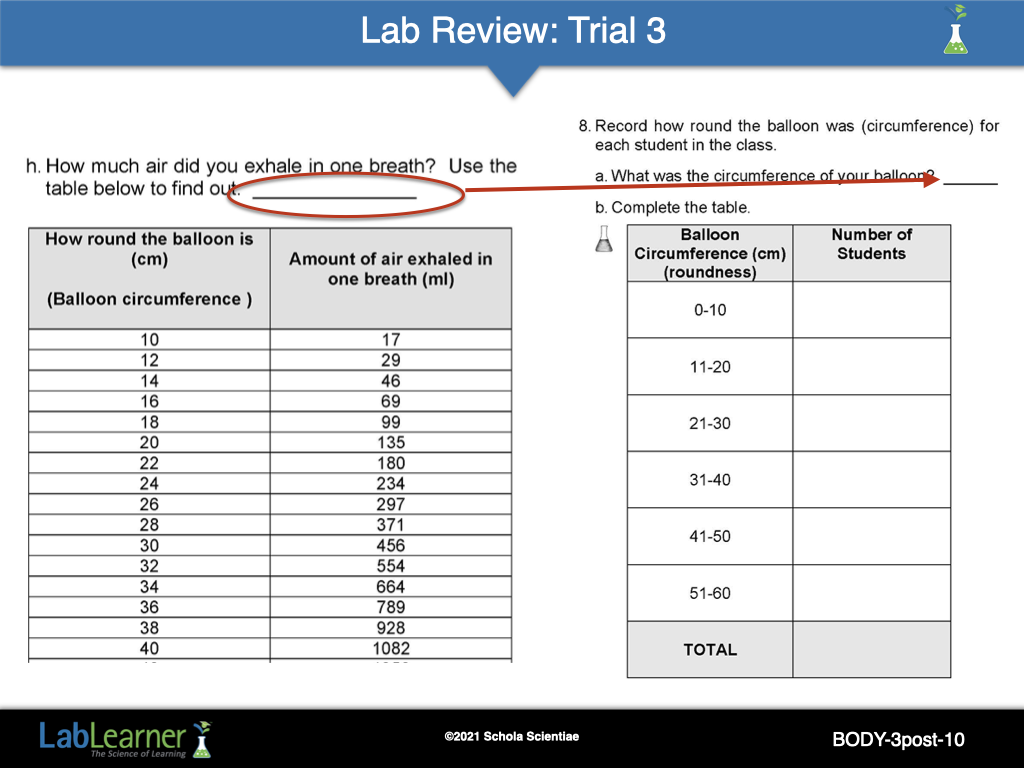
Ask students to refer to problem 6h of their Student Data Record and have them locate the space where they recorded how round their balloon was. Encourage students to copy this number into the space provided in problem 8a of their Student Data Record.
______________________________________________
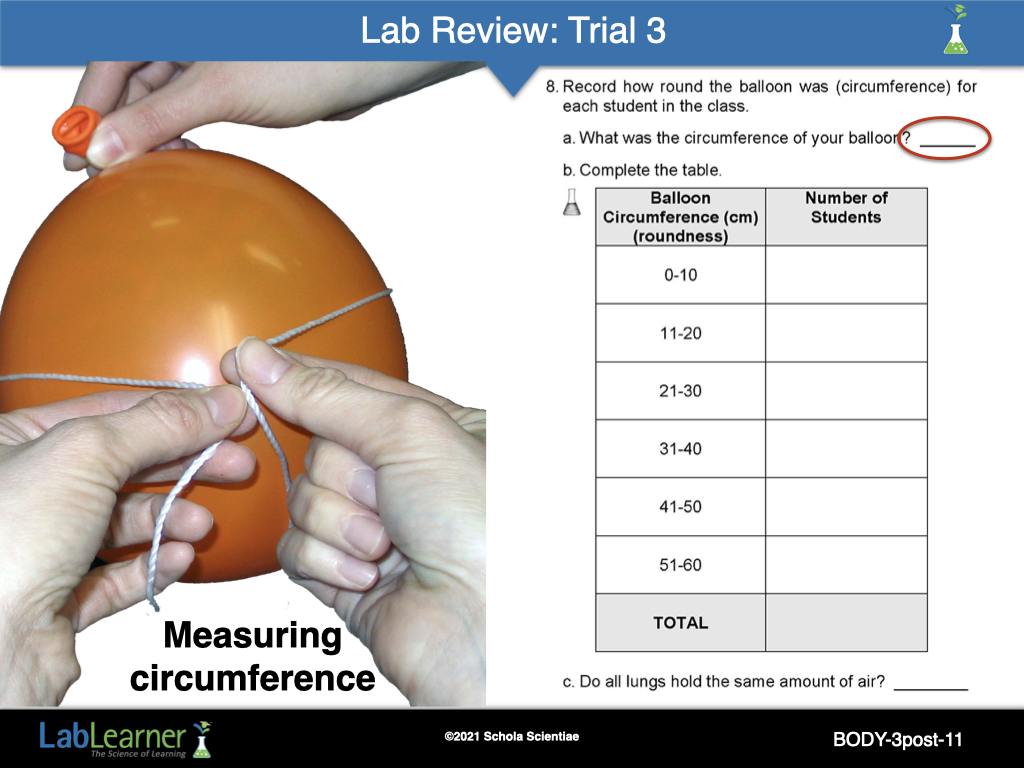
SLIDE BODY-3post-11
Explain to students that when a scientist talks about how round an object is, he or she uses the word circumference. Circumference is a measurement of the distance around a circle. Ask students to repeat the word several times.
Direct students to look at the table in problem 8. Explain that the first column contains the circumferences of the balloons. They are listed as ranges.
Tell students: If your balloon had a circumference of 18 cm, it would fall into the range of 11 to 20 cm.
Explain to students that the second column is where they are going to record the class data from the experiment. Tell students that the instructor will be including his or her data along with the student data for comparison.
Ask students: By a show of hands, how many students had a balloon circumference between 0 and 10 cm?
Encourage all students to record that number in the appropriate space on the table.
If students are having difficulty filling the table in on their own, prompt students to locate the column that says “Number of Students” and have them point to it. Direct students to move their finger down the column until it is in the block next to “0 – 10 cm.” Encourage students to record their answer in this block.
Repeat the process until all of the class data is recorded.
Tell the students to add the number of students they marked in the second column, and place the total number in the appropriate box at the bottom of the column. This number includes the instructor.

Ask students: Do all lungs hold the same amount of air?
Encourage students to record their answer in problem 8c of their Student Data Record. Students should indicate that all lungs do not hold the same amount of air.
Ask students: What are some things that could create this difference in your data?Student answers may vary. Sample answers may include size of lungs, age of person, or the physical shape of person. Some students may also indicate that they had difficulty inflating the balloon using only one breath.
______________________________________________
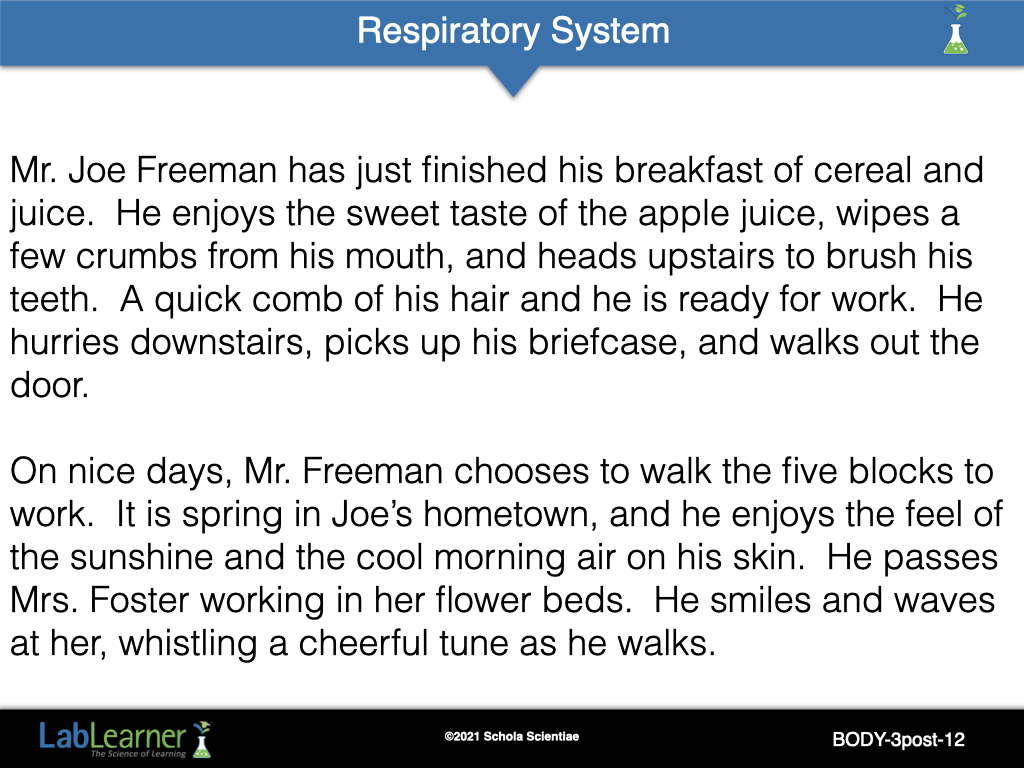
SLIDE BODY-3post-12
Encourage students to apply their knowledge of the respiratory system as you read a short story aloud to them.
Ask students: How often in your day do you think you use your respiratory system? Student answers may vary. Some students may respond by indicating that they use their respiratory system every time they think about taking a breath. Other students may feel that the respiratory system is used all of the time.
Tell students that you are going to re-read the short story about Mr. Freeman aloud to them. Instruct students to find the story in problem 9 of their Student Data Record. Ask them to follow along as you read the story to them.
Remind students to use the Mind Movie tool as they listen to the following story.
A Mind Movie is a tool that can be used to help a person draw a picture or create a movie that shows something with a lot of detail. While they listen to the story, students should try to picture Mr. Freeman in their minds, creating a movie with their imagination.
Explain to students that after the story is finished, they will think about how Mr. Freeman used his respiratory system. By picturing Mr. Freeman and his activities in their minds, students will be better able to answer the questions.
______________________________________________
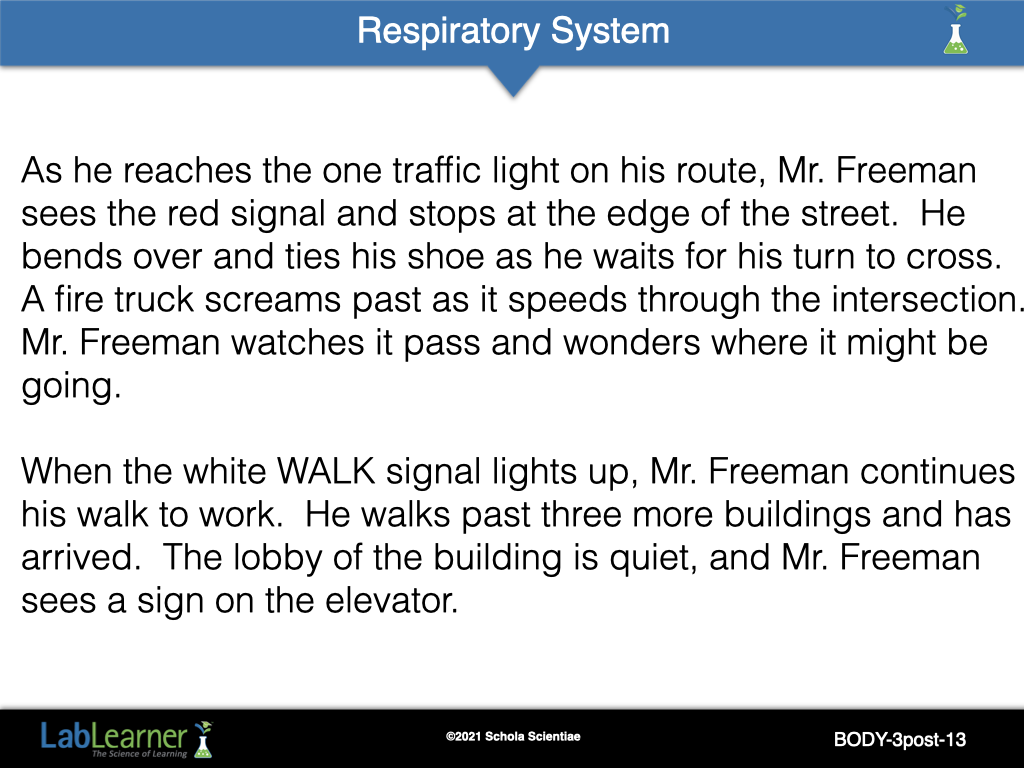
SLIDE BODY-1post-13
Continue reading the story aloud.
______________________________________________
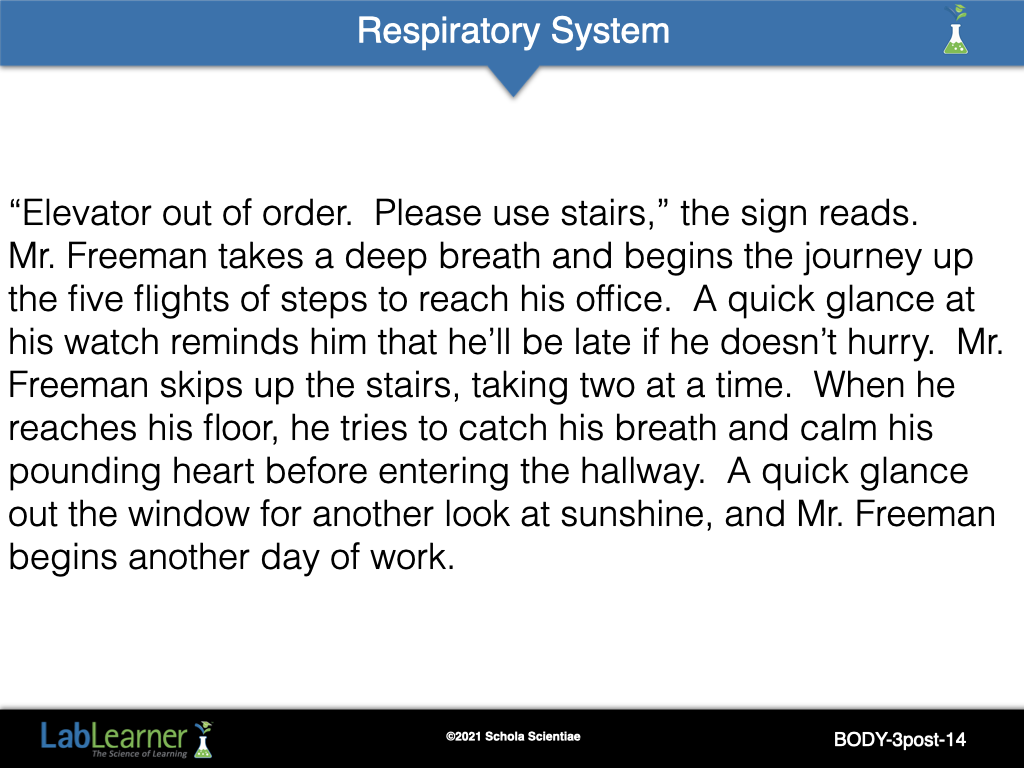
SLIDE BODY-3post-14
After you have finished reading the story aloud ask students: How did Mr. Freeman use his respiratory system throughout his trip from the breakfast table to his office? Student answers may vary. Encourage students to realize that Mr. Freeman is breathing in and out during the entire story.
To help students understand when Mr. Freeman was using his respiratory system, mark these parts of the story.
Ask students: How did Mr. Freeman use his respiratory system? Sample answers include: whistling a tune, taking a deep breath before climbing the stairs, and trying to catch his breath before entering the hallway.
Underline specific instances in the story as students suggest them. Encourage students to underline the passages in their story in problem 9.
Ask students: Do you think that Mr. Freeman’s respiratory system was ever not being used in this story? Student answers may vary. Encourage students to realize that Mr. Freeman’s respiratory system was used constantly in the story. Put a box around the entire story to indicate that Mr. Freeman was breathing during the entire story.
 _____________________
SLIDE BODY-3post-15
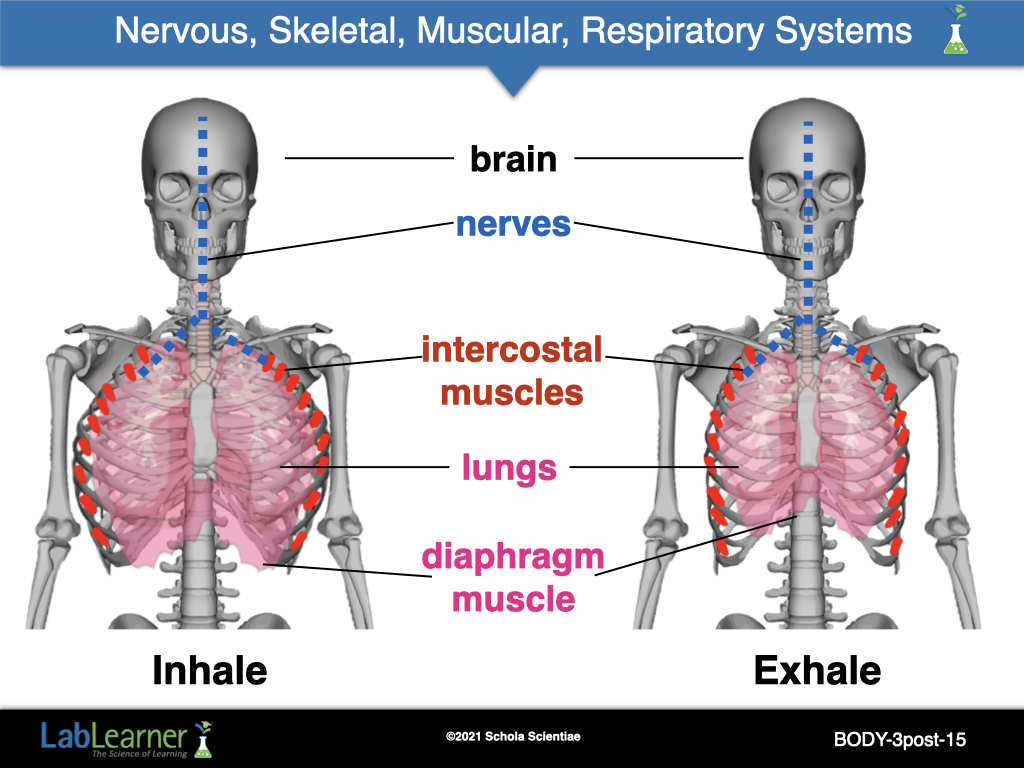
Ask students: Do you think Mr. Freeman was using his nervous system while he was using his respiratory system? Students should indicate that the nervous system and the respiratory system were working together in the story because the nervous system tells the lungs when to expand and relax.
Ask students: How do the nervous system and respiratory system work together? Students should indicate that signals are sent back and forth between the two systems when the body needs oxygen.
Ask students: Do you think Mr. Freeman was using his skeletal and muscular systems while he was using his respiratory system? Students should indicate that Mr. Freeman was using his skeletal and muscular systems to move at the same time as he was using his respiratory system to breathe. These systems are working at the same time.
Ask students: How do the nervous, respiratory, skeletal, and muscular systems work together? Students should indicate that as the muscles and bones are working together to create movement, they will signal the respiratory system that more oxygen is needed. The brain send signal via nerves to the respiratory system. The respiratory system responds by increasing the respiratory rate. The muscles around the rib cage (intercostal muscles) move the rib cage up and out and the diaphragm down to inhale causing the lungs to expand. During exhalation, the intercostal muscles and diaphragm relax and the ribs move in and down and the lungs relax.
Ask students: Do you think that the respiratory, skeletal, and muscular systems could work without the nervous system? Students should indicate that they could not work without the nervous system. The nervous system sends the signals back and forth between all of the systems of the body.
Conclude the lesson by encouraging students to think about air moving through their respiratory system as they breathe in and out for the rest of their day. Ask students to consider the following question: How does the oxygen in your lungs get sent to the muscles in your fingers or toes?
We will answer this question during our next investigation.
______________________________________________