
 ZERO-IN
Italicized font represents information to be shared orally or physically completed with the students at this time.
Non-italicized font represents additional information included to support the teacher’s understanding of the content being introduced within the CELL.
BRANCH OUT
Explain to students that botanists are scientists that study plants and zoologists are scientists who study animals. Together, botanists and zoologists are called biologists.
PRINT IT
Use your browser to download a printable PDF as a help during the slide presentation and to make additional notes. In your browser, go to File > Print and then choose to save as PDF.
NAVIGATE IT
Once the slide presentation is launched
- use your left and right arrows to advance or go back in the slide presentation, and
- hover your mouse over the left edge of the presentation to get a view of the thumbnails for all the slides so that you can quickly move anywhere in the presentation.
- Click on the button below to launch the slide presentation for the CELL.
[aio_button align=”center” animation=”pulse” color=”red” size=”medium” icon=”play” text=”Click Here to Play” target=”_blank” relationship=”dofollow” url=”https://v2est.lablearner.com/content/1/uploads/keynote/OBSERV2CAP/assets/player/KeynoteDHTMLPlayer.html#0″]
SHARE IT
Slide OBSERVE 2-1:
In this CAP we ask students to make observations of pictures to discover the essential things that plants and animals (including humans) need to survive. Students will make observations and draw conclusions from what they have observed. Remind students that they can use different senses to make observations: sight, hearing, smell, taste, and touch.
We will also ask students to use their senses to observe how pollution can impact the environment. Students will view three major types of pollution; water, land and air pollution and think of ways to limit pollution and its damage so as to create environments that are conducive to the health of plants and animals.
Slide OBSERVE-2-2:
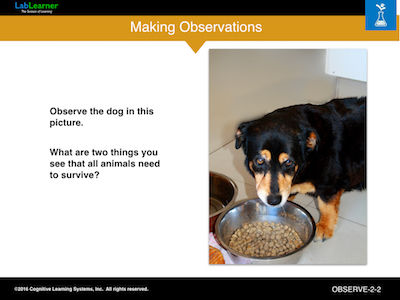
Many young students have experience with pet dogs. Show your students this slide and ask them, “What are two things you see in this picture that all animals need to survive?”. The answer, of course, is food and water. Once the students identify these two factors, ask them if humans need these two things as well to survive.
Slide OBSERVE-2-3:
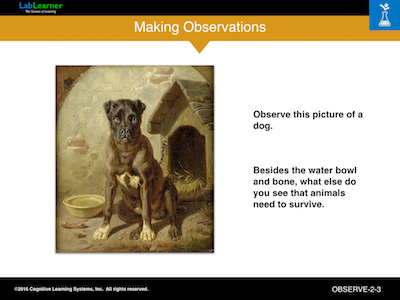
This slide shows another image of a dog. Pictured in the image is a third factor that most animals require to survive – shelter. Once your students identify this requirement, you way wish for them to name other forms of shelter animals use. Answers will, of course, vary but may include things such as nests, caves, underground dens (burrows) and so forth.
Slide OBSERVE-2-4:
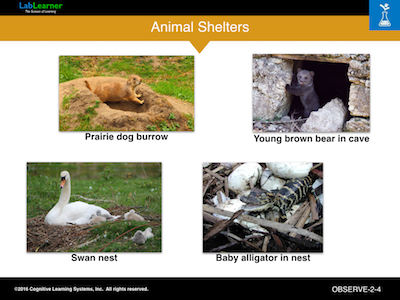
Ask students what theses pictures have in common with the doghouse in the preceding slide. Students should indicate that these are all different types of shelters.
Slide OBSERVE-2-5:
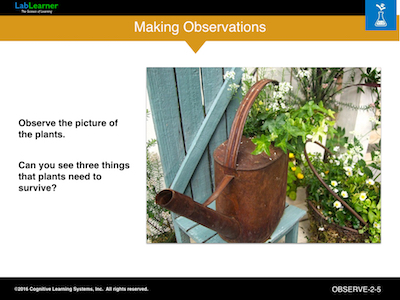
Have students observe this slide and give them a moment. The ask them, “Can you see three things that plants need to survive?”. The answer is water, sunlight (or Sun) and soil. This is a bit more difficult than the previous slides in that the sun is shining on the plants and the soil is in the pot. Nonetheless, once discussed, students should see these three requirements for plant life.
Slide OBSERVE-2-6:
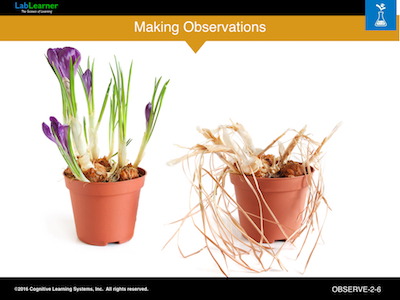
Ask students, “Why do you think some of these plants are healthy and some died?”. Students should suggest that the healthy plants had water, light and soil in which to grow. The plants that died may not have had enough water, enough light, or soil in which to grow.
Slide OBSERVE-2-7:
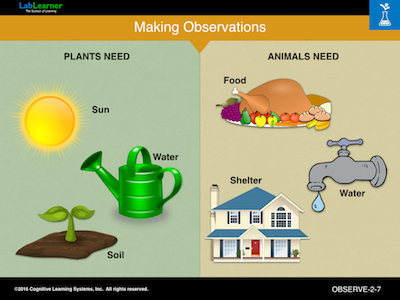
This slide is a simple review of what the students observed and discussed in the previous slides. Plants need sunlight, water and soil to survive. Animals, including humans, require food, water and shelter to survive.
Ask students, “ What things that plants and animals need to survive are the same?”. “What things are different?” Students should see that both need water, but plants also need light and soil. Animals need shelter and food. You may wish to probe deeper, discussing that plants need soil for minerals and nutrients, similar to the food that animals require.
Slide OBSERVE-2-8:
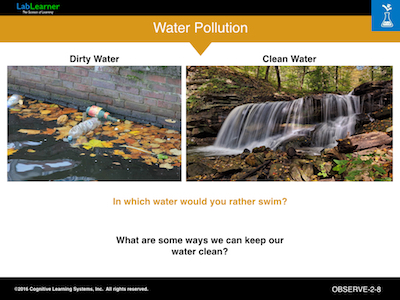
The following four slides build on students’ sense of sight to observe different types of pollution and to consider how pollution affects things that plants and animals need to survive.
This slide shows dirty, polluted water on the left and clean water on the right. Ask students, “In which water would you rather swim? Which water do you think is best for animals and plants? Can polluted water change what plants and animals need to survive?” Next, briefly discuss the ways to keep our water clean. (not dump chemicals in water, don’t throw garbage in water, etc.)
Slide OBSERVE-2-9:
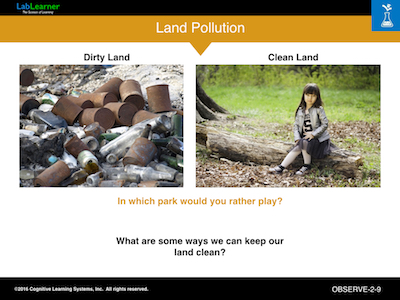
This slide shows dirty land on the left and clean land on the right. Ask students, “In which park would you rather play? In which park do you think animals should build their shelters?” Next, briefly discuss the ways to keep our land clean. (put trash in recycling containers, don’t cut down all the trees, etc.)
Slide OBSERVE-2-10:
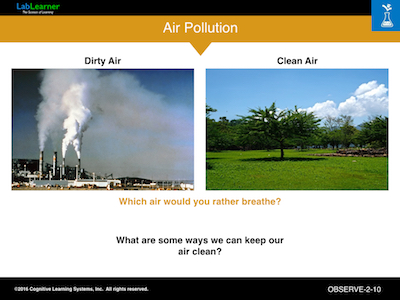
This slide shows dirty air on the left and clean air on the right. Ask students, “Which air would you rather breathe? Which air do you think is better for other animals to breathe?” Next, briefly discuss the ways to keep our air clean. (don’t burn trash, don’t put chemicals in the air, drive a bicycle instead of a car if possible, etc.)
Slide OBSERVE-2-11:
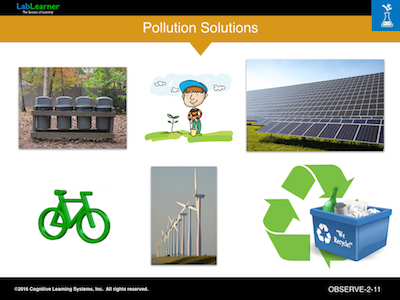
This final slide shows some of the solutions to water, land and air pollution. Students may have brought some of these up earlier. Ask students if they can think of other solutions to the problem of pollution.