
 ZERO-IN
Italicized font represents information to be shared orally or physically completed with the students at this time.
Non-italicized font represents additional information included to support the teacher’s understanding of the content being introduced within the CELL.
BRANCH OUT
Explain to students that meteorologists are scientists who study the weather. Many of the weathermen and women we see on television are trained as meteorologists.
PRINT IT
Use your browser to download a printable PDF as a help during the slide presentation and to make additional notes. In your browser, go to File > Print and then choose to save as PDF.
NAVIGATE IT
Once the slide presentation is launched
- use your left and right arrows to advance or go back in the slide presentation, and
- hover your mouse over the left edge of the presentation to get a view of the thumbnails for all the slides so that you can quickly move anywhere in the presentation.
- Click on the button below to launch the slide presentation for the CELL.
[aio_button align=”center” animation=”pulse” color=”red” size=”medium” icon=”play” text=”Click Here to Play” target=”_blank” relationship=”dofollow” url=”https://v2est.lablearner.com/content/1/uploads/keynote/OBSERVE1CAP/assets/player/KeynoteDHTMLPlayer.html#0″]
SHARE IT
Slide OBSERVE 1-1:

In this CAP we will give students an experience of making observations over a long period of time (two or three weeks). This will allow you and them to look at the data that was collected and discuss it. Therefore, this simple CAP provides students with practice in observing and recording. The teacher should try to have his or her students understand the term Data by the end of this CAP.
Slide OBSERVE-1-2:
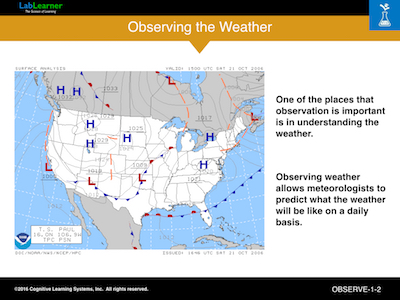
This slide shows a weather map. Notice that it has low and high pressures indicated (L and H, respectively). The lines with triangles are fronts. This weather map is included because many students will have seen similar graphics on television.
Slide OBSERVE-1-3:
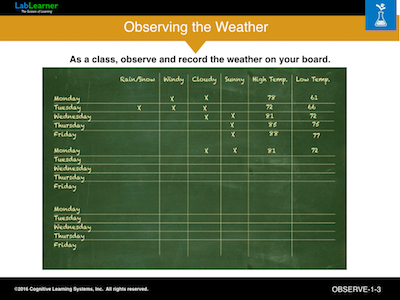
This slide shows weather data being collected over a period of three weeks. Notice that Saturdays and Sundays are not include on the table. It would, of course, be difficult to hold students responsible for collecting such data over the weekend. However, if the teacher would like to include weekend data, he or she is free to do so. The important point is for students to learn to record data, not how much data is actually recorded.
Each day the teacher might ask for volunteers to contribute or record the data, thereby familiarizing students with this important vocabulary word and concept.
The teacher might also ask at the end of the week, “Do you see any patterns in the weather?” For example, students may see a pattern in that the temperature is increasing or decreasing as the week progresses.
The teacher should help students reflect on the concept of patterns, asking if they remember examples of patterns from the experiments they performed in this CELL. Upon reflection the teacher can tie patterns students investigated in the CELL with patterns in their weather data.
Slide OBSERVE-1-4:
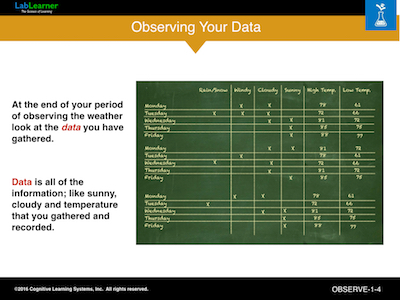
This final slide is simply included to remind the teacher to review the data collected prior to erasing the board. He or she might ask “How many times did it rain over the past three weeks?” or ‘What was the hottest day during the period that we observed the weather?”. He or she might also ask students questions about patterns in the weather over the course of the three weeks. For example, “Is there a pattern between windy days and cooler temperatures? Or sunny days and warmer temperatures?” These questions should help students tie their understanding of patterns from their Investigations to patterns in weather.
Teachers might ask whether it is easier to detect patterns when the observations are made over a longer time period. Teachers may wish to challenge students by asking, “What if we recorded the weather for an entire year? Would we see any patterns?” “How might these patterns help meteorologist forecast our weather?