
LABLEARNER PRESCHOOL:
TIME
CROSS-CURRICULAR
These investigations lay the foundation for children’s understanding time on various levels. Children will begin to understand time through the context of changes, through observations of objects before and after changes occur, and through sequences of events. As children develop, this understanding will aid them in making observations, collecting data, and sequencing events.
Science concepts for each Investigation are included in the Investigations tabs section below.
Children will begin to understand time as it relates to events and observations in their environment. This understanding will serve as a foundation for children as they broaden this understanding and later learn to use numbers to describe time in terms of hours, minutes, and seconds.
Math concepts for each Investigation are included in the Investigations tabs section below.
During these investigations, children will begin to develop a vocabulary through which they can describe their world in terms of time. Children will use terms such as first, next, and last to put the steps of a process in an order. In addition, children will use terms such as before and after when comparing objects and noting changes that have occurred. These investigations will lay the groundwork for further understanding of their environment and allow them to use language to communicate their observations.
Language Arts concepts for each Investigation are included in the Investigations tabs section below.
LEARNING MOMENTS
The Investigations included in this CELL should be implemented at times appropriate for the individual children in your classroom. In each section below is one potential idea for the context in which an Investigation could be used. These ideas are meant to provide a possible framework within which the Investigations could be implemented. You may also use these suggestions to prompt your own ideas of when the Investigations are appropriate for the children in your room.
 Schedule: Children may thrive on following a daily or weekly schedule. Discussion of such a schedule enables children to gain a beginning understanding of order of events and time.
 Cooking: When cooking or baking, children follow directions and create something different from what they used to begin. Children may observe these changes and use terms such as before and after as they develop a sense of time.
 Games: Children may be interested in playing games that involve competition of time, either performing the most quickly or the most slowly. Such games provide children with an understanding of time within the context of speed.
 Timers and Stopwatches: Although at this stage of development children have little understanding of time as a measurable segment of their lives, using timers and stopwatches helps to familiarize children with the terms hours, minutes and seconds. Setting stopwatches and timers to mark the end of an activity may help children to develop the understanding that a period of time has a beginning and end.
THE INVESTIGATIONS
Time Investigations
Pan Balance
Investigation Goal:
Children will place different objects in a pan balance and will make observations concerning the order of the placement of the objects. They will use terms such as before, after, first, then, next, and last to describe their actions. Although children may also gain knowledge of the property of weight from this activity, the primary goal of this activity is to aid children in developing a beginning understanding of time.
Investigation Summary:
During this activity children will explore sequence of events while experimenting with the pan balance.
Science Concepts:
- Comparison
- Measurement
- Observation
- Problem Solving
- Numbers
- Testing
Math Concepts
- Sequential order
- Ordinal numbers
- Qualitative/quantitative properties
- Use of manipulatives
- Comparing (non)measurable characteristics
- Greater than/less than/equal to
- Properties of weight
ELA Concepts
- Show interest in new vocabulary
- Pronounce new vocabulary
- Describe and explain details
- Communicate with peers
- Ask and answer questions
When?
Small Group Activity
Science Tools
Provide the following item for each pair of children:
- 1 pan balance
Also, provide children with various objects to manipulate, such as:
- gram (counting) bears
- paper towels
- small blocks
- tissues
Use of Science Tools
A pan balance is used to compare the weight of various objects. During this activity it will aid students in making observations about the order of events (first, next, last).
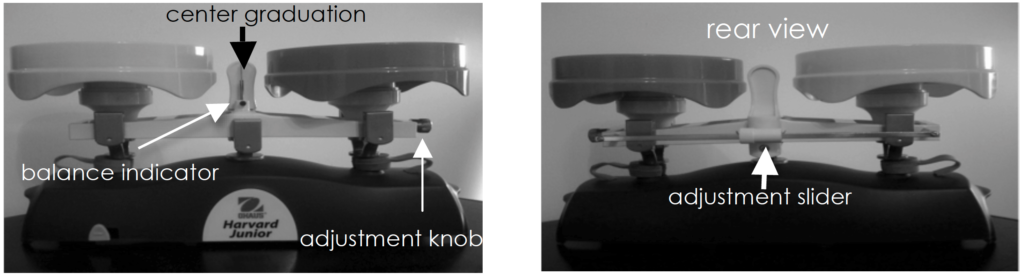
It is important that each balance be equilibrated. Look at the balance indicator and center graduation. If they are not lined up, move the adjustment knob. If they are still not aligned, move the adjustment slider either right or left to better balance the pans. Then use the adjustment knob to line up the balance indicator and center graduation line.
 Procedural Considerations
Show children a variety of objects, some lighter than others. Allow children to hold two objects and predict which is heavier.
Introduce the pan balance to the children. Tell children that the pan balance can help them find out which object is heavier. Ask children to predict how the pan balance is used.
After children have offered suggestions, demonstrate the use of the pan balance. Place a light items such as a tissue in one pan. Place a heavier item such as a medium rock in the opposite pan. Listen as children observe what happens. Encourage them to voice observations.
After one or two demonstrations, pose a question to the children. Hold an item and ask: Can you find something heavier/lighter than this? Allow children to hunt for items of various weights. Listen as children explore.
Cognitive Considerations 
- I see you placed one thing in each pan. Which item did you put in first? Which did you put in last?
✔︎ What did the balance look like before you added the _____?
✔︎ What did it look like after you added the _____?
✔︎ I have a small ball. Can I put it in your balance pan? Did the pan balance change? How did it change?
- Which object is heavier? How do you know?
- Which object is lighter? How do you know?
- This pan just moved up. I would like to make it go down. What should I do next?
- Now I want the pan to go up. What should I do next?
- Before you put this block in the pan, the pan was up high. What happened after you put the block there? Why did that happen?
Extension Activities
Large Group: Place items of various weights in the circle area. Ask individual children to place a heavy or light object in one pan of the pan balance. Ask questions similar to those in your cognitive toolbox. Who put in the first light item? Who was first person to put in a heavy object? What happened after _____ (child’s name) put in the _____? Who used the pan balance before _____?
Transition: As a child moves from one activity to the next, discuss what he or she just did. Ask: What was the last thing you did?
Transition: As children move into work time or independent play, discuss with them what they plan to do next. Ask: What is the first thing you would like to do?
Combining Substances
Investigation Goal
Children will begin to understand the importance of a record of the order of events when performing a science experiment and conducting multiple trials.
Investigation Summary
During this investigation, children will experiment using four substances: gravel, baking soda, vinegar, and water. By combining the substances, children will find which two create bubbles when placed together.
Science Concepts
- Comparison
- Cause and Effect
- Observation
Math Concepts
- Sequential order
- Volume in ml
- Ordinal numbers
- Addition
ELA Concepts
- Recognize common words
- Draw or tell about a topic or event
- Retell events
- Describe and explain details
- Communicate with peers
- Ask and answer questions
When?
Small Group Activity
Science Tools
Place the following items at each child’s place at the table:
- 1 cup filled halfway with baking soda
- 1 cup filled halfway with colored vinegar (red wine or apple cider, for example)
- 1 cup filled halfway with water
- 1 cup filled halfway with gravel
- 1 400 ml beaker
- 1 100 ml beaker
- extra cups, as needed
Label the cups containing baking soda, vinegar, water, and gravel.
Use of Science Tools
These substances will be used as children conduct multiple trials to find the two substances which, when combined, cause bubbles to form. The two beakers are used to aid in the combination of substances.
When combined, baking soda (a base) and vinegar (an acid) cause a chemical reaction due to the chemical composition and pH of each substance. However, because neither substance is a strong base nor a strong acid, neither is harmful for children to handle. The resulting bubble-generating gas is carbon dioxide, also a harmless substance.
Procedural Considerations
Briefly introduce students to the four substances in the cups, naming each substance as you point to each one. Tell children that today they will conduct a science experiment.
Tell children that two of these substances will create bubbles when combined. Ask: Which two of these do you think will make bubbles?
Allow children to explore the substances by creating varying combinations. Soon after they begin combining, ask: Which two substances did you try first?
As children continue, ask questions from the Cognitive Toolbox which assess their understanding of the sequence in which they are combining the substances.
Cognitive Considerations
Suggestions for Conversation
✔︎ (Ask the following question soon after children begin combining.) Which two substances did you try first?
- Which substance did you add to the water first?
✔︎ What happened after you added the _____ to the _____?
- What happens when you put the baking soda in the cup first?
- It looks like bubbles formed. How did you make them form?
- I see that you added baking soda to water. What will you do next?
- (Ask the following question immediately after the children have ended their exploration.) What was the last thing you did in your science experiment?
Extension Activities
Work Time: Provide children with these substances and others to investigate during work time. Appropriate substances may include vinegar, water, baking soda, sand, sugar, salt, and pepper. Allow children to mix the substances and observe how the substances interact. If possible, converse with children to encourage the use of the terms before, after, next, and last.
Large Group: Create a schedule of daily events in the front of the room. At the beginning of the day, go over the events in the order in which they will occur. As you review the schedule, use words like first, next, then, later and last.
Colored Liquids
Investigation Goal
This activity will guide children to an understanding of time as it relates to speed, using terms such as fast and slow. In addition, children will practice ordering and serialization while describing their actions in terms of first, last, next and then.
Investigation Summary
During this investigation, children will color water using food coloring. They will think of and test ways to mix the color quickly and to mix it slowly. In addition, they will combine colors to create colors such as purple or orange.
Science Concepts
- Cause and Effect
- Sequencing
- Observation
- Comparison
- Properties of Matter
Math Concepts
- Sequential order
- Time in terms of speed
- Volume in ml
- Qualitative/quantitative properties
- Problem solving
- Least to greatest
ELA Concepts
- Recognize common words
- Draw or tell about a topic or event
- Retell events
- Describe and explain details
- Communicate with peers
- Ask and answer questions
When?
Large Group Activity
Scientific Tools
Place the following items at the large group activity area:
- 1 box of food coloring, including red, blue, yellow, and green coloring
- 8 400 ml beakers filled with 200 ml of water
- spoons or straws for stirring
Use of Scientific Tools
Beakers and other graduated containers are often used to hold liquids during scientific exploration.
Procedural Considerations
Begin the activity by telling children that they will investigate water. Show children a beaker of water and ask: What do you know about this water? Children may comment on its wetness, color, or other properties.
Tell students that they are going to solve a problem. Ask: How can we make this water colored? Allow children to direct the exploration. After they suggest food coloring, add one drop to the water in a beaker. Watch as it disperses in the water. Ask: How can we make it mix faster? Listen as children make suggestions, such as stirring the water or rotating the beaker. Ask: How can we make it mix more slowly?
Continue the exploration by suggesting different colors of water such as purple or orange which may involve combining colors. Allow children to guide the exploration of color, following their suggestions for color combinations.
Cognitive Considerations
Suggestions for Conversation
- How can we make the food coloring move faster?
✔︎ When did the color mix slowly? When we just watched or when we stirred?
- What happens to the color when we stir?
✔︎ Now the water is _____ (name of color). How did we make it _____ (name of color)?
- What was the color of the water at the beginning?
- What did we do first to color the water?
- What color should we add next? Why do you think that would be a good choice?
- Let’s make this beaker of water the color of _____’s shirt. How can we do that?
- (Ask the following question immediately after the children have ended their exploration.) What was the color of the water at the end of the science experiment?
Extension Activities:
Large Group/Small Group: Make a snack or a food for lunch. Follow a simple recipe, bringing children’s attention to the steps followed in the process. If possible, follow a recipe with steps that must be performed in a certain order. For example, make a mini-pizza by putting cheese on an English muffin followed by pizza sauce, or decorate cookies by attempting to put on sprinkles before icing. Allow children to correct you and emphasize the importance of following ordered directions.
Work Time: Watch as children play at the sand table. Ask: How can we dig that hole in the sand quickly? How can we dig it slowly? If using a water table, ask: What tool can we use to pour the water slowly? How can we pour quickly? After asking these questions, initiate an “opposite race.” Fill two beakers and see who can pour the sand or water from the beaker most slowly.
Pouring Sand
Investigation Goal
Through this investigation, children will gain an understanding of rate and speed. Children will use terms such as fast, quickly, slow and moderate (or medium) as they pour.
Investigation Summary
During this activity, children will practice pouring sand quickly, slowly, and at a moderate pace. They will participate in various games created to encourage the use and understanding of vocabulary pertaining to rate.
Science Concepts
- Sequencing
- Observation
- Comparison
- Rate
Math Concepts
- Sequential order
- Rate/speed
- Least to greatest
- Volume in ml
- Ordinal numbers
ELA Concepts
- Recognize common words
- Draw or tell about a topic or event
- Describe and explain details
- Communicate with peers
- Ask and answer questions
When?
Small Group Activity
Science Tools
Place the following item at each child’s place at the table:
- 1 plastic container
Place the following within the container:
- 1 400 ml beaker
1 100 ml beaker filled to the 80 ml line with sand (or water, if sand is unavailable
Place the following at the table for teacher use:
- 1 stopwatch or timer
Use of Science Tools
Beakers and other graduated containers are often used to hold and pour liquids and some solids during scientific exploration.
Procedural Considerations
Tell children that during this activity they are going to play a game. They will pour sand from one beaker to the other. Allow all children to pour the sand from the 100 ml beaker to the 400 ml beaker.
Instruct the students to watch you as your pour the sand. Pour once at a moderate rate. Ask them to keep watching as you pour the sand again, this time quickly. Ask: How did I pour differently the second time?
Initiate various pouring games based on rate. Prepare children to pour, then say fast, slow or moderate (medium). Children should pour as you direct. Allow children to take turns being the caller.
Play a copying game. Ask children to watch you as you pour and try to pour their sand at the same rate that you are pouring. Pour fast, slowly, and at a moderate (medium) rate. Allow children to take turns being the leader. After each turn pouring, ask a child whether the pour was fast, slow, or moderate (medium).
Cognitive Considerations
Suggestions for Discussion
- Did we both pour at the same rate (the same way)?
✔︎ Can you show me how to pour slowly?
✔︎ Can you show me how to pour quickly?
✔︎ How did I/you pour differently the second time?
- What if you didn’t want to spill any sand? How would you pour? Why?
- What if you pour the sand slowly while holding your beaker high? What happens to the sand?
- What if you pour the sand slowly while holding your beaker low? What happens to the sand?
- When it rains, water falls from the clouds. What would it feel like if sand fell from the sky?
Extension Activities
Large Group/Outdoor Play: Encourage children to play running games similar to the pouring games. Ask a child to be the leader and call out the speed at which children should run. Children may use the terms fast, slow, and moderate (or medium).
Large Group: Play a variety of music samples for the class. As a song is played, ask one children to say aloud whether the song seems fast, slow, or moderate. After the child responds, allow children to dance or move in place quickly, slowly, or at a moderate pace.