Teacher Portal:
Exploring Density
Performance Assessment – Lab
 BE PREPARED
Materials
Class materials:
- 2 liter pitchers
- 1800 ml water
- 450 g salt
- 1 1000 ml graduated cylinder
- 1 glass stir rod
- 1 triple beam balance
- 1 weigh dish
- 2 400 ml beakers
- 2 100 ml graduated cylinders
- 40 gram cubes
- 1 roll of masking tape
- 1 marker
Group materials
- 2 400 ml beakers
- 1 acrylic cylinder
- 1 rubber stopper, size 00
- 1 triple beam balance
- 1 100 ml graduated cylinder
- 1 metric ruler
- Paper towels
Individual materials
- 1 Scientist Data Record
TEACHER PREPARATION
1. Create the water station.
a. Fill a liter pitcher with 1 L of water. Label the liter pitcher “Liquid A.”
b. Make a salt solution:
-
- Fill a liter pitcher with 800 ml of water.
- Add 450 g of salt to the pitcher. This can be approximated by filling a 1000 ml graduated cylinder up to the 360 ml mark with salt.
- Stir until the salt is completely dissolved.
- If necessary, bring the volume of the solution to 1 liter by adding additional water.
- Label the liter pitcher “Liquid B.”
c. Place Liquid A, Liquid B, one (1) triple beam balance, two (2) 400 ml beakers, and two (2) 100 ml graduated cylinders in one location that is designated as the “water station.”
2. Snap four gram cubes into a two by two rectangle for each group.
3. Write the formula for density (density = mass ÷ volume) on the board or at another central location in the room.
4. Place the required materials at a distribution point.
5. Separate the class into groups of three students.
INSTRUCTION
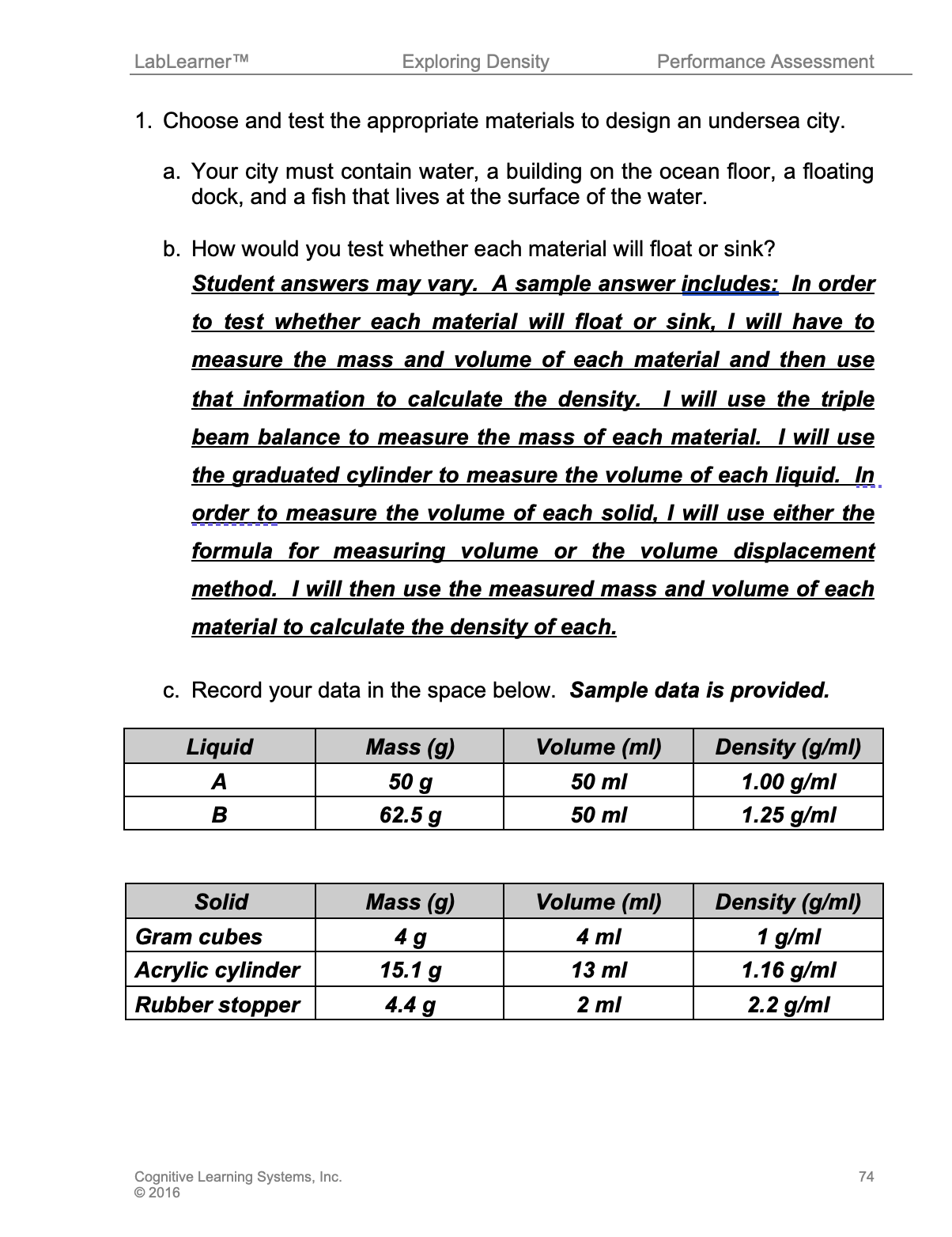
1. Direct students to use the materials available to them at the distribution point to participate in this performance assessment: two (2) 400 ml beakers, one (1) acrylic cylinder, one (1) rubber stopper, size 00, one (1) triple beam balance, one (1) 100 ml graduated cylinder, one (1) metric ruler, one (1) 2 × 2 square of gram cubes, and paper towels.
PROCEDURE
1. Begin the Performance Assessment by either reading the opening paragraph from the Student Data Record aloud or encouraging students to read the paragraph independently. Briefly review the contents of the paragraph and outline the goals of this project to the class. Read aloud the goals from the list on the Student Data Record.
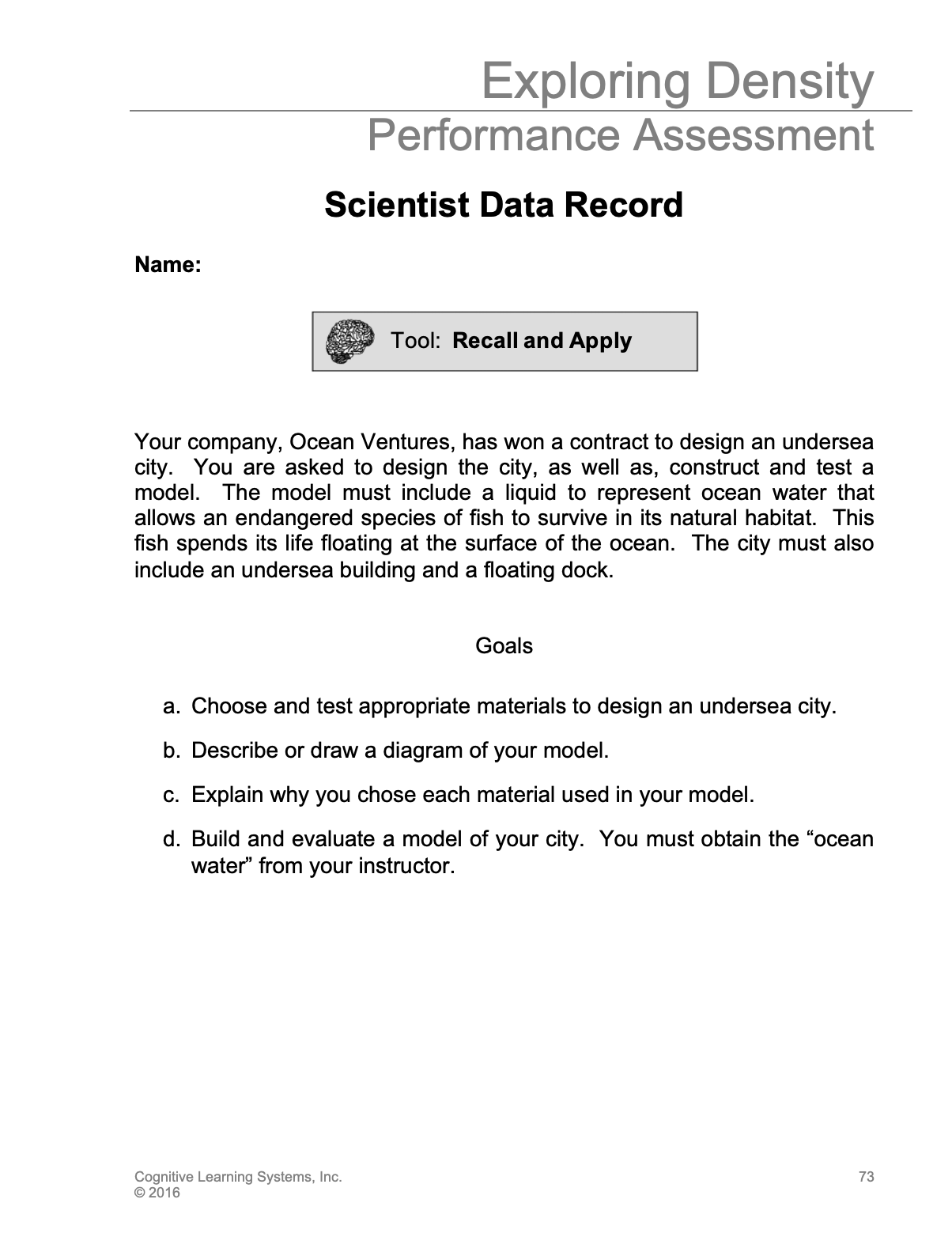
Your company, Ocean Ventures, has won a contract to design an undersea city. You are asked to design the city, as well as, construct and test a model. The model must include a liquid to represent ocean water that allows an endangered species of fish to survive in its natural habitat. This fish spends its life floating at the surface of the ocean. The city must also include an undersea building and a floating dock.
Goals
- Choose and test appropriate materials to design an undersea city.
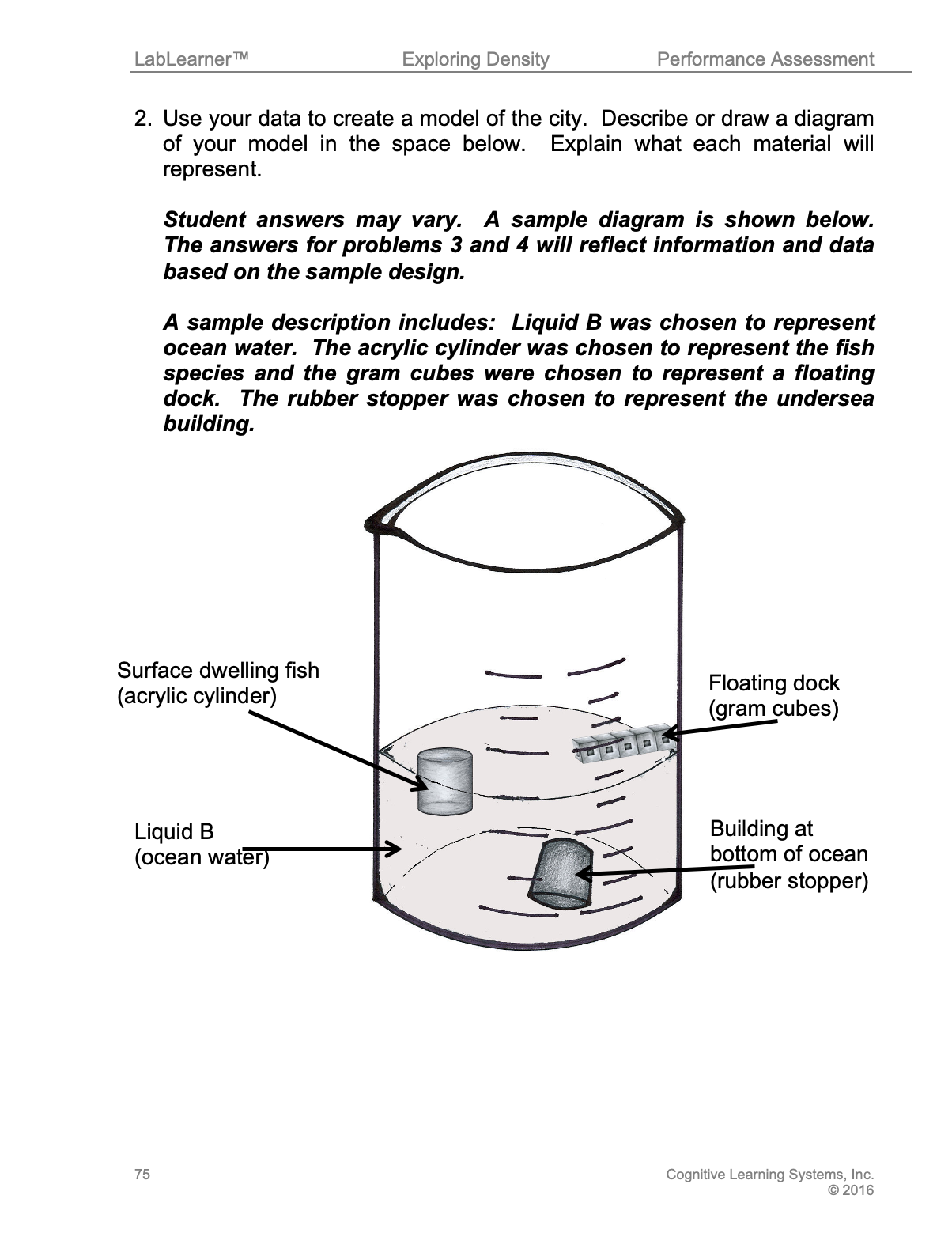
- Describe or draw a diagram of your model.
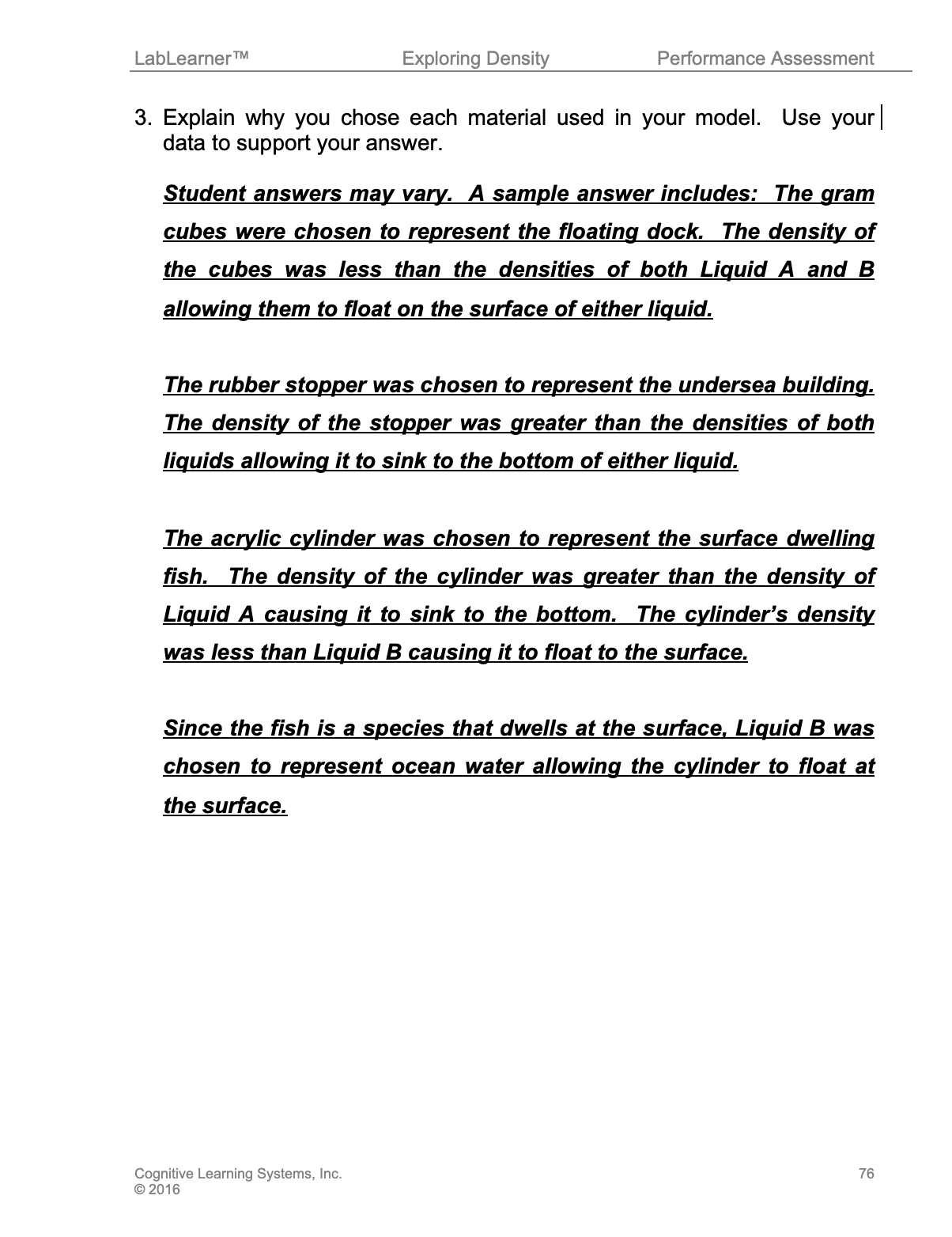
- Explain why you chose each material used in your model.
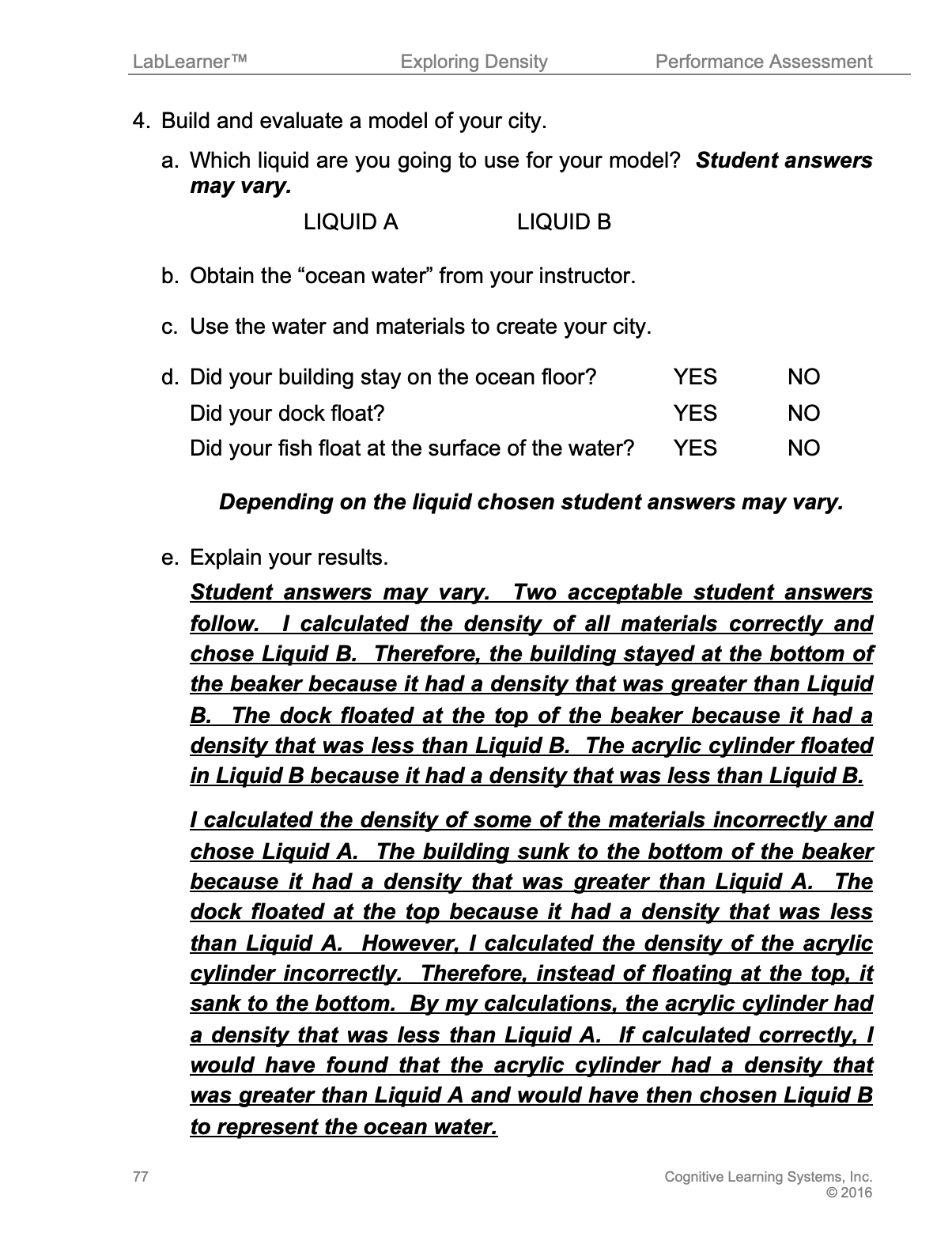
- Build and evaluate a model of your city. You must obtain the “ocean water” from your instructor.
2. Before students begin the Investigation, they should walk through the four steps in the project. Encourage students to be creative and draw on their understanding of density from the first five Investigations.
3. Explain to students that a portion of goal 1 is set-up as a station. Student groups will rotate through the station at the instructor’s direction. If students come to this portion of goal 1 before reaching the station, they should skip this portion and move on to the next goal of the Performance Assessment.
4. In order for students to complete Goal #4, they will need to decide which liquid they are going to use for their model. The students should approach the instructor for 100 ml of the chosen liquid when they reach Problem 4b of their Student Data Record.
5. Allow students to complete their Performance Assessments. You may wish to informally or formally evaluate students as they work on their Performance Assessments. An evaluation rubric for the performance assessment has been provided to aid in the evaluation process.
6. Upon completion of the project, permit enough time to clean up the lab and return the materials and equipment to their assigned location.
CLEAN UP
Let students know your expectations and instruct them to clean up their lab bench after the Performance Assessment.
KEYS: PERFORMANCE ASSESSMENT