Teacher Portal:
Exploring Density
Investigation 4 – PreLab
 PRINT IT
Use your browser to download a printable PDF as help during the slide presentation and to make additional notes. In your browser, go to File > Print and then choose to save as PDF.
MINDSET
This Investigation is designed to:
- demonstrate that different solids possess constant, but differing, densities.
- reinforce the concept that because the density of a single type of matter is constant, changing the mass or volume does not affect the density.
- provide students with an opportunity to calculate the density of solids in two ways: the formula for calculating volume and the volume displacement method.
- allow students to discover whether or not the density of a solid can be measured by using the formula for volume or the volume displacement method is dependent on the unique properties of that solid.
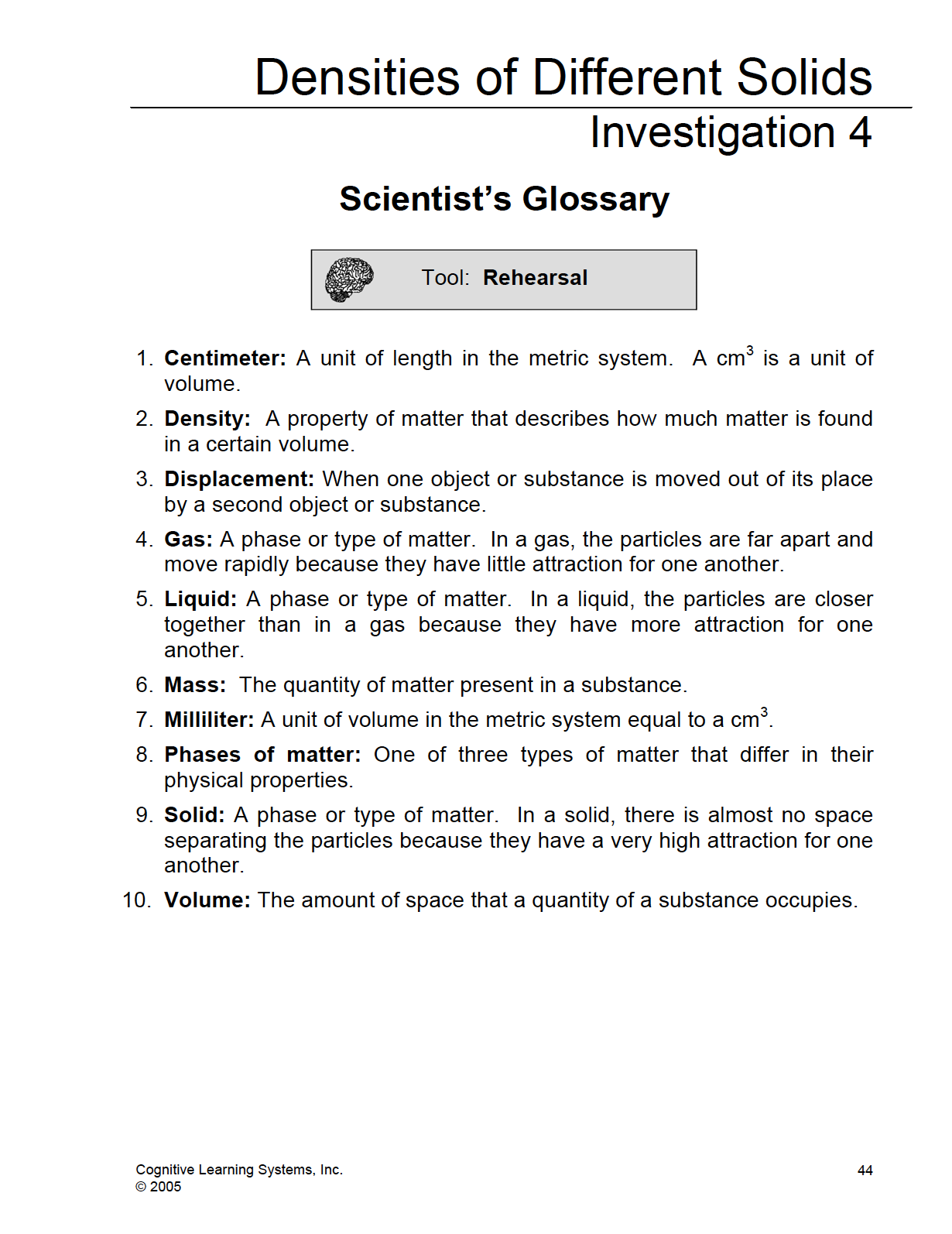
SCIENTIST’S GLOSSARY
1. Centimeter: A unit of length in the metric system. There are 100 centimeters in a meter. A cm3 is a unit of volume.
2. Density: A property of matter that describes how much matter is found in a certain volume.
3. Displacement: When one object or substance is moved out of its place by a second object or substance.
4. Gas: A phase of matter in which particles are far apart and moving rapidly because they have little attraction for one another.
5. Liquid: A phase of matter in which the particles are closer together than in a gas because they have more attraction for one another.
6. Mass: The quantity of matter present in a substance.
7. Milliliter: A unit of volume in the metric system that is equal to one cm3.
8. Phases of Matter: The four types of matter that differ in their physical properties.
9. Solid: A phase of matter in which there is almost no space separating the particles because of the very high attraction for one another.
10. Volume: The amount of space that a quantity of a substance occupies.
BE PREPARED
Watch the Investigation 4 Teacher Video and Student Video below to prepare for the PreLab.
SET FOR SUCCESS
- Tell students that they will continue working on the Exploring Density CELL.
- Ask students to share the kinds of things they might learn in these Investigations.
Begin the PreLab Concept Slides to start students on their learning journey. Then watch the Pre-Lab Student Video afterward as a class.
NAVIGATE IT
Once the slide presentation is launched
- use your left and right arrows to advance or go back in the slide presentation, and
- hover your mouse over the left edge of the presentation to get a view of the thumbnails for all the slides so that you can quickly move anywhere in the presentation.
- Click HERE to launch the slide presentation for the CELL.
SHARE IT
SLIDE DEN4-pre-1
This is the fourth Investigation of the LabLearner CELL Density. In this Investigation, students will determine the densities of several different solids. They will use both mathematic formulas and volume displacement methods to determine volume.
______________________________________________
SLIDE DEN4-pre-2
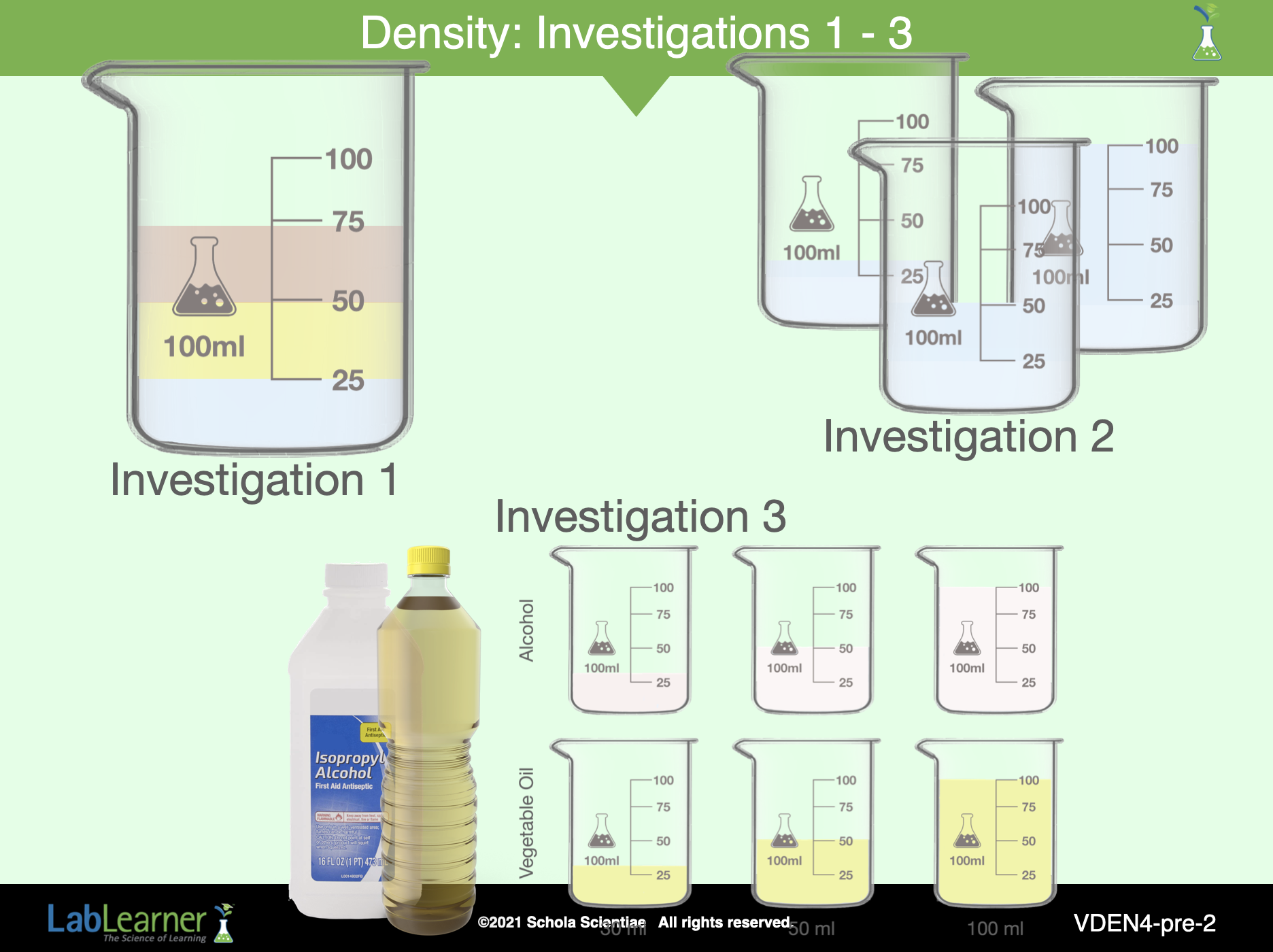
A. Begin the Investigation by encouraging students to recall what they discovered about density in the previous three Investigations. Pose the following questions to prompt student discussion:
1. Ask students: Which property of solids and liquids have you been investigating? Students should indicate that they have been investigating density.
2. Ask students: What are some of the ways you have determined the density of solids and liquids? In Investigation One, students determined the density of liquids by combining two different liquids together. They found that the less dense liquid floated on the surface of the liquid with the greater density. Students also combined solids and liquids together in this Investigation. They found that if a solid had a greater density than the liquid, the solid sank to the bottom of the liquid. If the solid was less dense than the liquid, it floated. In Investigation Two, a volume of water was measured and the mass of the volume was determined. The density was then calculated by dividing the mass by the volume. In Investigation Three, students determined the density of rubbing alcohol and vegetable oil. The volume of each liquid was measured and the mass of the volume was determined. The density was then calculated by dividing the mass by the volume.
3. Ask students: Which two factors affect density? Students should indicate that mass and volume affect density. As the volume of a substance is increased or decreased, the mass of the substance increases or decreases by the same magnitude. The ratio of mass to volume, the density, is unchanged.
______________________________________________
SLIDE DEN4-pre-3
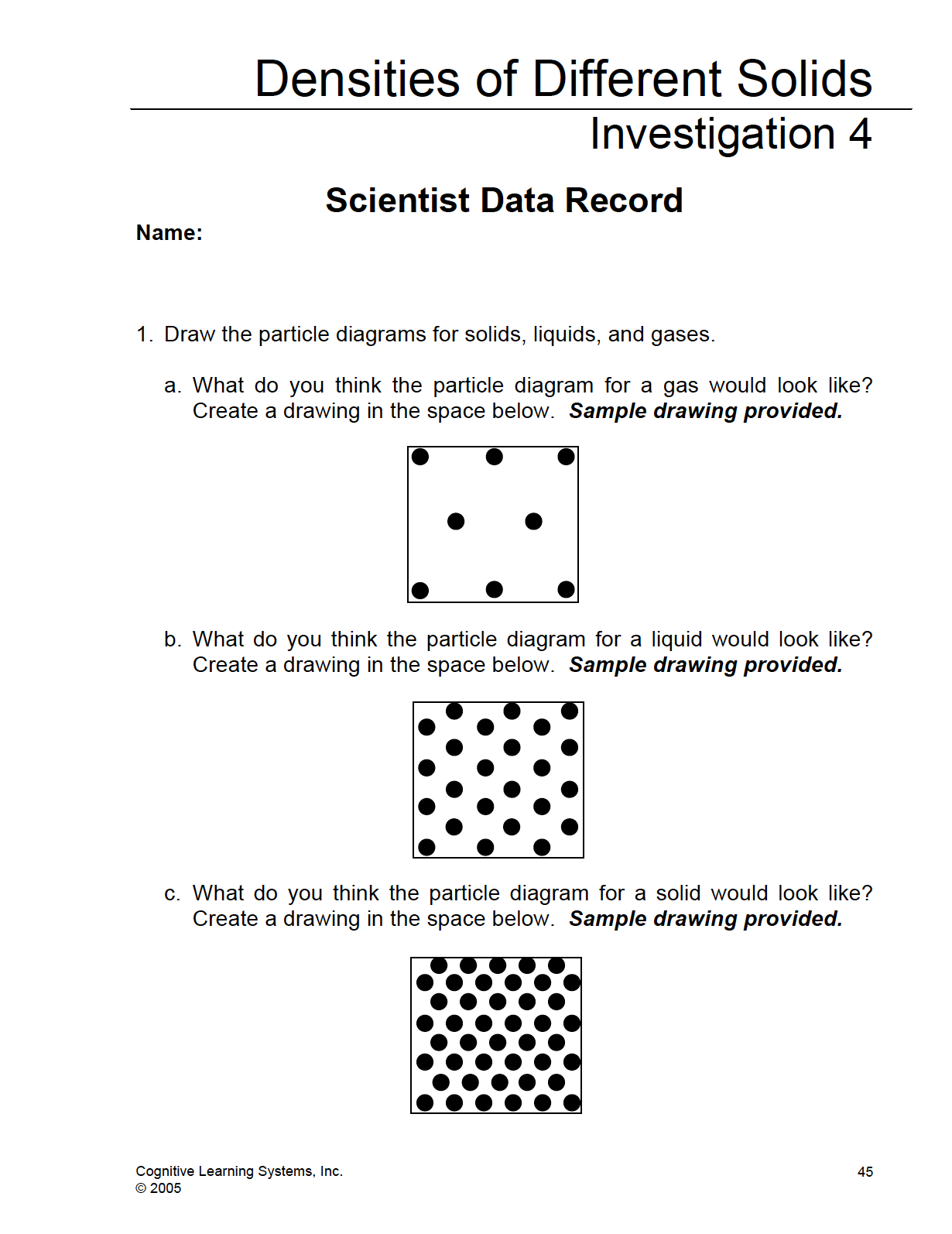
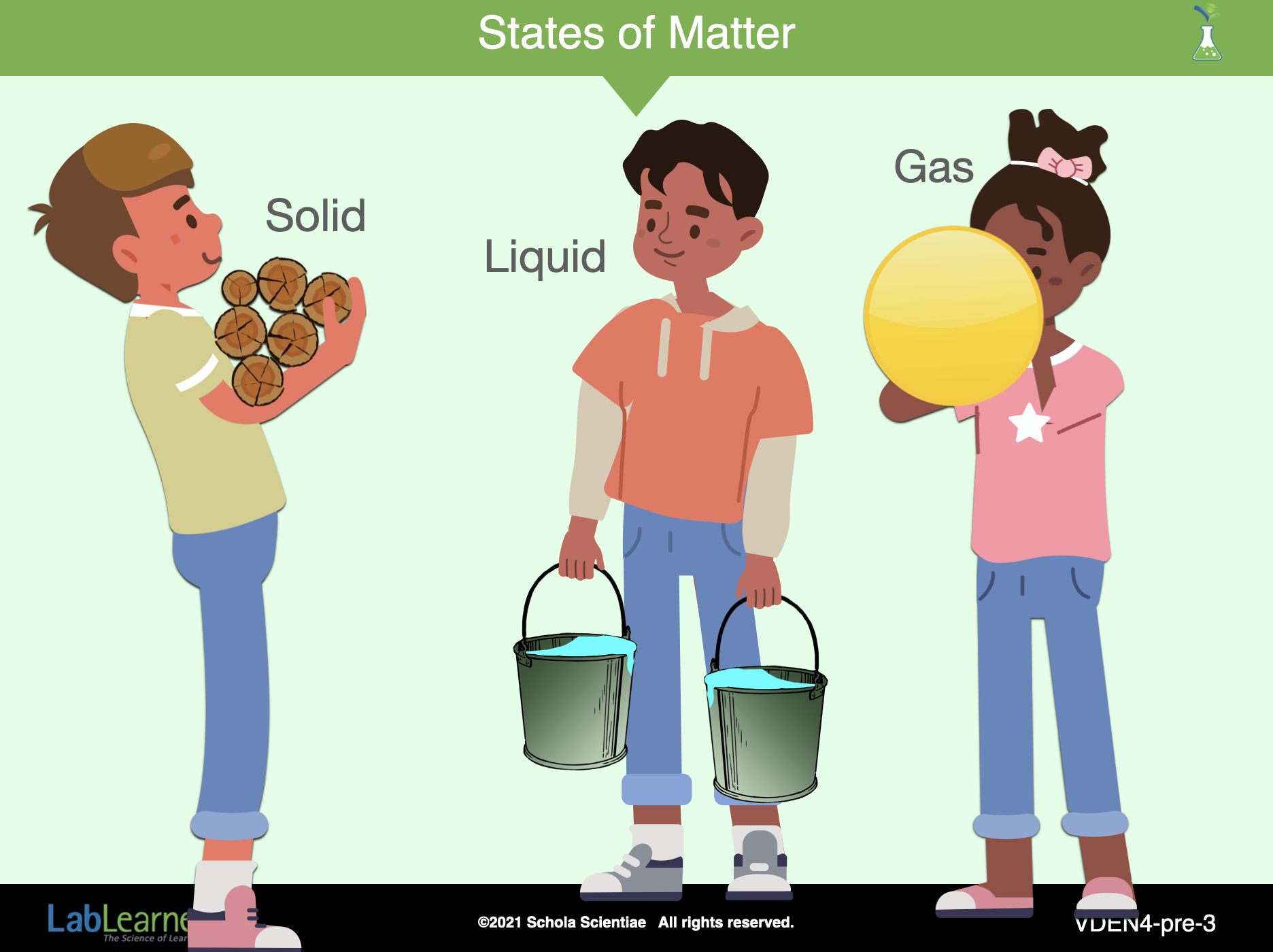
B. Continue this Investigation by broadening the discussion to include the three states of matter: gases, liquids, and solids. To facilitate discussion, divide the class into groups, and allow students to brainstorm as each question is asked. As each state is discussed, encourage students to predict what each particle diagram will look like for gases, liquids, and solids.
1. Initiate a discussion with students about some of the characteristics, or properties, of each of the three states of matter.
a. Ask students: What are some of the characteristics of gases? Student answers may vary. Students may describe gases as being light, transparent, or weightless.
b. Ask students: What are some of the characteristics of liquids? Student answers may vary. Students may describe liquids as wet, runny, and being able to spread and flow without a definite shape.
c. Ask students: What are some of the characteristics of solids? Student answers may vary. Students may describe solids as hard with a definite shape.
d. Ask students: Do you think gases have density? Student answers may vary.
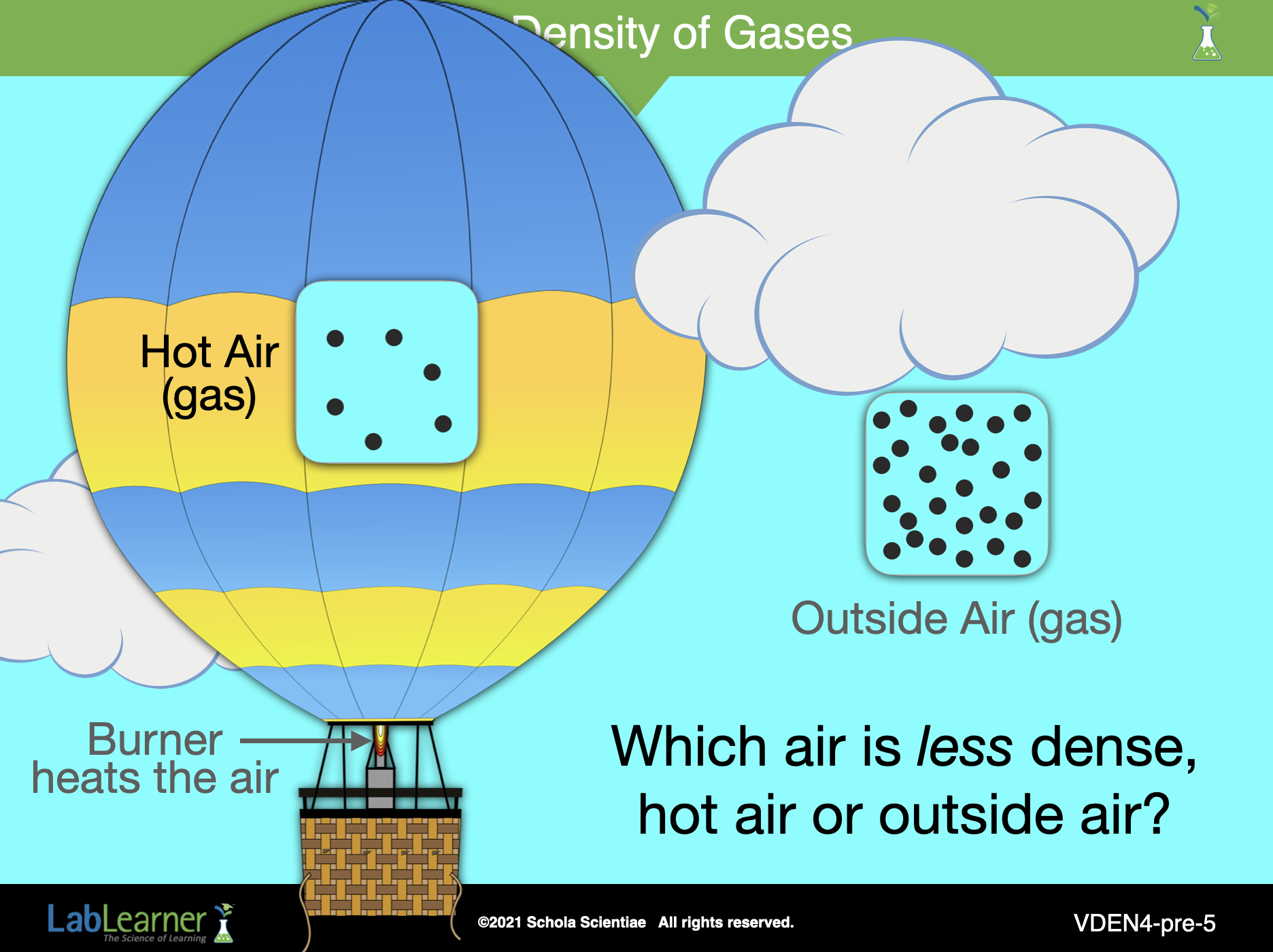
Encourage students to realize that gases have density because all matter has the property of density. You can also talk about the different densities of air at different temperatures, like a hot air balloon or cool air sinking to the basement and warm air floating upstairs or to the attic.
e. Ask students: Do you think liquids have density? Student answers may vary. Encourage students to realize that, as shown in Investigations Two and Three, liquids have density.
f. Ask students: Do you think solids have density? Student answers may vary. Encourage students to realize that, as shown in Investigation One, solids have density (metal cube in water).
______________________________________________
SLIDE DEN4-pre-4
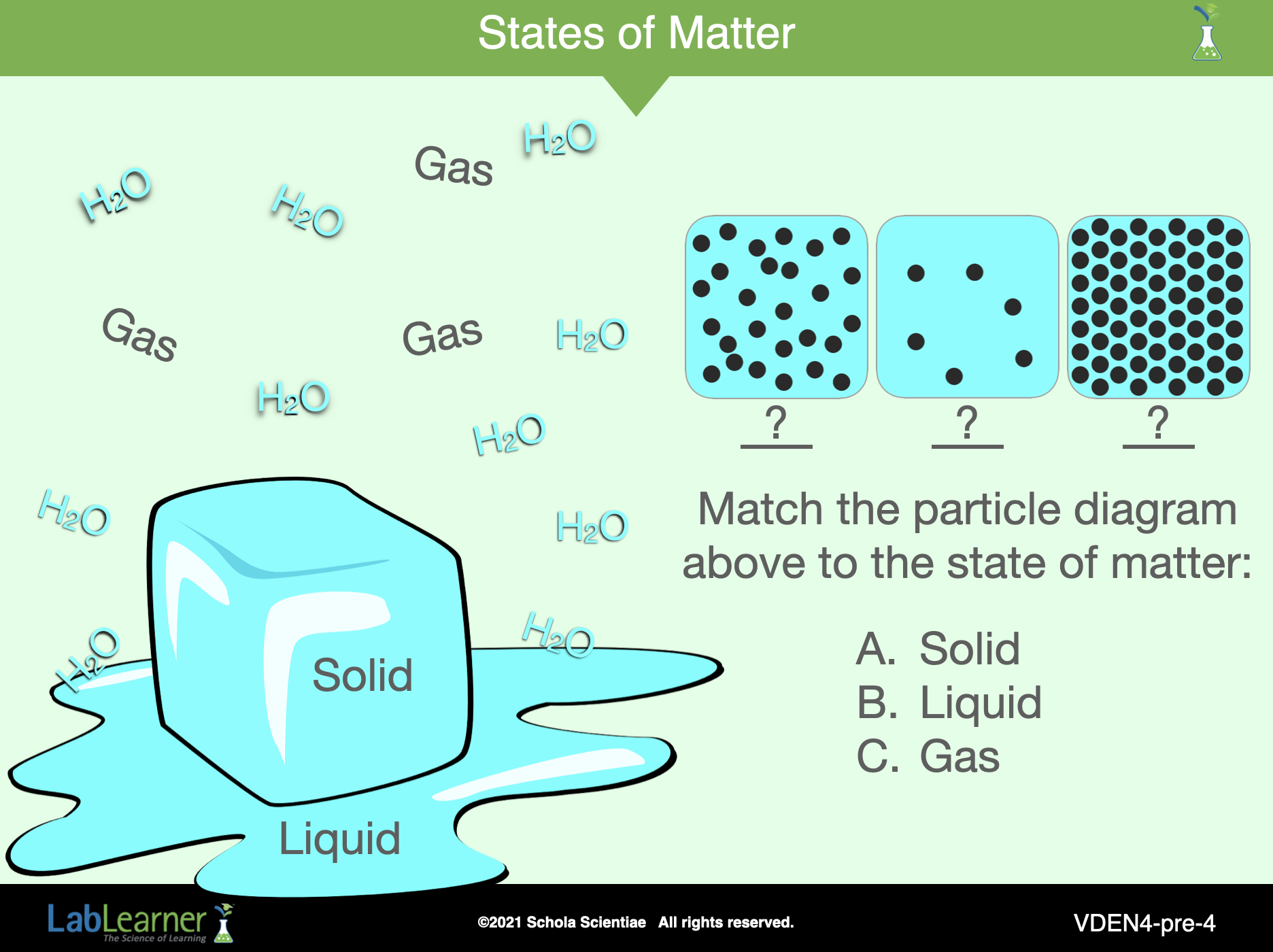
2. Explain to students that the amount of space between the particles in the three states of matter determines each of their densities. Ask students to predict the arrangement of the particles that compose all three states of matter.
a. Ask students: Of the three states of matter, which do you think has the highest density? The lowest density? Student answers may vary.
b. Ask students: Think about the characteristics of gases. Do you think that the particles that compose gases are close together or far apart? Student answers may vary. Ask students to draw what the particle diagram for a gas would look like.
Encourage students to draw their diagram in Problem 1a of their Student Data Record.
c. Ask students: Think about the characteristics of liquids. Do you think that the particles that compose gases are close together or far apart? Student answers may vary.
Ask students to draw what the particle diagram for a liquid would look like and encourage students to draw their diagram in Problem 1b of their Student Data Record.
______________________________________________
SLIDE DEN4-pre-5
3. Ask students to begin to think about how they would determine the densities of gases, liquids, and solids.
a. Ask students: In Investigations Two and Three, how did you measure the density of liquids? Student answers may vary. Students should indicate that they poured the liquids into a graduated cylinder to measure volume and then determined the mass of the liquid in the graduated cylinder. Density was calculated by dividing the mass by the volume.
b. Ask students: Do you think that you can measure the density of a gas? How do you think you could do it? Student answers may vary. Encourage students to think about how the mass and volume of a gas could be calculated. An example would be as follows: A balloon of known mass is filled with the gas. The mass of the balloon and the gas is determined and the mass of the empty balloon is subtracted to yield the mass of the gas. The density is then calculated by dividing the mass by the volume of the balloon.
c. Ask students: Do you think that the density of a solid can be measured? How do you think you could do it? Student answers may vary. Students should indicate that they would need to measure the mass and volume of the solid.
______________________________________________
SLIDE DEN4-pre-6
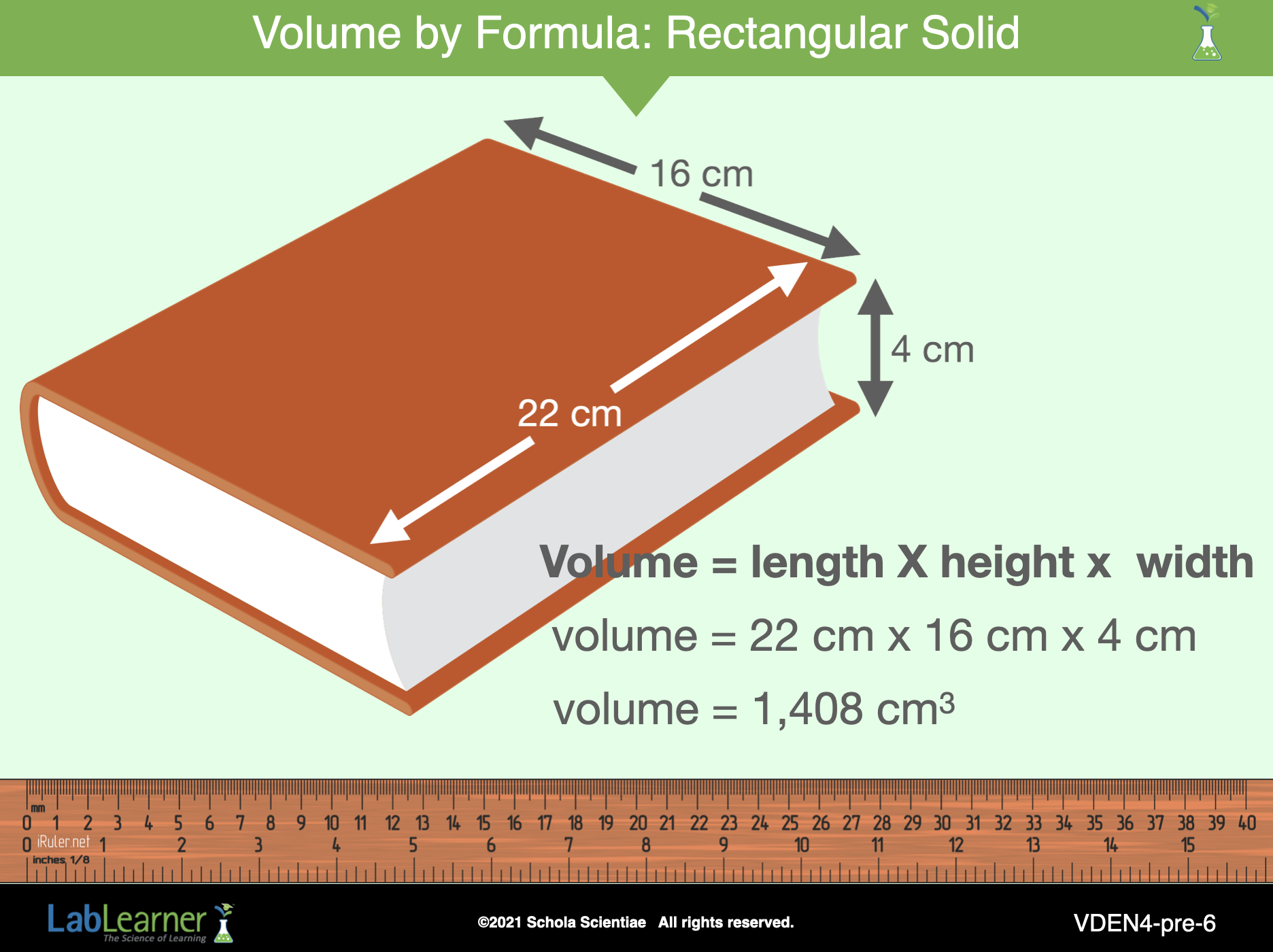
Note: The length, width and height of the rectangular solid book on the slide may be different than the one measured in class. Use these dimensions as practice.
C. Begin a discussion of how the volume of a solid can be determined. Tell students that measuring the volume of a solid can be done in two different ways.
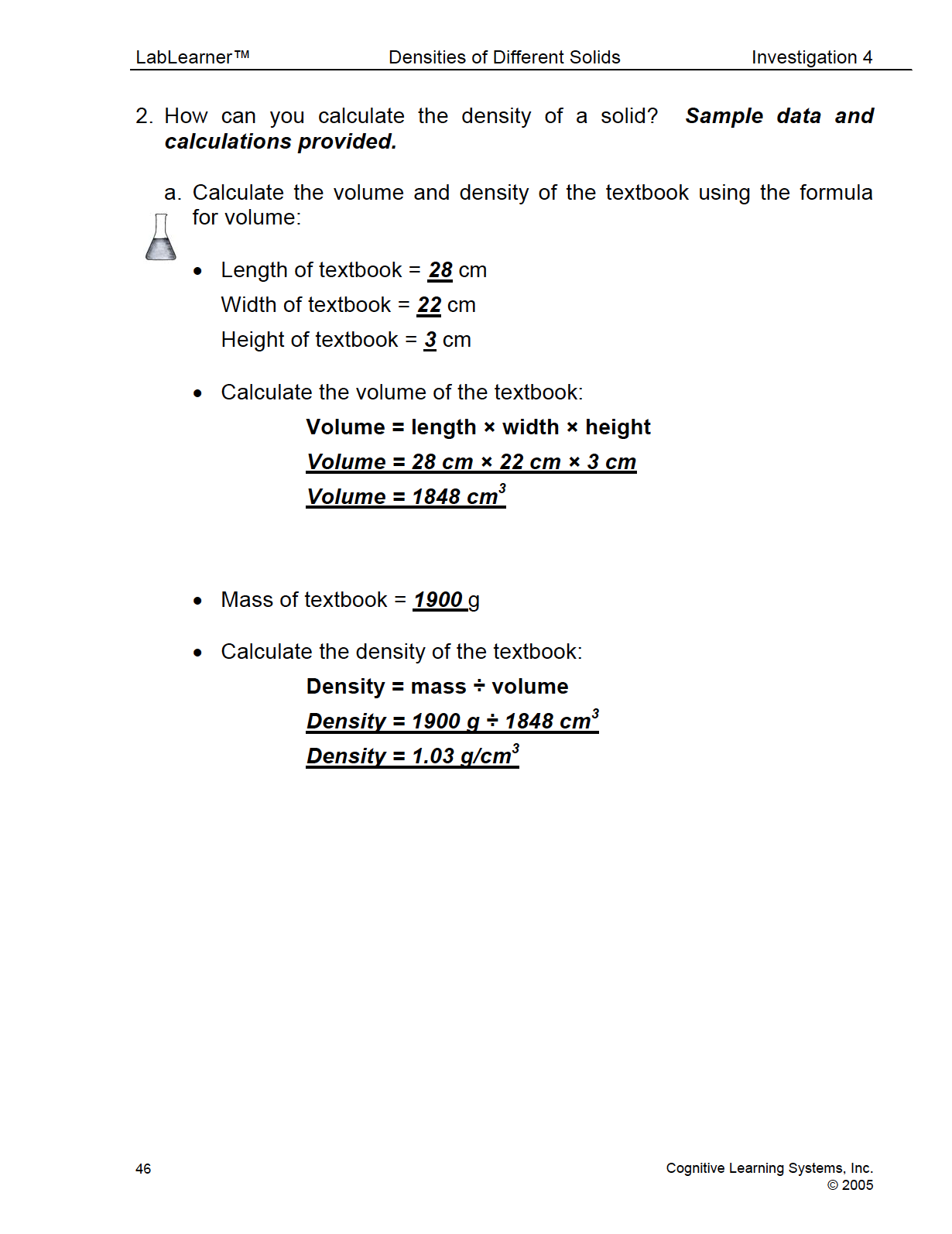
1. Explain to students that the first method to measure the volume of a solid uses a tool from the Procedural Toolbox called Determination of Volume Using a Mathematical Formula. The formula uses three dimensions of the solid object. Since solid objects may have different shapes (rectangular, spherical, triangular), their dimensions will be different. This may require that each differently shaped solid object have a different formula.
a. Show students a textbook. Explain that an object, such as a textbook, can be identified as a rectangular solid because of its shape. The shape of a rectangular solid or similarly shaped object is determined by sides that are parallel to each other.
• Ask students: What three dimensions determine the shape of a rectangular solid? Students should indicate that a rectangular solid is determined by length, height, width. Encourage students to realize that in the metric system, each of the three dimensions can be measured in centimeters.
• Ask students: How would you find the volume of a rectangular solid? Student answers may vary. Students should indicate that the volume of a rectangular solid or similarly shaped object can be determined by multiplying the three dimensions together: length (cm) × width (cm) × height (cm).
• Ask a student volunteer to use a metric ruler to measure the three dimensions of a textbook in centimeters. Write the three dimensions on the board including the units of centimeter (cm).
Encourage students to copy the dimensions in Problem 2a of their Student Data Record.
• Ask students to multiply the three dimensions in Problem 2a. Tell students that the units used to derive the volume of the book are cm3.
• Ask students: Do you think you could use this information to help you calculate the density of this textbook? Do you need any additional information to calculate the density? Students should indicate that the volume that they calculated could be applied to the formula for density, density = mass ÷ volume. However, in order to calculate the density, they would need to know the mass of the textbook. For the purpose of this problem, tell students that the textbook has a mass of 1.9 kg or 1900 g.
• Encourage students to complete Problem 2a of their Student Data Record.
______________________________________________
SLIDE DEN4-pre-7
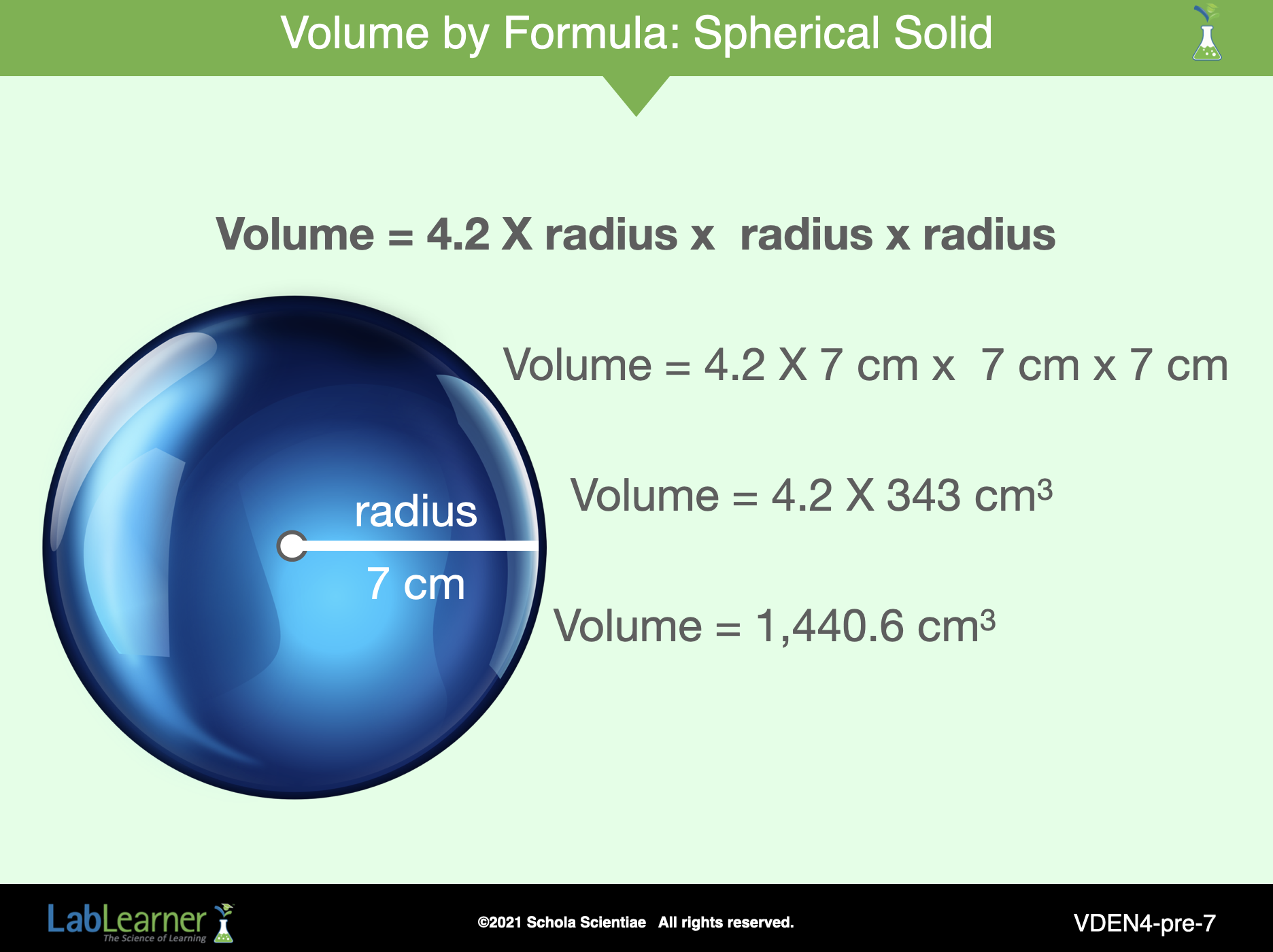
Note: The radius of the sphere on the slide may be different than the one measured in class. Use these dimensions as practice.
b. Tell students that they will have to determine the volume of a sphere in this investigation. Use a ball as an example of a sphere.
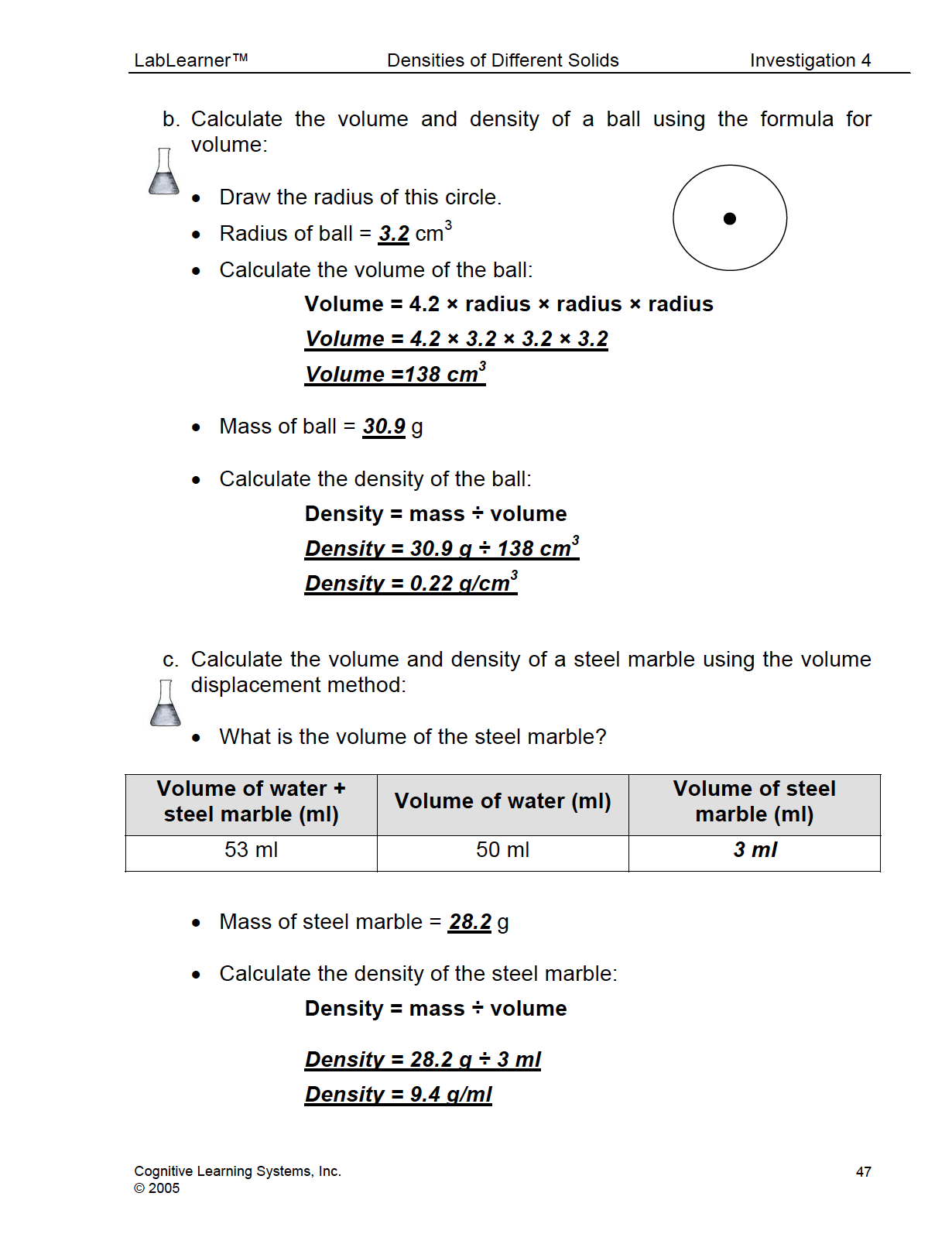
• Explain to students that in order to calculate the volume of a sphere, they will have to use the formula:
Volume of sphere = 4.2 × radius × radius × radius.
• Draw a circle on the board. Place a dot in the center of the circle. Ask a student volunteer to come to the board and indicate how to find the radius of the circle.
Encourage students to draw the radius on the circle in Problem 2b of their Student Data Record.
• Ask students: How would you measure the radius of a sphere? Student answers may vary. Students should indicate that they could use a ruler to measure from one edge of the sphere into the center.
• Ask a student volunteer to use a metric ruler to measure the radius of the ball. Write the measurement on the board including the units of centimeter (cm). Encourage students to copy the dimensions in Problem 2b of their Student Data Record.
• Ask students to use the radius of the ball to calculate the volume of the ball in Problem 2b. Tell students that the units used to derive the volume of the ball are cm3.
• Ask students: Do you think you could use this information to help you calculate the density of this ball? Do you need any additional information to calculate density? Students should indicate that the volume that they calculated could be applied to the formula for density, density = mass ÷ volume. However, in order to calculate the density, they would need to know the mass of the ball. For the purpose of this problem, tell students that the mass of the ball is 30.9 g.
• Encourage students to complete Problem 2b of their Student Data Record.
______________________________________________
SLIDE DEN4-pre-8
2. Tell students that the second method of determining the volume of a solid object uses a tool from the Procedural Toolbox called Determination of Volume Using the Volume Displacement Method.
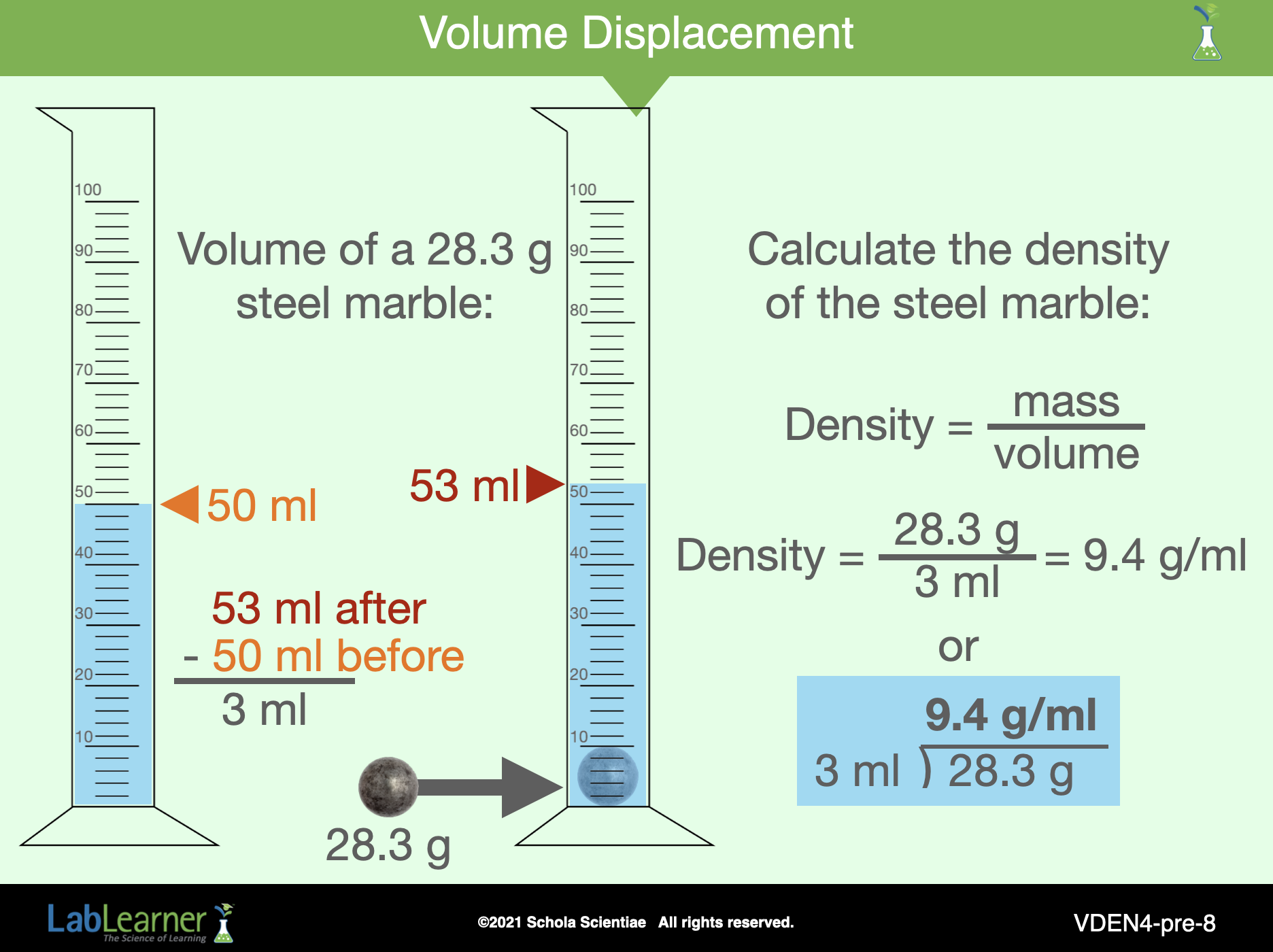
a. Explain to students that in this method, a solid object, such as a steel marble, is added to a graduated cylinder that contains a known volume of water.
b. Ask students: What do you think will happen to the level of the water after the steel marble is added?
Student answers may vary. Encourage students to realize that the steel marble displaces the water and raises the level of the water in the graduated cylinder so it appears that the volume of the water has increased.
c. The increase in the water volume is equal to the volume of the solid object.
d. Draw a diagram of a graduated cylinder on the board to show this concept.
e. Tell students to locate the Table in Problem 2c of their Student Data Record. This Table contains data for the volume of a steel marble using the volume displacement method. Encourage students to calculate the volume of the steel marble.
f. Ask students: After you determine the volume of the steel marble, do you think you could use this information to help you calculate the density of the steel marble? Students should indicate that the volume they calculate could be applied to the formula for density, density = mass ÷ volume. However, in order to calculate the density, they would need to know the mass of the steel marble. For the purpose of this problem, tell students that the mass of the steel marble is 28.2 g.
g. Encourage students to complete Problem 2c of their Student Data Record.
h. Explain to students that when using the volume displacement method, volume is expressed as milliliter (ml). When using the formula for calculating volume, volume is expressed as cubic centimeter (cm3). In the metric system, ml and cm3 are the same when measuring volume.
______________________________________________
SLIDE DEN4-pre-9
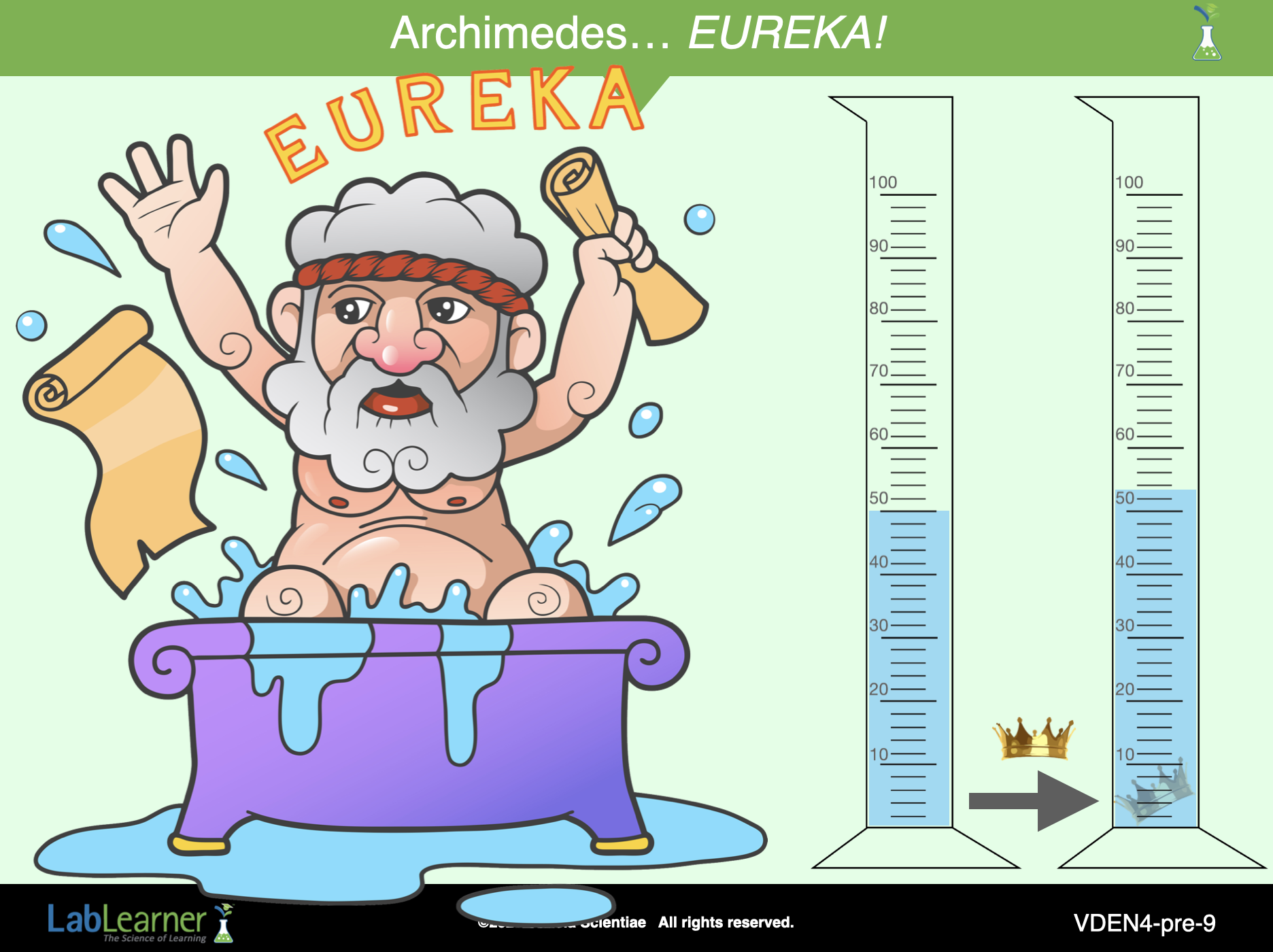
Archimedes
Archimedes was a scientist who lived in Greece around 300BC. A story goes that he was assigned a problem to solve by the King. Archimedes had to determine the volume of an irregularly-shaped solid object (the King’s crown).
One day, his bath was filled too full – right to the very brim. When Archimedes got into the tub, water overflowed and he immediately realized that the water that overflowed water was equal to his body’s volume. He discovered volume displacement!
It is also told that upon making this discovery, he was so excited he shouted aloud “Eureka, Eureka!“. Since that time, many people, not just scientists, will say the word “Eureka” when they figure out something important.
______________________________________________
SLIDE DEN4-pre-10
D. Explain to students that in this Investigation, they will determine the density of several solid objects using both methods of determining volume. Their results will answer the following questions:
- Can the volume of all solids be measured using both the formula for measuring volume and the volume displacement method?
- Do all solids possess the same density?
- Does the density of solids depend on the size of the sample?
Student Video
Watch the Investigation 3 Student Video after the Share It presentation to prepare for the PreLab.
KEYS