Teacher Portal:
Exploring Density
Investigation 1 – PreLab
 PRINT IT
Use your browser to download a printable PDF as help during the slide presentation and to make additional notes. In your browser, go to File > Print and then choose to save as PDF.
MINDSET
This Investigation is designed to:
- review the concepts of mass and volume with students.
- review the three phases of matter with students.
- introduce density as a physical property of matter.
- demonstrate that a lower density solid is buoyant in a liquid and a higher density solid sinks in a liquid.
- demonstrate that a lower density liquid floats on top of a higher density liquid.
- demonstrate that some solids possess densities that are less than the densities of some liquids and some solids possess densities that are more than the densities of some liquids.
- compare the difference in densities among different solids and different liquids.
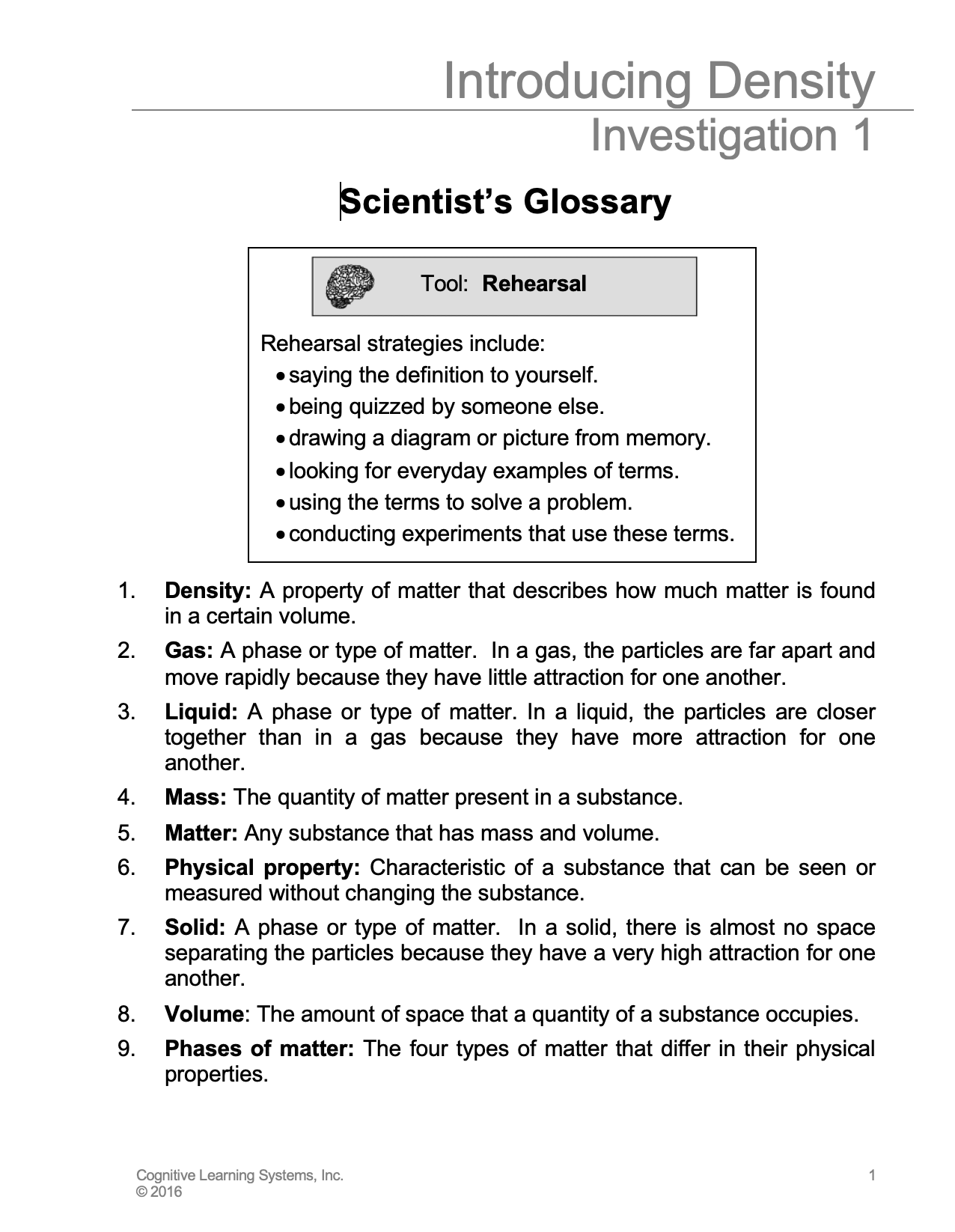
SCIENTIST’S GLOSSARY
1. Density: A physical property that describes how much matter is found in a certain volume.
2. Gas: A phase of matter in which the particles are far apart and moving rapidly because they have little attraction for one another.
3. Liquid: A phase of matter in which the particles are closer together than in a gas because they have more attraction for one another.
4. Mass: The quantity of matter present in a substance.
5. Matter: Any substance that has mass and volume.
6. Physical Property: Characteristic of a substance that can be seen or measured without changing the substance.
7. Solid: A phase of matter in which there is almost no space separating the particles because of the very high attraction for one another.
8. Volume: The amount of space that a quantity of a substance occupies.
9. Phases of matter: The four types of matter that differ in their physical properties.
BE PREPARED
Watch the Investigation 1 Teacher Video and Student Video below to prepare for the PreLab.
SET FOR SUCCESS
- Tell students that they are about to begin the Exploring Density CELL.
- Ask students to share the kinds of things they might learn in these Investigations.
Begin the PreLab Concept Slides to start students on their learning journey. Then watch the Pre-Lab Student Video afterward as a class.
NAVIGATE IT
Once the slide presentation is launched
- use your left and right arrows to advance or go back in the slide presentation, and
- hover your mouse over the left edge of the presentation to get a view of the thumbnails for all the slides so that you can quickly move anywhere in the presentation.
- Click HERE to launch the slide presentation for the CELL.
SHARE IT
SLIDE DEN1-pre-1
This is the first Investigation of the LabLearner CELL Exploring Density. In it, students will examine solids and liquids of varying masses, volumes, and densities.
______________________________________________
SLIDE DEN1-pre-2
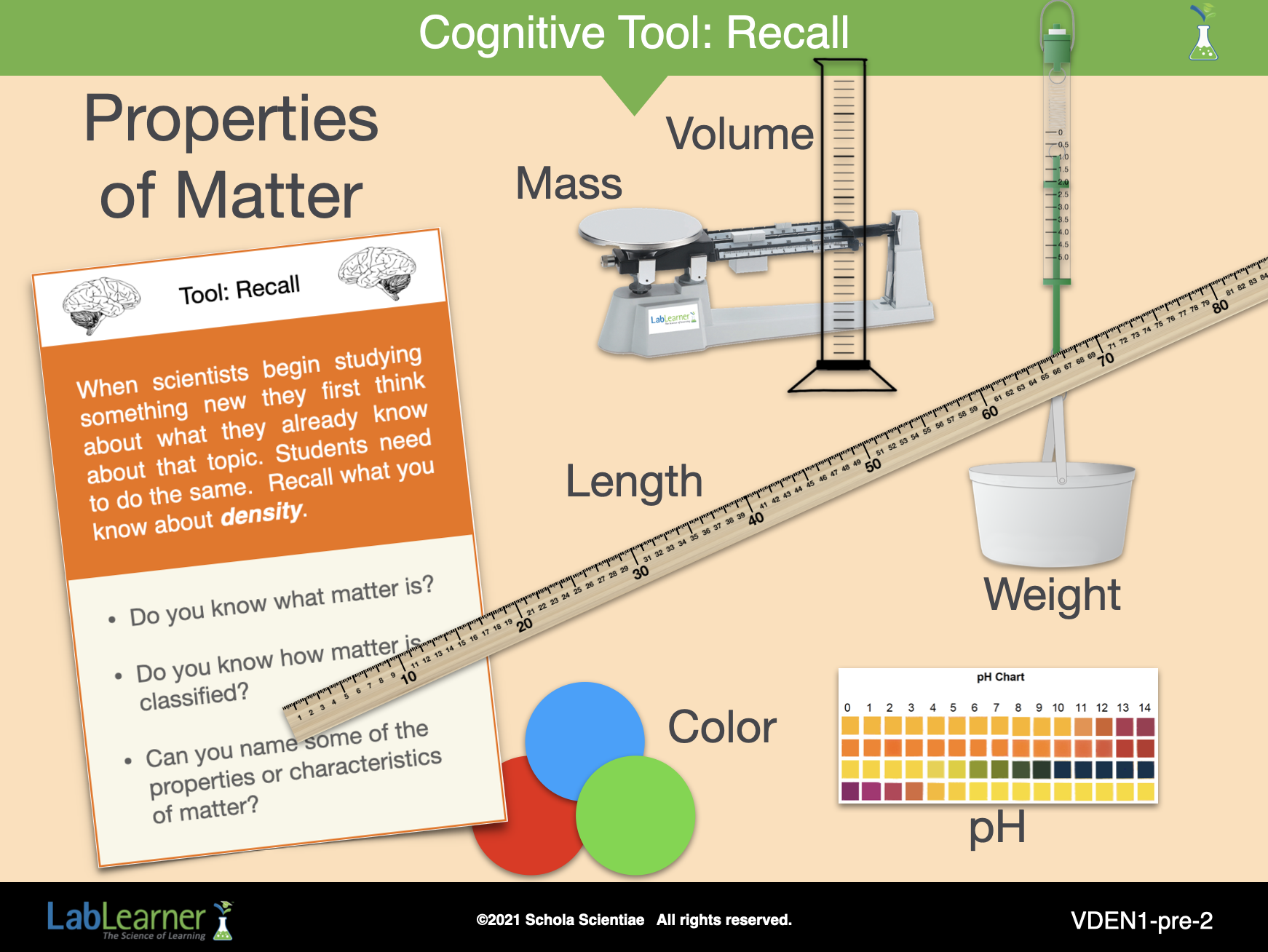
A. Begin the investigation by explaining to students that this Core Experience will explore density, a property of matter.
1. Ask students: Do you know what matter is? Do you know how matter is classified? Matter is classified as anything that has mass and occupies space. Matter can be classified as solid, liquid, gas, or plasma. For the purposes of this Core Experience, however, students will only be expected to identify matter as solid, liquid, or gas, as plasma only occurs under specific conditions, and will not be encountered by students during any of the investigations.
2. Ask students: Can you name some of the properties or characteristics of matter? Properties of matter include color, hardness and appearance, as well as length, mass and volume, and pH.
B. Continue the discussion of matter by encouraging students to consider what they already know about mass and volume.
1. Ask students: How would you describe mass? Student answers may vary. Mass is the amount of matter in a substance. It is usually measured in units of grams.
2. Ask students: How would you describe volume? Student answers may vary. Volume is the amount of space occupied by matter. One way to measure volume is in units of milliliters.
______________________________________________
SLIDE DEN1-pre-3
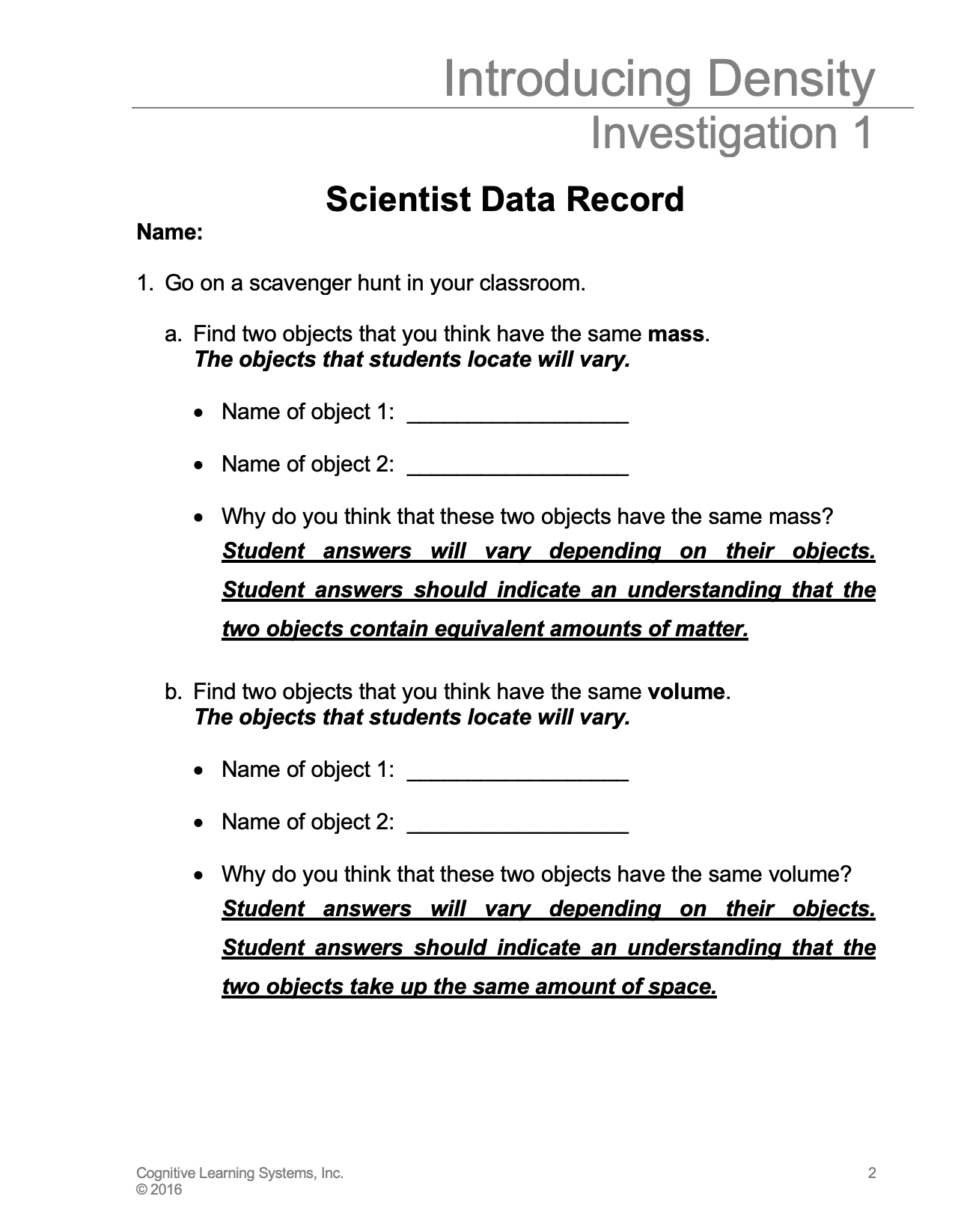
3. Use the following activity to find out how much students understand the properties of mass and volume.
a. Divide students into five cooperative groups.
b. Engage student groups in a scavenger hunt to find two objects that they think have the same mass, and two objects that they think have the same volume.
c. Once each group has found its objects, encourage each group to identify each of the two objects that they think have similar masses.
Ask students: Why do you think the masses of the two objects are similar? Student answers should indicate an understanding that the objects contain equivalent amounts of matter.
d. Encourage students to record their answers in Problem 1a of their Student Data Record.
e. Encourage each group to identify the two objects that they think have similar volumes.
Ask students: Why do you think the volumes of the two objects are similar? Student answers should indicate an understanding that the two objects take up the same amount of space.
f. Encourage students to record their answers in Problem 1b of their Student Data Record.
______________________________________________
SLIDE DEN1-pre-4
C. Begin a discussion about density by directing students’ attention to the term density in their Scientist’s Glossary.
1. Ask a student volunteer to read the definition aloud:
“Density: A physical property that describes how much matter is found in a certain volume.”
2. Remind students that matter is made up of smaller parts of matter that can be referred to as particles. One type of particle that students may have already learned about is a molecule.
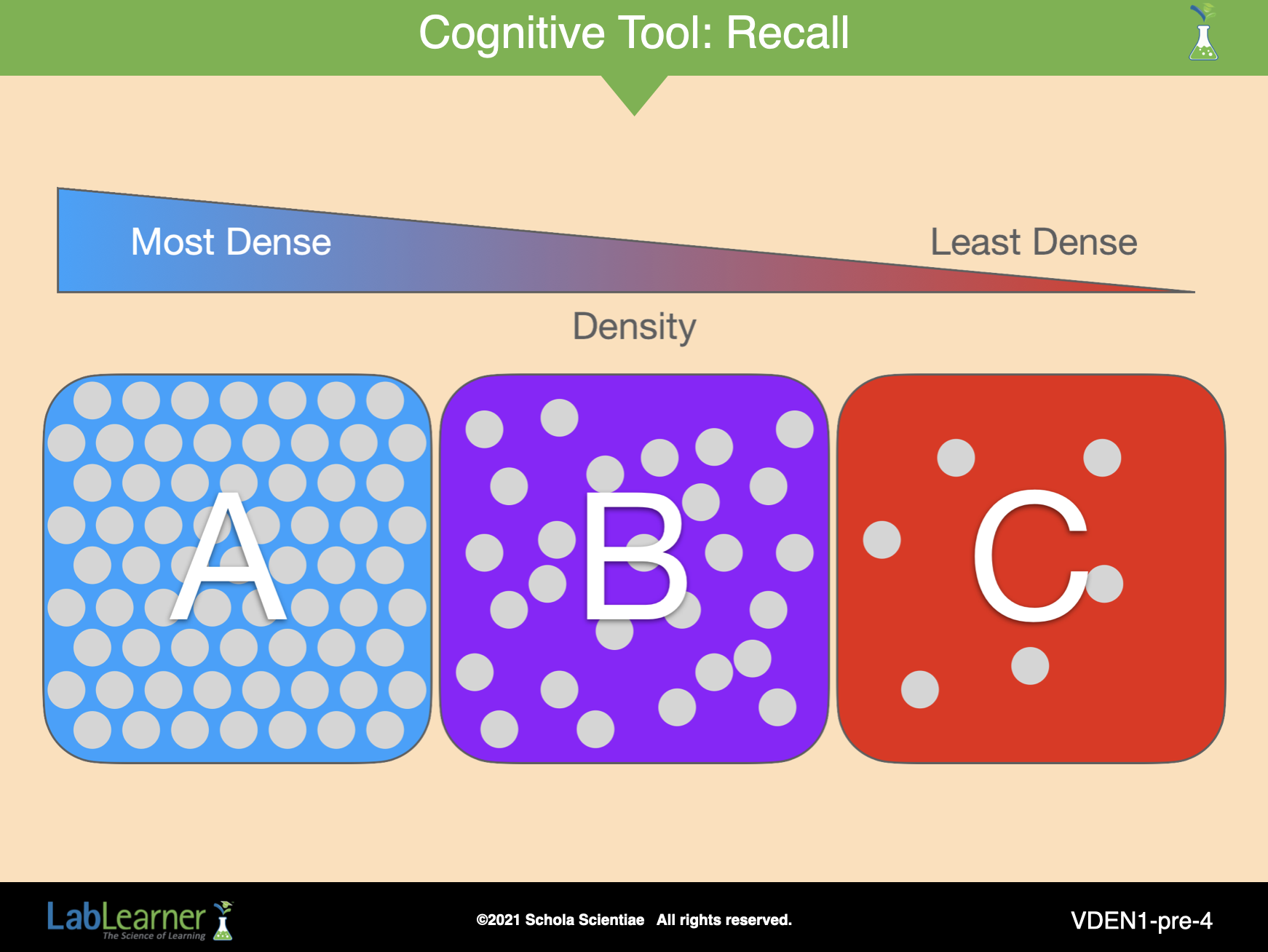
3. Explain that the density of matter is determined by the number of particles in a given volume of matter. If a type of matter is made up of molecules, then density is determined by the number of molecules in a given volume of matter.
4. Refer to the slide.
5. Explain that the squares each represent different types of matter that are the same volume and that the dots in the squares represent molecules.
Ask students: Which matter has the lowest density? Which has the greatest density? Why? Students should indicate that square (A) has the greatest density, and square (C) has the lowest density. As more molecules are packed into the same volume, density increases. This results in square (A) having the greatest density. Since the fewest molecules are found in the same volume in square (C), it has the lowest density.
6. Ask student groups to think about whether the objects they chose during their scavenger hunt have the same densities. Encourage students to share their observations with the class. Student answers will vary. Students are not expected to necessarily give correct answers at this point. However, students’ responses should reflect an understanding that they need to consider the number of molecules in the space occupied by each object in order to make a decision about density.
______________________________________________
SLIDE DEN1-pre-5
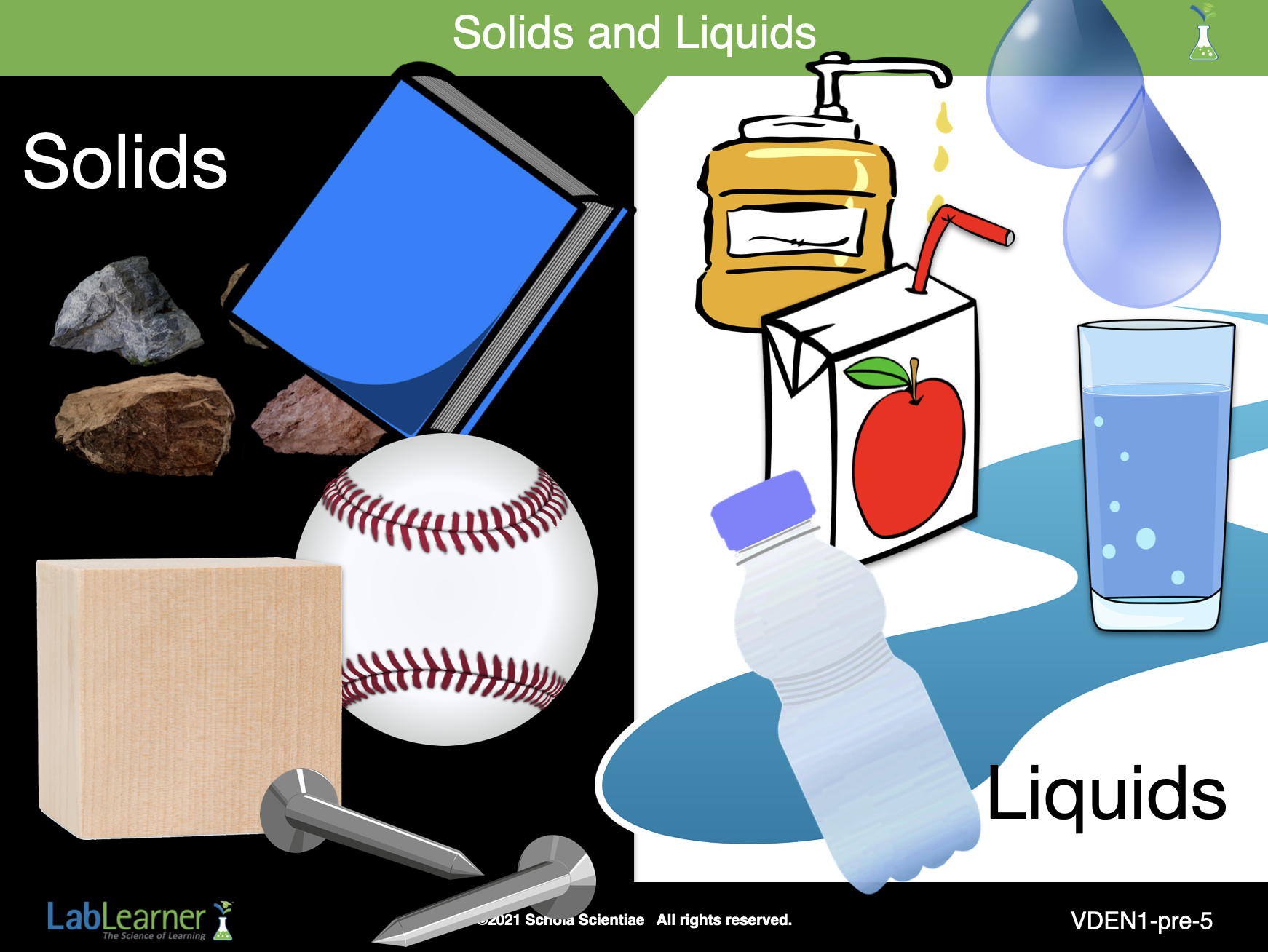
D. Explain to students that all types of matter, whether a solid, a liquid, or a gas possess a density. Density is a property of matter.
1. Ask students: Can you name different types of matter that are solids? Encourage students to look around the room for examples of solids. Student answers may vary. Sample answers include the wood of lab tables, the metal of chairs, the cotton of their clothing, and the paper of their books and notebooks.
2. Ask students: Can you name different types of matter that are liquids? Encourage students to think of liquids that are present in their homes or those that they come in contact with during the day. Student answers may vary. Sample answers include water, vinegar, gasoline, and nail polish remover.
3. Ask students: Do you think all solids have the same density? Do you think all liquids have the same density? Student answers will vary. Tell students that they will explore these questions in the laboratory.
E. Explain to students that in this Investigation, they will compare the densities of three liquids and two solids in order to answer the following questions about density:
• How do the densities of two liquids affect what will happen when they are added together?
• How does the density of a solid affect what will happen when it is added to a liquid?
• How does the density of a liquid affect what will happen when it is added to a solid?
______________________________________________
SLIDE DEN1-pre-6
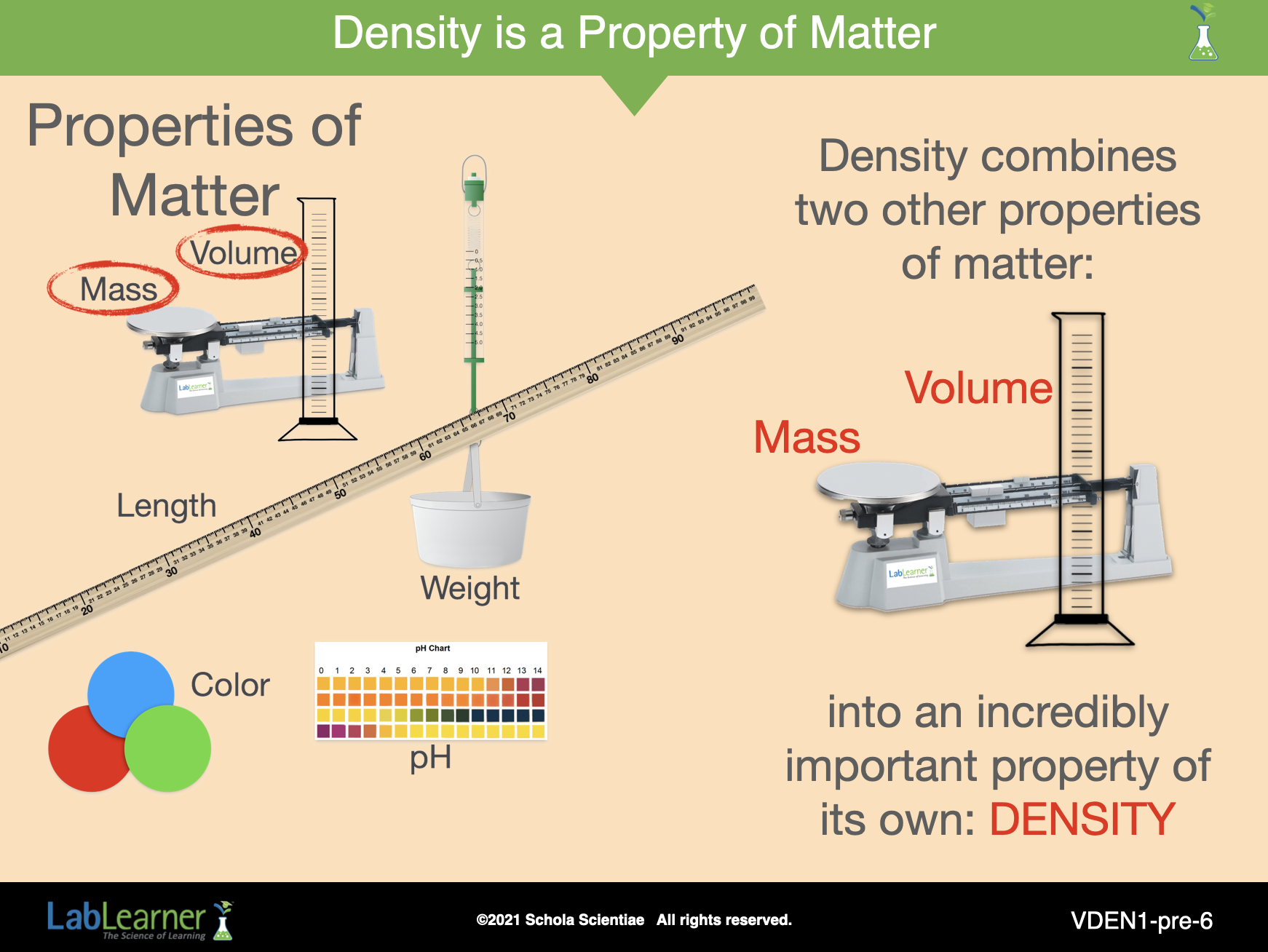
Density is a property of matter, just as mass, volume, color, pH, length, and so on are properties of matter. However, density is very interesting because it combines two other properties, mass and volume. In the Lab, you will see exactly how mass and volume are involved in the physical property of density.
Student Video
Watch the Investigation 1 Student Video after the Share It presentation to prepare for the PreLab.
KEYS