Teacher Portal:
Investigating Heat
Investigation 3 – PreLab
 MINDSET
This Investigation is designed to:
- introduce students to the concept that heat transfer occurs during chemical reactions.
- introduce students to the difference between endothermic and exothermic reactions.
- promote understanding of the Law of Conservation of Energy.
- promote understanding that temperature changes during chemical reactions are often accompanied by other signs of chemical change.
SCIENTIST’S GLOSSARY
- Chemical reaction: the process in which one or more substances interact chemically to form one or more different substances. Chemical changes result from chemical reactions.
- Endothermic process: a chemical reaction or physical change that absorbs heat.
- Exothermic process: a chemical reaction or physical change that releases heat.
- Heat: The energy transferred from one molecule to another because of a difference in kinetic energy between the two molecules. Heat is transferred from molecules with higher kinetic energy to molecules with lower kinetic energy.
- Law of conservation of energy: Energy is neither created nor destroyed, it simply changes form.
- Physical change: A change in which no new substance is produced but the original substance changes form
BE PREPARED
Watch the Investigation 3 Teacher Video (below) and Student Video (at end of PreLab SHARE IT) to prepare for the PreLab.
SET FOR SUCCESS
- Tell students that they will continue with the Investigating Heat CELL.
- In this Investigation, students will learn chemical reactions can produce heat or require heat when they occur.
- Ask students to share the kinds of things they think they might learn in this Investigation.
Begin the PreLab Concept Slides to start students on their learning journey. Then watch the Pre-Lab Student Video as a class.
NAVIGATE IT
Once the slide presentation is launched
- use your left and right arrows to advance or go back in the slide presentation, and
- hover your mouse over the left edge of the presentation to get a view of the thumbnails for all the slides so that you can quickly move anywhere in the presentation.
- Click HERE to launch the slide presentation for the CELL.
SHARE IT
SLIDE VHEAT3-pre-1
In this Investigation students will continue their study of heat. Endothermic and exothermic chemical reactions will be explored. Students will learn that the release or absorption of energy stored in chemical bonds results in temperature change during chemical reactions.
______________________________________________
SLIDE VHEAT3-pre-2
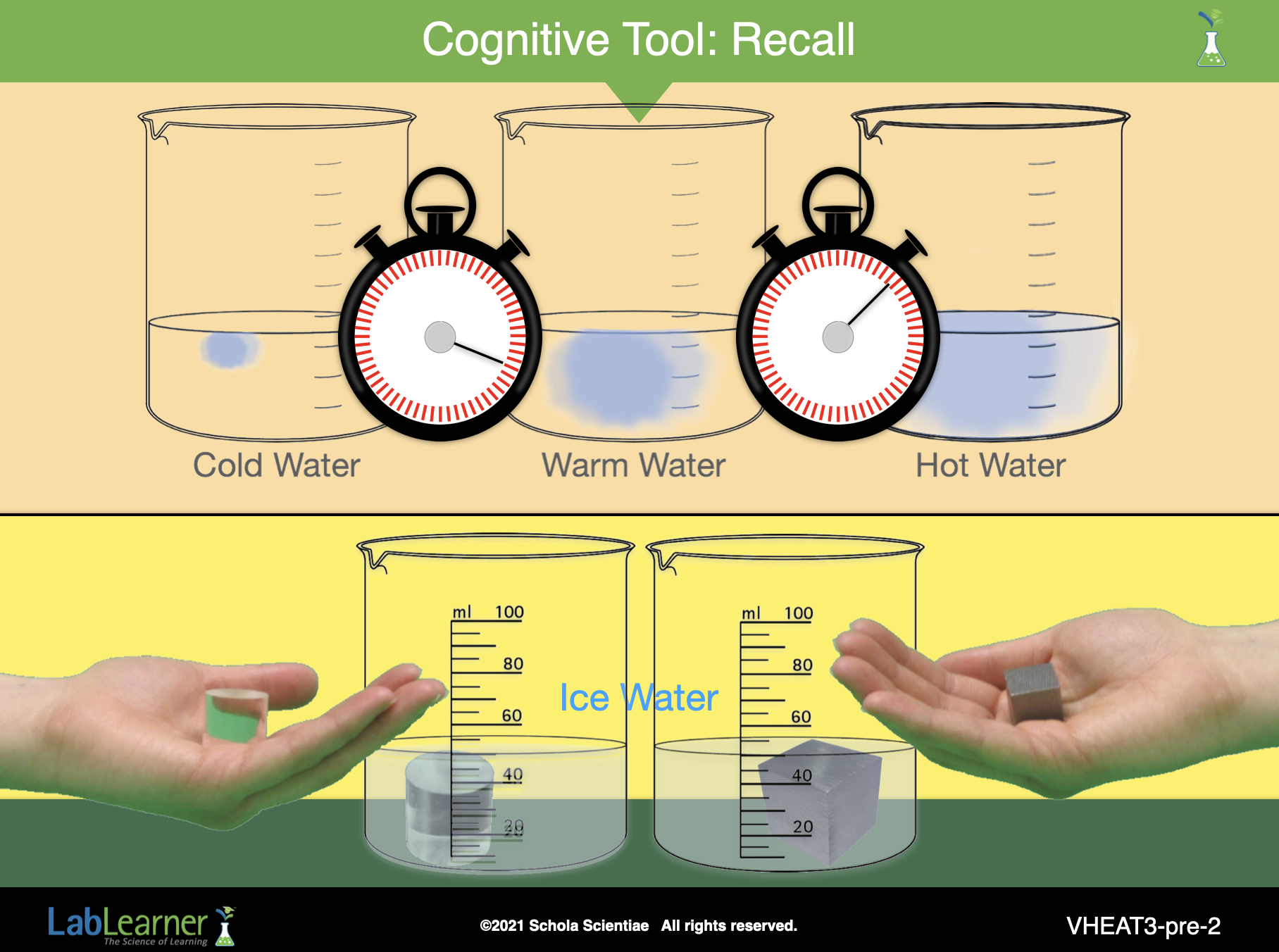
Begin this part of the Investigation by asking students to summarize what was learned in Investigations One and Two. The following questions may be helpful in assisting students to recall the previous experiments.
1. What experiments did you perform in Investigation One? What did you learn from those experiments? Students observed a demonstration of a test tube filled with alcohol and capped with a balloon added to a beaker of recently boiled water. This demonstration illustrated how molecules of alcohol respond when energy is transferred from substances of higher temperatures to those of lower temperatures. The kinetic energy of the alcohol molecules increased and the alcohol expanded into a gas. Students placed thermometers in beakers of hot, warm, and cold water to determine the temperature of the water in each beaker. Students then added food coloring to each beaker to observe the relationship between the kinetic energy or movement of the molecules of food coloring and water. Increases in the temperature of the beakers were correlated with increases in the kinetic energy of the molecules of water and food coloring increased.
2. What experiments did you perform in Investigation Two? What did you learn from those experiments? Students compared the effects of immersing a metal cube and an acrylic cylinder in ice water to learn the difference between a conductor of heat and an insulator of heat. Students then tested a glass rod, a brass fastener, a ball of aluminum foil, a gram bear, gravel, and a woodblock to determine which ones were conductors of heat and which ones were insulators of heat. Students learned that materials vary in their ability to conduct heat. Substances that allow heat to be easily transferred are described as conductors whereas those that do not easily transfer heat are described as insulators. Students constructed a thermos from a beaker using their choice of aluminum foil, paper, and/or plastic bags to investigate how using insulating materials affects the rate of heat transfer from air to a beaker of ice water.
______________________________________________
SLIDE VHEAT3-pre-3
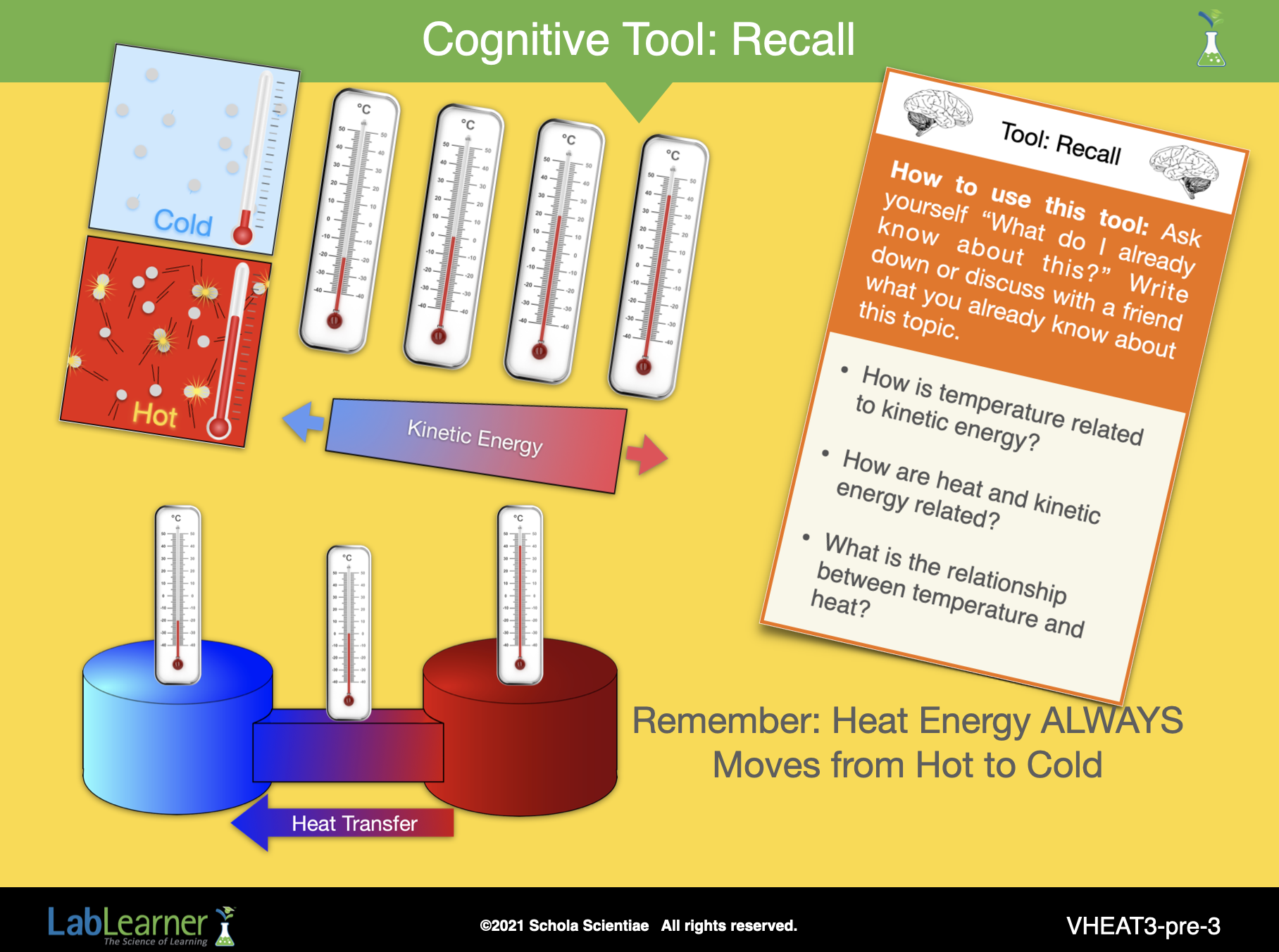
A. Continue the review by encouraging students to recall what they have learned about heat and its relationship to temperature and energy. Ask the following questions to prompt discussion.
1. Ask students: How is temperature related to kinetic energy? Temperature is a measure of the kinetic energy of a substance.
2. Ask students: How are heat and kinetic energy related? Heat is the transfer of kinetic energy from molecules with higher kinetic energy to those with lower kinetic energy.
3. Ask students: What is the relationship between temperature and heat? Temperature changes can be used as a measure of the transfer of kinetic energy, or the transfer of heat. The direction of heat or energy transfer is always from areas of higher temperature (kinetic energy) to areas of lower temperature (kinetic energy).
______________________________________________
SLIDE VHEAT3-pre-4
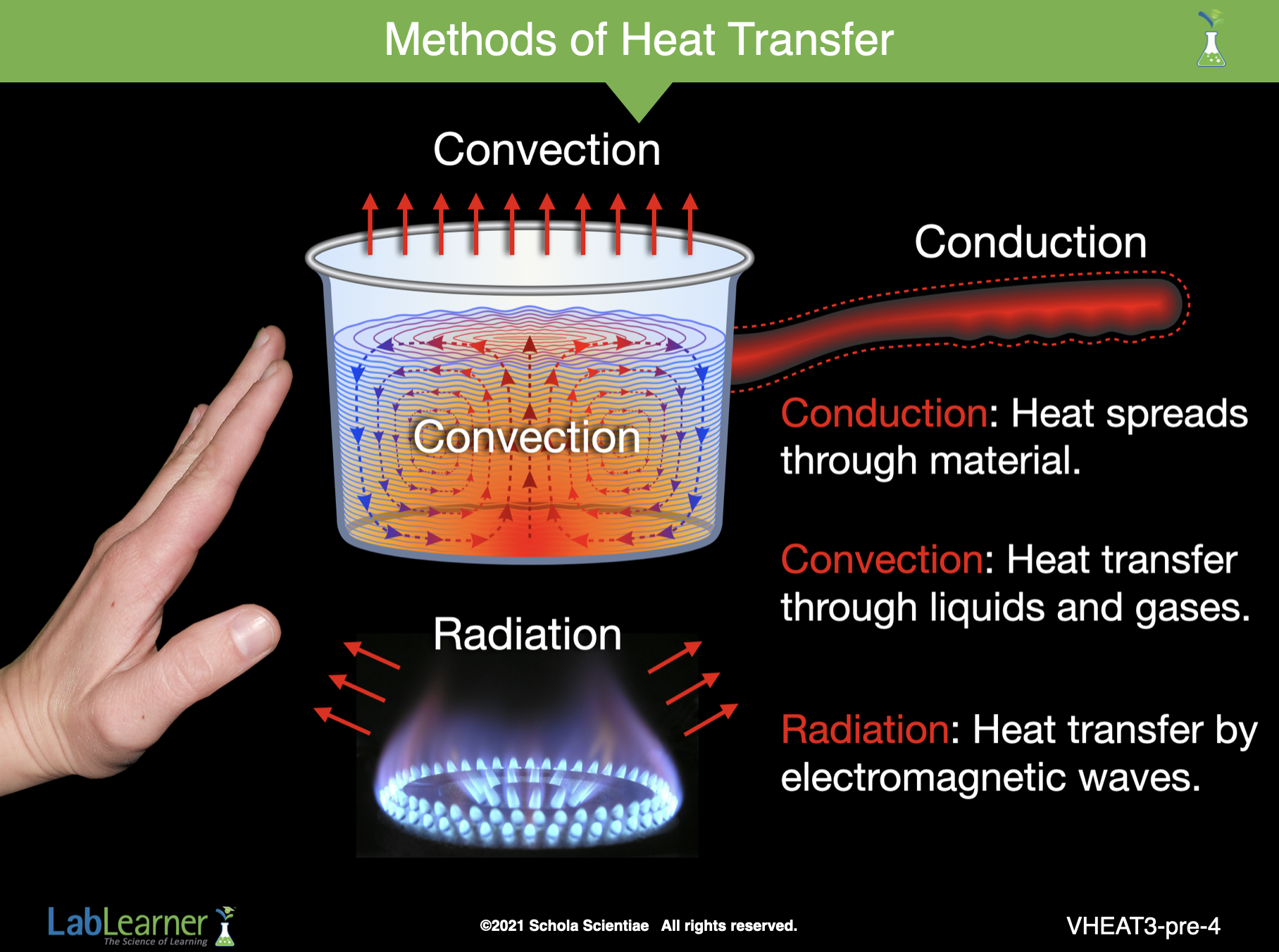
B. Remind students that there are three ways energy can be transferred as heat.
1. Ask students: What are the three methods of heat transfer? The three methods of heat transfer are conduction, convection, and radiation.
2. To help students rehearse and apply what they know about the three types of heat transfer, encourage students to brainstorm examples of heat transfer. The three methods of heat transfer are listed on the slide.
a. Ask students: What are some examples of heat transfer by conduction? Student answers will vary. Some examples may include the heat felt when holding a warm sandwich, the heat transferred to food by a cooking utensil, or the heat felt when holding a cup of hot chocolate between a student’s hands. Students may exhibit an inclination to list examples where warmth is felt. Encourage students to share examples where a feeling of cold is an example of heat transfer to demonstrate understanding that objects and materials absorb heat as well as release heat. Examples of heat transfer where materials absorb heat would be holding a metal cube in the palm of the hand, sitting on a stone bench in winter and feeling the cold seeping through clothing, or holding an ice cube on their tongue.
b. Ask students: What are some examples of heat transfer by convection? Student answers will vary. Again, encourage students to include examples where heat is absorbed as well as where heat is released. Examples of convection may include the wind blowing across the ocean, warm air rising from a heat vent, ocean currents, hot water spreading through cooler water in a bathtub, or heat waves rising from hot pavement.
c. Ask students: What are some examples of heat transfer by radiation? Student answers will vary. Examples include heat from the Sun warming a rock, heat from a light bulb warming a hand, and cold radiating from the sides of a bowl of ice cream (heat radiating away from hands toward the ice cream).
C. Investigation Three continues the study of heat transfer by providing students the opportunity to explore heat transfer during chemical reactions.
1. Introduce Investigation Three by reminding students that in Investigation Two they studied heat transfer between air and the water in their beakers.
a. Ask students: Why did the water become warmer in each beaker? The water temperature increased because heat was transferred to the water from the warmer air surrounding it.
b. Ask students: How did the motion of the water molecules change as the water became warmer? Student answers may vary. Students should indicate that as the kinetic energy of a liquid increases, its molecules move faster and farther apart.
______________________________________________
SLIDE VHEAT3-pre-5
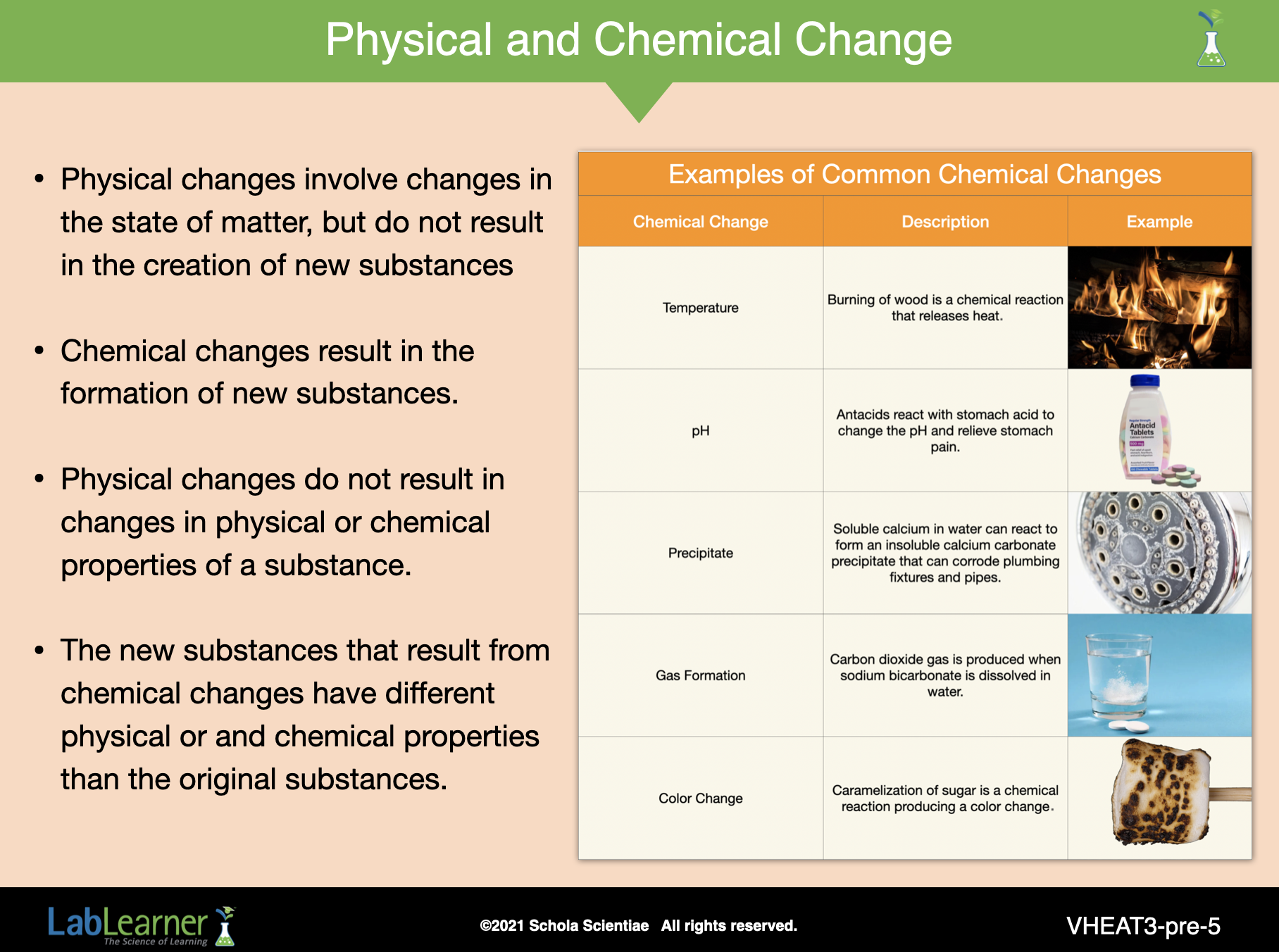
2. Remind students that matter can undergo two types of change: physical and chemical changes. Some students may recall the two types of changes from the experiments they conducted in the Chemistry, Matter and Interactions CELL. However, if students have not completed this CELL, their previous knowledge of physical and chemical changes may be limited.
a. Remind or explain to students the differences between physical and chemical changes:
- Physical changes involve changes in the state of matter, but do not result in the creation of new substances.
- Chemical changes result in the formation of new substances.
- Physical changes do not result in changes in physical or chemical properties of a substance.
- The new substances that result from chemical changes have different physical and chemical properties than the original substances.
b. Depending on students’ prior knowledge, you may need to provide some examples of changes. In addition, ask students: What are some more examples of physical changes? Do any of these changes involve a change in temperature? Student answers will vary. Examples may include ice, snow, or frozen food melting; water boiling, steam condensing on a cold surface; or any example involving a change in the state of matter.
c. Chemical changes are often accompanied by one or more of ten common signs:
- change in pH,
- change in temperature,
- an unexpected color change,
- formation of a precipitate,
- formation of a gas,
- change in electrical conductivity,
- change in volume,
- change in chemical or physical properties,
- change in odor, or
- change in melting or boiling point.
In the Chemistry, Matter and Interactions CELL, students observed three of these changes: an unexpected color change, formation of bubbles due to the production of a gas, and a change in temperature.
d. Ask students: What are some examples of chemical change? Do chemical changes involve a change in temperature? Student answers may vary. Examples of chemical changes include cookies baking, fruit browning, wood-burning, and instant hot/cold packs. Chemical changes often involve changes in temperature, because a change in temperature is a sign of chemical change.
______________________________________________
SLIDE VHEAT3-pre-6
3. Direct students’ attention to their Scientist’s Glossary. Ask students: What term is related to chemical change? Students should indicate that chemical reaction is related to chemical change.
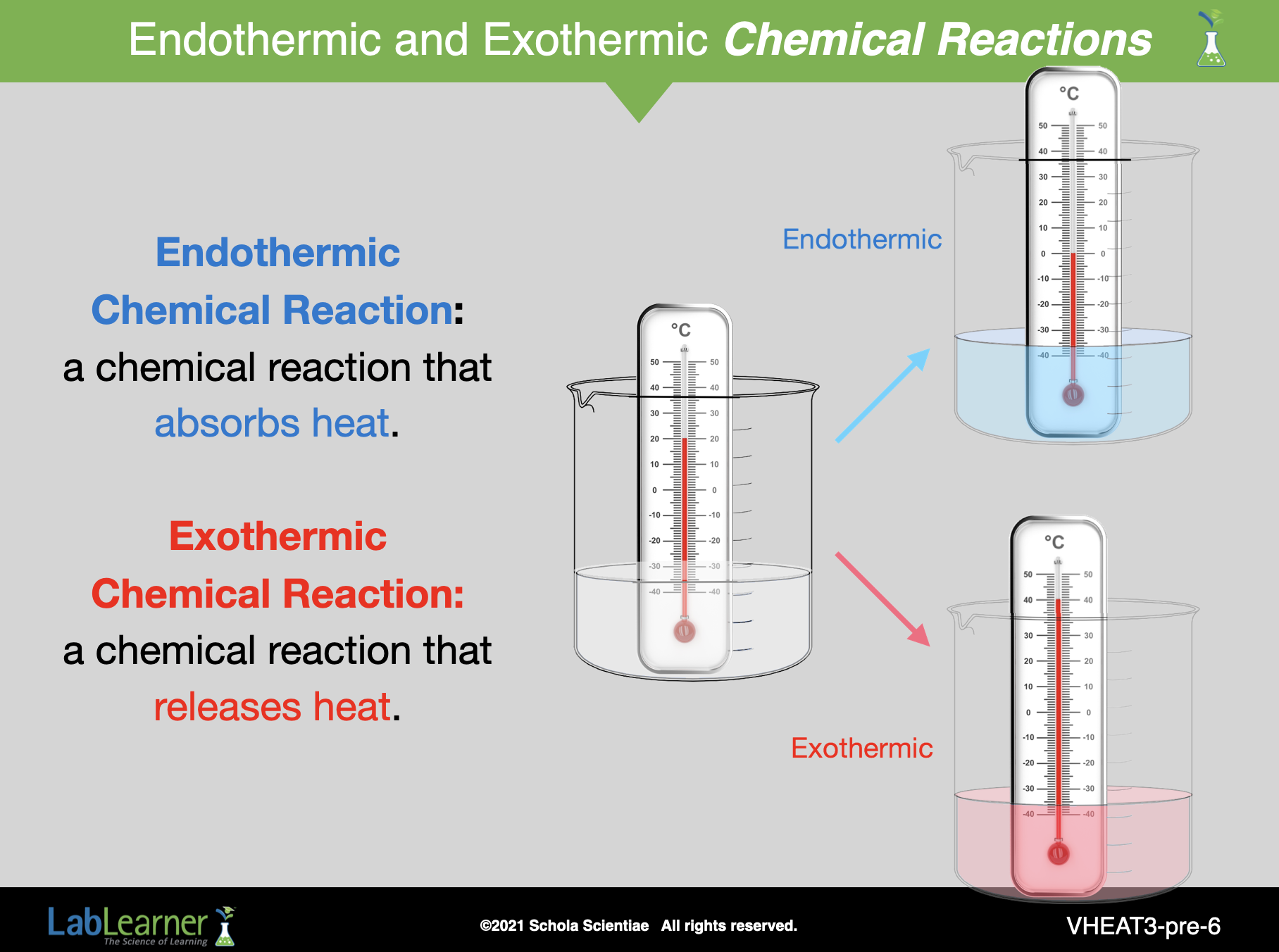
4. Explain that chemical changes are the result of chemical reactions. In a chemical reaction, two chemicals or more chemicals exchange pieces, creating new chemicals.
a. Explain that most chemical reactions involve a transfer of energy. Some transfers of energy are easier to observe than others. Ask students: How do you think you could tell that energy has been transferred during a chemical reaction? Student answers may vary. An energy transfer could be detected as a change in the temperature of the reaction.
b. Direct students’ attention to their Scientist’s Glossary. Explain that when there is a transfer of heat during a chemical reaction, scientists say the reaction is either exothermic or endothermic. Ask students: According to the terms in the Glossary, how do these types of processes differ? Both types of reactions involve a transfer of heat. The difference between the two is the direction of heat transfer in relation to the reaction. Endothermic reactions are said to absorb heat, meaning that heat is transferred into the chemical reaction from its surroundings. Exothermic reactions release heat, meaning heat is transferred from the chemical reaction to the surroundings.
5. In order for students to understand how to distinguish between an endothermic and an exothermic reaction, they need to be aware of the type of results they should expect with each reaction and the temperature changes that generally occur in each type of reaction. Pose the following questions to assist students in understanding the changes that occur in endothermic and exothermic reactions:
a. Ask students: What sign should you look for to tell you that a transfer of heat has occurred during a chemical reaction? A change in temperature indicates that a transfer of heat has occurred during a chemical reaction.
b. How could you verify that the temperature change in an endothermic or exothermic reaction is due to a chemical reaction? Student answers may vary. In a chemical reaction, a change in temperature is often accompanied by one or more other signs of chemical change. Students may suggest that they should also look for signs such as unexpected color changes or production of a gas, as these signs were observed during the Chemistry, Matter and Interactions CELL. Students may also suggest additional signs of chemical change such as the formation of a precipitate or changes in pH, melting point, boiling point, volume, electrical conductivity or odor. Some of these chemical changes were listed on the previous slide.
______________________________________________
SLIDE VHEAT3-pre-7
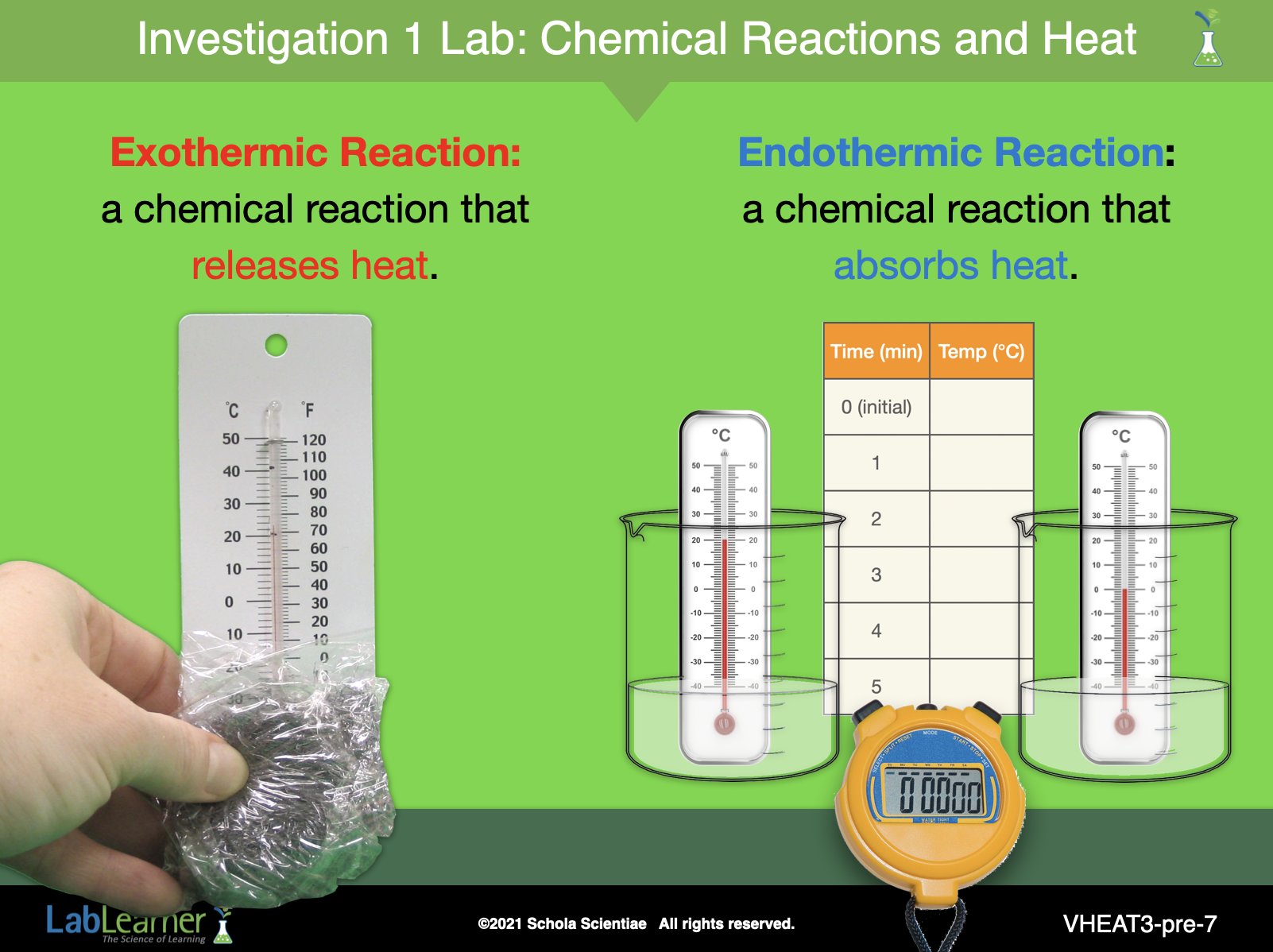
D. Conclude this portion of the Investigation by explaining that students will observe examples of endothermic and exothermic chemical reactions in the Lab. Remind students that because endothermic and exothermic reactions are chemical reactions, they are to look for signs of chemical change other than a change in temperature as proof that the temperature changes are the result of chemical reactions.
Explain that the purpose of this lab is to answer the question:
What is the difference in heat transfer between an endothermic reaction and an exothermic reaction?
WATCH IT
Play the following Student Video in preparation for the lab. Discuss as necessary to answer student questions.
KEYS