
Teacher Portal:
Investigating Heat
Investigation 1 – Lab
 BE PREPARED
| Class materials: |
|
| Group materials: |
|
| Individual Materials: |
|
| Teacher Demonstration Materials: |
|
Teacher Preparation
Trial 1 (Teacher Demonstration):
- Fill the 400 ml beaker with 300 ml of water and add the stir bar.
- Using the funnel, fill the falcon tube with 6 ml of rubbing alcohol. Use the funnel to transfer the alcohol from the falcon tube to the test tube.
- Write Heat on the balloon with the permanent marker. Force air out of the balloon and cap the test tube with the balloon. Place the test tube in the test tube rack.
- Bring a 400 ml beaker of water to a boil on a stir/hot plate. Turn off the hot plate and use the hot hand protector to remove the beaker from the stir/hot plate. Reserve water after demonstration*.
*Students will use this water in their experiments in Trial 2 in combination with cold water to create the beakers of “hot”, but not boiling, water.
Trials 2-5:
1. Label one (1) liter pitcher Cold and fill with 300 ml of cold tap water.
2. Add ice to the pitcher labeled Cold and allow the water to chill. The water should achieve a temperature between 0 and 4 oC. Discard any remaining ice and stir the water with a glass stir rod before the Lab begins.
3. Label one (1) liter pitcher Warm. Fill this pitcher with 300 ml warm tap water to achieve a temperature of 22 to 26 oC.
4. Place materials required by student groups at the distribution point.
5. Divide the class into 5 cooperative groups.
NOTE: Use the small squeeze bottles of food coloring to allow students to limit the amount used to one drop per beaker in Trials 3 – 5.
Instruction
-
Divide students into five cooperative groups. Direct each student group to obtain the following necessary materials from the distribution point: three (3) 100 ml beakers, three (3) thermometers, three (3) timers or stopwatches.
GET FOCUSED
- Students will learn how a glass thermometer works by watching a demonstration by their teacher.
- As students perform their lab experiments, they should keep the following question in mind:
How does a thermometer work?
INVESTIGATE
Trial 1 (Teacher Demonstration):
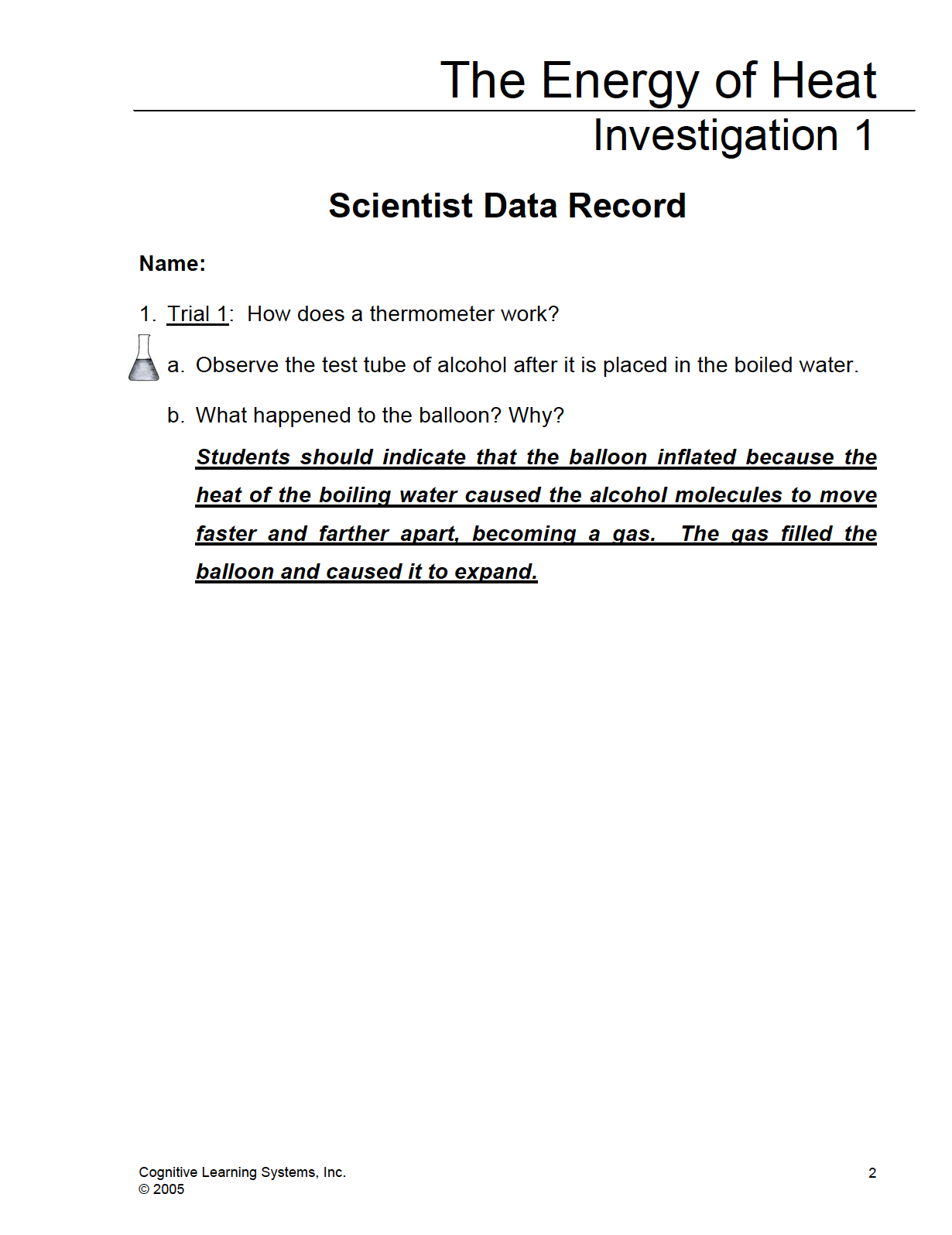
Trial 1 demonstrates the method in which a thermometer works. Students will observe a demonstration of a model of a thermometer constructed from a test tube, alcohol, and a balloon. A test tube will be filled with alcohol, capped with a balloon, and placed in recently boiled water. The heat from the water will cause the molecules of alcohol to increase their speed and motion, spreading out over a larger distance. As a result, the alcohol will be converted from its liquid to its gaseous form. The alcohol gas will expand to fill the test tube and balloon, demonstrating that the alcohol contained in a thermometer expands when it is exposed to heat.
a. Hold the test tube containing the alcohol and capped with a balloon up for students to see. Direct students to study the thermometers on their lab table. Explain to students that the test tube contains alcohol, the same substance found inside their thermometers. The test tube will serve as a model of a thermometer.
b. Place the test tube in the beaker of boiled water. Direct students to observe the thermometer model as the alcohol heats.
c. Ask students: What happens when the liquid in the test tube is heated? Student answers may vary. Students should notice that the balloon attached to the test tube begins to expand.
d. Explain that liquids expand when they are heated and form gases. This change occurs because as heat is applied, the molecules in the liquid begin to move faster and further. Eventually, they move far enough apart that the liquid becomes a gas.
e. Ask students: How do you know that a gas was produced? The gas-filled the balloon and caused it to expand.
f. Ask students: Do you think the alcohol in your thermometers produces gas when it is heated? Student answers will vary. Remind students that molecules need space in order to expand from a liquid into a gas. Explain that their thermometers and other thermometers are closed systems, meaning that there is not enough room for molecules to move far enough apart to become a gas. However, the expansion of the liquid is visible as it climbs up the glass tube.
g. Direct students to answer Problem 1b in their Student Data Record.
Trial 2
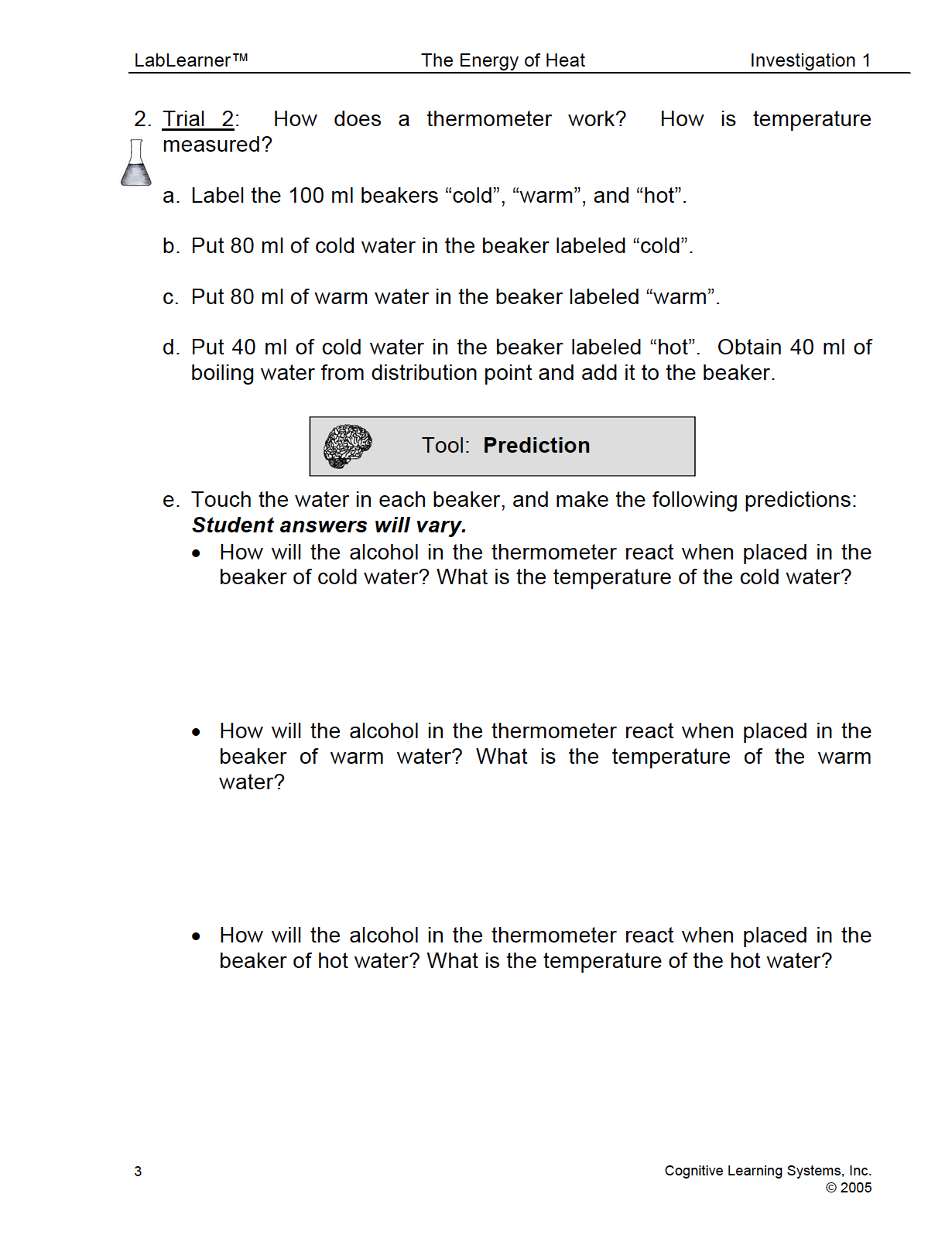
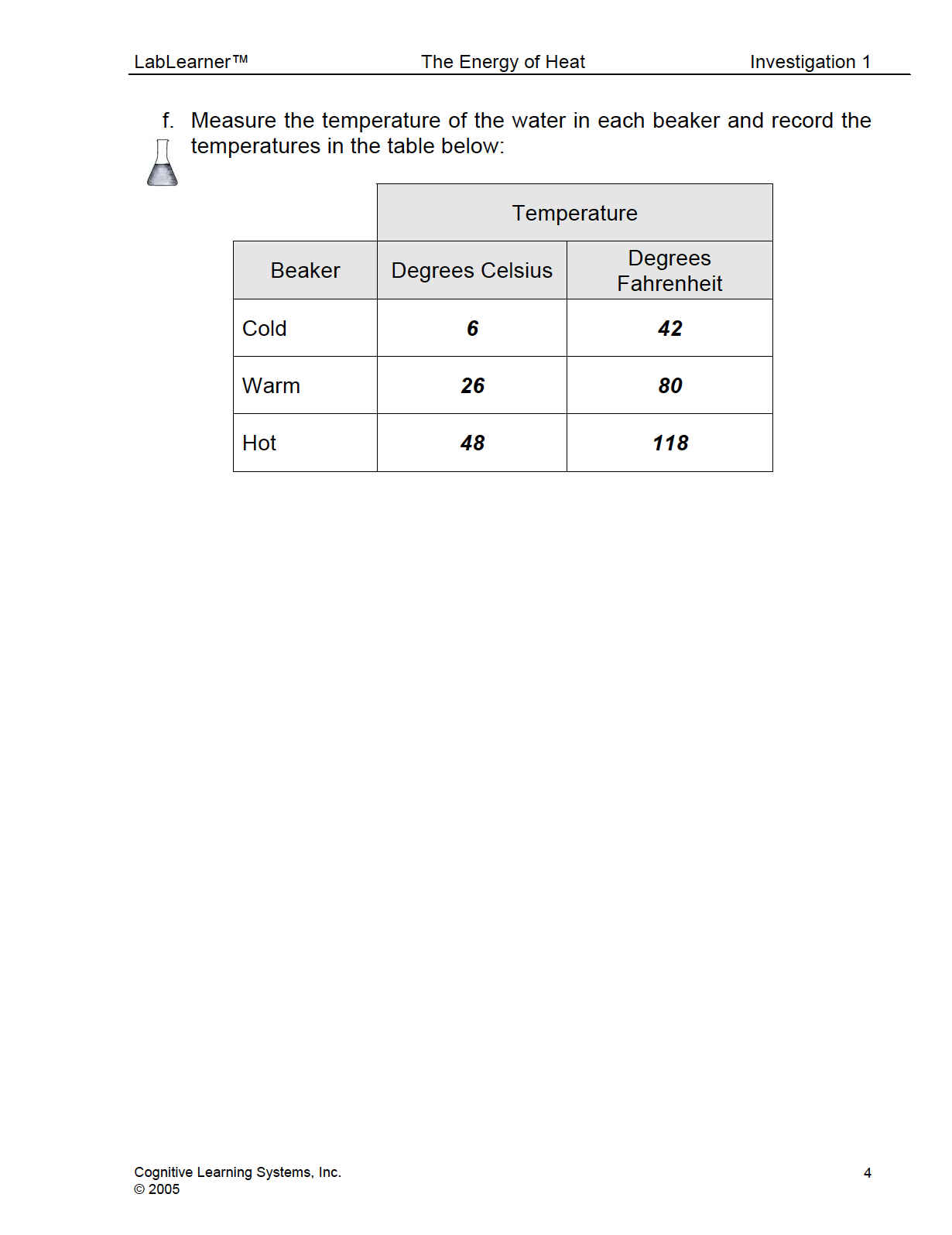
Trial 2: Trial 2 introduces temperature as a method of measuring the kinetic energy of molecules. Following the demonstration of the thermometer model, students will observe how the alcohol inside a thermometer responds to water temperature in three different beakers of water: cold, warm and hot. Students will observe that the alcohol inside the thermometer responds to cold water by contracting, thus registering a lower number on both the Fahrenheit and Celsius scales than it does in warm or hot water. Students will also observe that the alcohol in the thermometer expands more in hot water than it does in warm water, demonstrating that the amount of expansion is directly related to the kinetic energy of the molecules in a substance.
How does a thermometer work?
How is temperature measured?
Trial 3-5
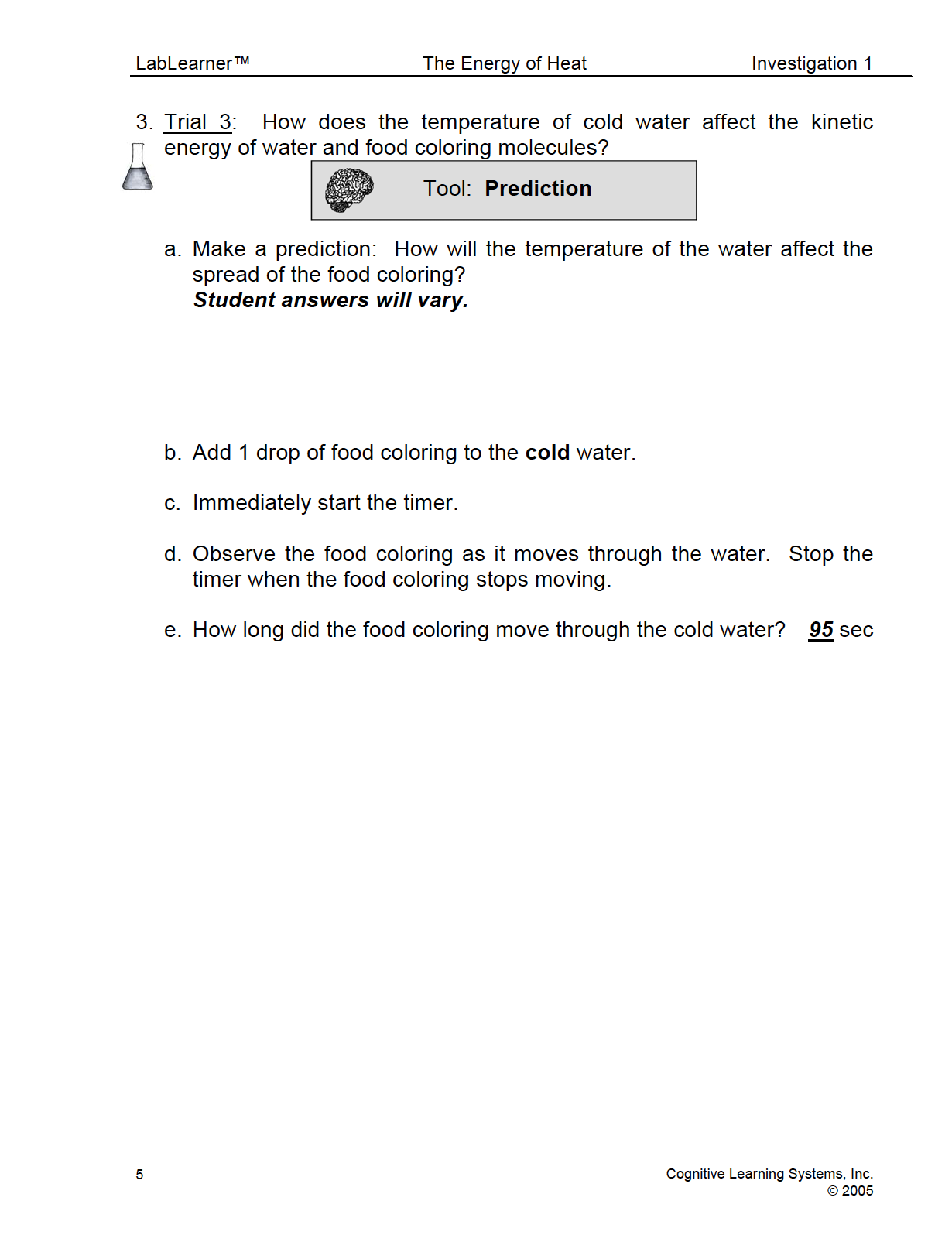
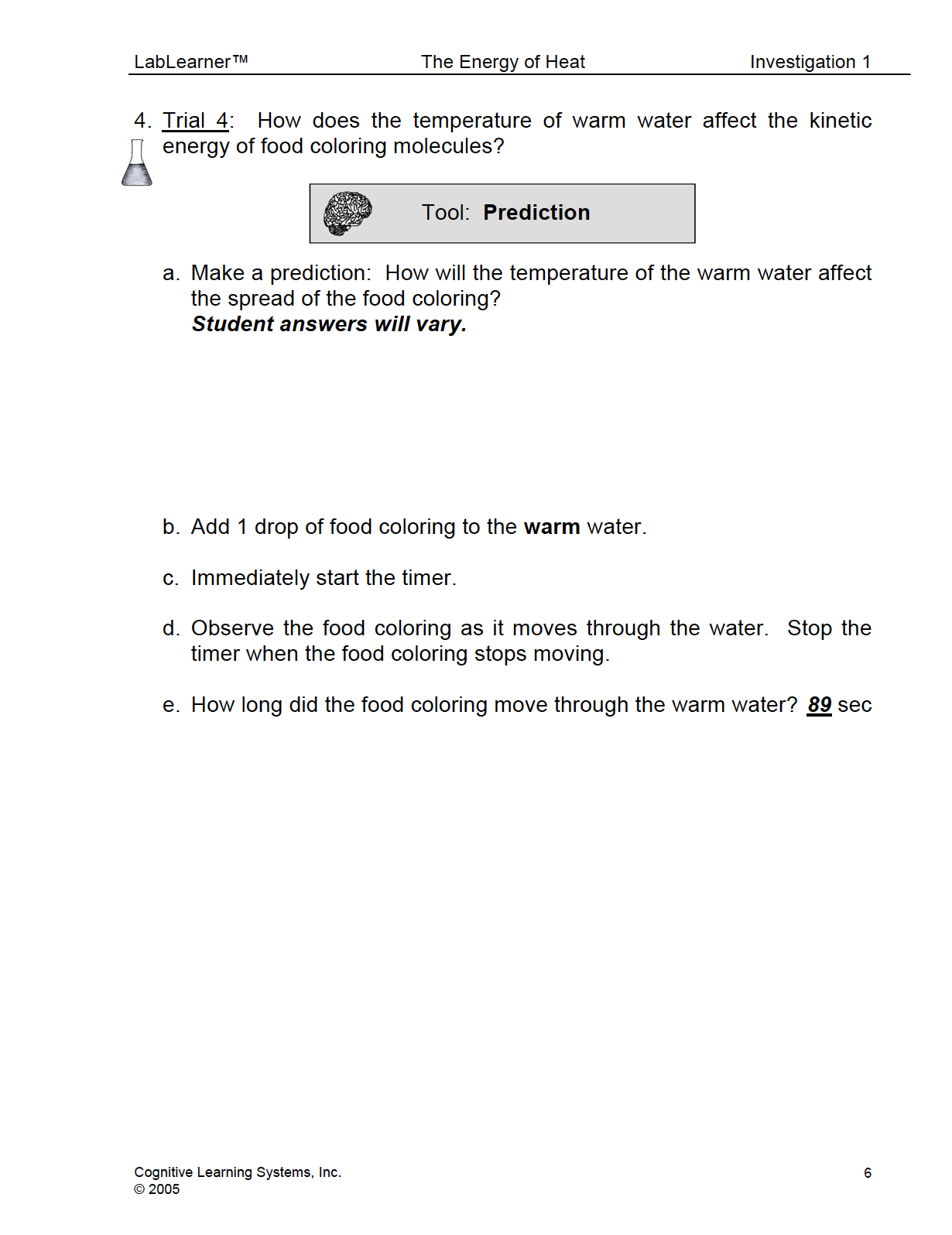
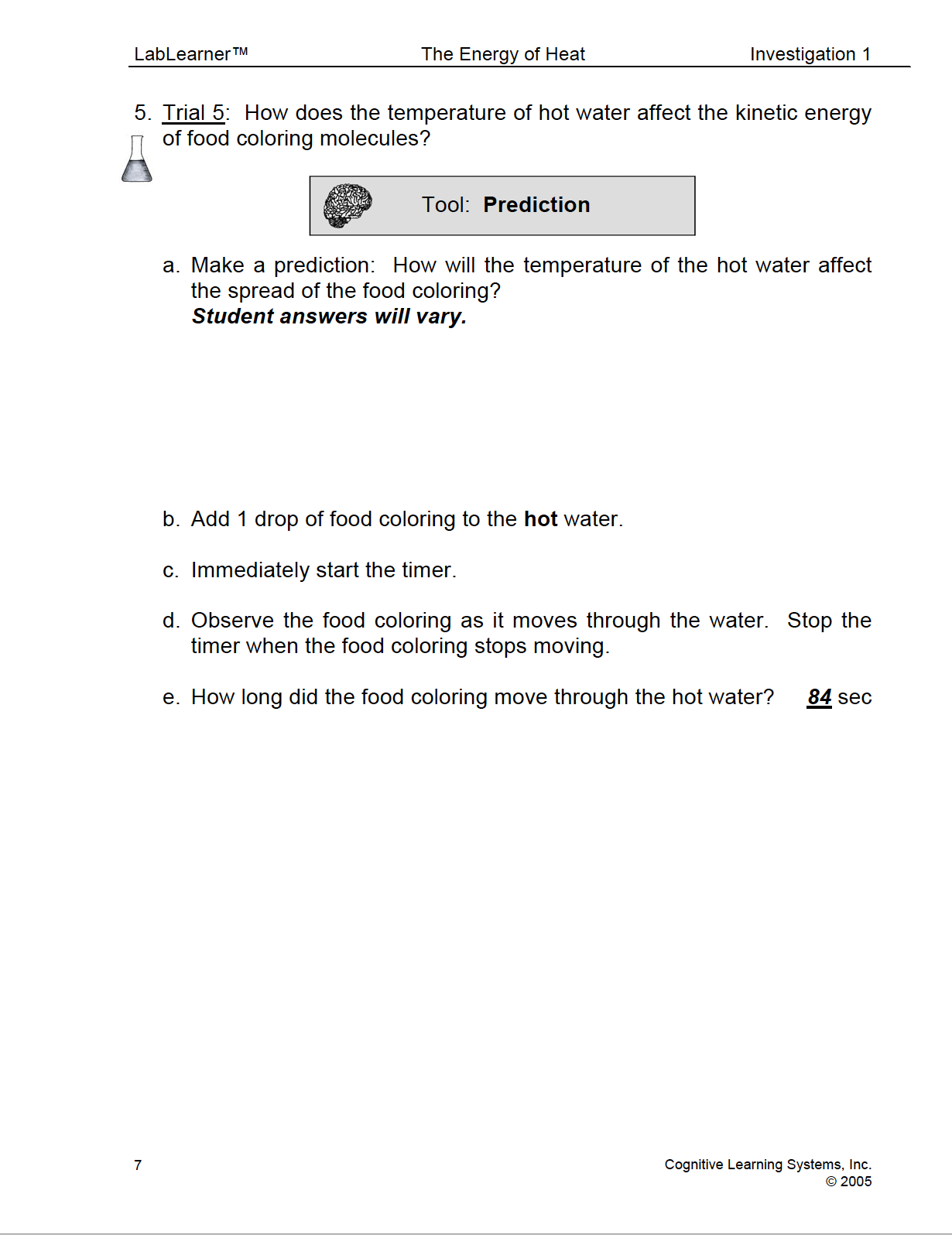
Students will continue their study of temperature by exploring the effect of water temperature on the movement of food coloring molecules and water molecules. Students will be asked to make a series of predictions regarding their expectations of how water temperature will influence the movement of food coloring through the water and how temperature relates to the kinetic energy of the molecules of water and food coloring. Students will then test their predictions by placing a drop of food coloring in each beaker of water, observing the spread of the color in the water, and determining the amount of time required for the dispersal of the food coloring to stop.
Students will use their observations to form conclusions about the effect of temperature on the speed of the water and food coloring molecules and the distance traveled by these molecules. Students will discover that as water temperature increases, the time necessary for color dispersal decreases. At the same time, students should observe that color spreads further in warmer temperatures than it does in colder temperatures. Trials 3 – 5 answer the following question:
How does the temperature of the water affect the kinetic energy of water and food coloring molecules?
NOTE: Student groups will need to take turns with the food coloring bottles.
KEYS
CLEAN UP
Let students know your expectations for clean-up. Ask them to clean up.