Teacher Portal:
Microscopes and Magnification
Investigation 4 – PreLab
 ASK WHY
Microscopes have made a tremendous contribution to science since their use began in the sixteenth century (the 1500s).
Microscopes are one of the most important scientific instruments developed. In fact, in the medical field, microscopes are largely responsible for making modern medicine “modern”!
BRANCH OUT
Microscopists today work in many different fields including field and laboratory life sciences, chemistry, materials science, and nearly every branch of biomedical research and medicine.
PRINT IT
Use your browser to download a printable PDF as help during the slide presentation and to make additional notes. In your browser, go to File > Print and then choose to save as PDF.
MINDSET
This Investigation is designed to:
- allow students to construct and use a lens.
- provide students with the opportunity to use the compound microscope and observe differences in magnification and field of view between objectives.
- allow students to use multiplication to calculate a specimen’s total magnification.
- allow students to apply a mathematical formula to calculate the total magnification produced by the low, medium, and high-power lenses of the compound microscope.
- provide a review of concepts and key terms from previous Investigations.
SCIENTIST’S GLOSSARY
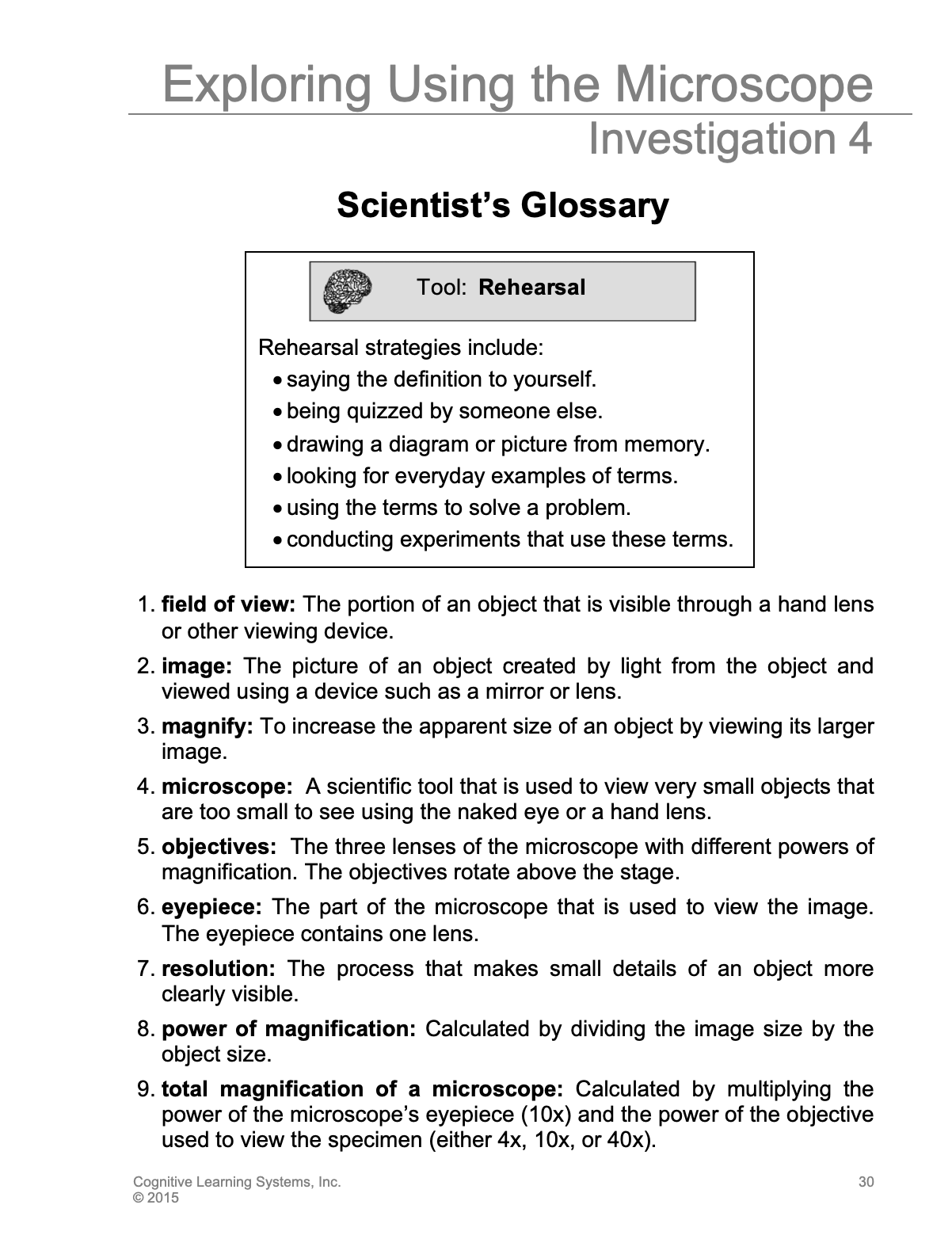
- Field of view: The portion of an object that is visible through a hand lens or other viewing device.
- Image: The picture of an object created by light from the object and viewed using a device such as a mirror or lens.
- Magnify: When a lens refracts light and increases the size of an object’s image.
- Microscope: A scientific tool that is used to view very small objects that are too small to see using the naked eye or a hand lens.
- Objectives: The three lenses of the microscope with different powers of magnification. The objectives rotate above the stage.
- Eyepiece: The part of the microscope that is used to view the image. The eyepiece contains one lens.
- Resolution: The process that makes fine details more clearly visible.
- Power of magnification: Calculated by dividing the image size by the object size.
- Total magnification of a microscope: Calculated by multiplying the power of the microscope’s eyepiece (10x) and the power of the objective used to view the specimen (either 4x, 10x, or 40x).
BE PREPARED
Watch the Investigation 4 Teacher Video and Student Video below to prepare for the PreLab.
SET FOR SUCCESS
- Tell students that they will continue their exploration of lenses and microscopes.
- Ask students to share the kinds of things they might learn in this Investigation.
Begin the PreLab Concept Slides to start students on their learning journey. Then watch the Pre-Lab Student Video as a class.
NAVIGATE IT
Once the slide presentation is launched
- use your left and right arrows to advance or go back in the slide presentation, and
- hover your mouse over the left edge of the presentation to get a view of the thumbnails for all the slides so that you can quickly move anywhere in the presentation.
- Click HERE to launch the slide presentation for the CELL.
SHARE IT
SLIDE M&M4-pre-1
Direct students to their Scientist’s Glossary. As the concepts in PreLab are discussed, refer students to the terms necessary for the discussion.
______________________________________________
SLIDE M&M4-pre-2
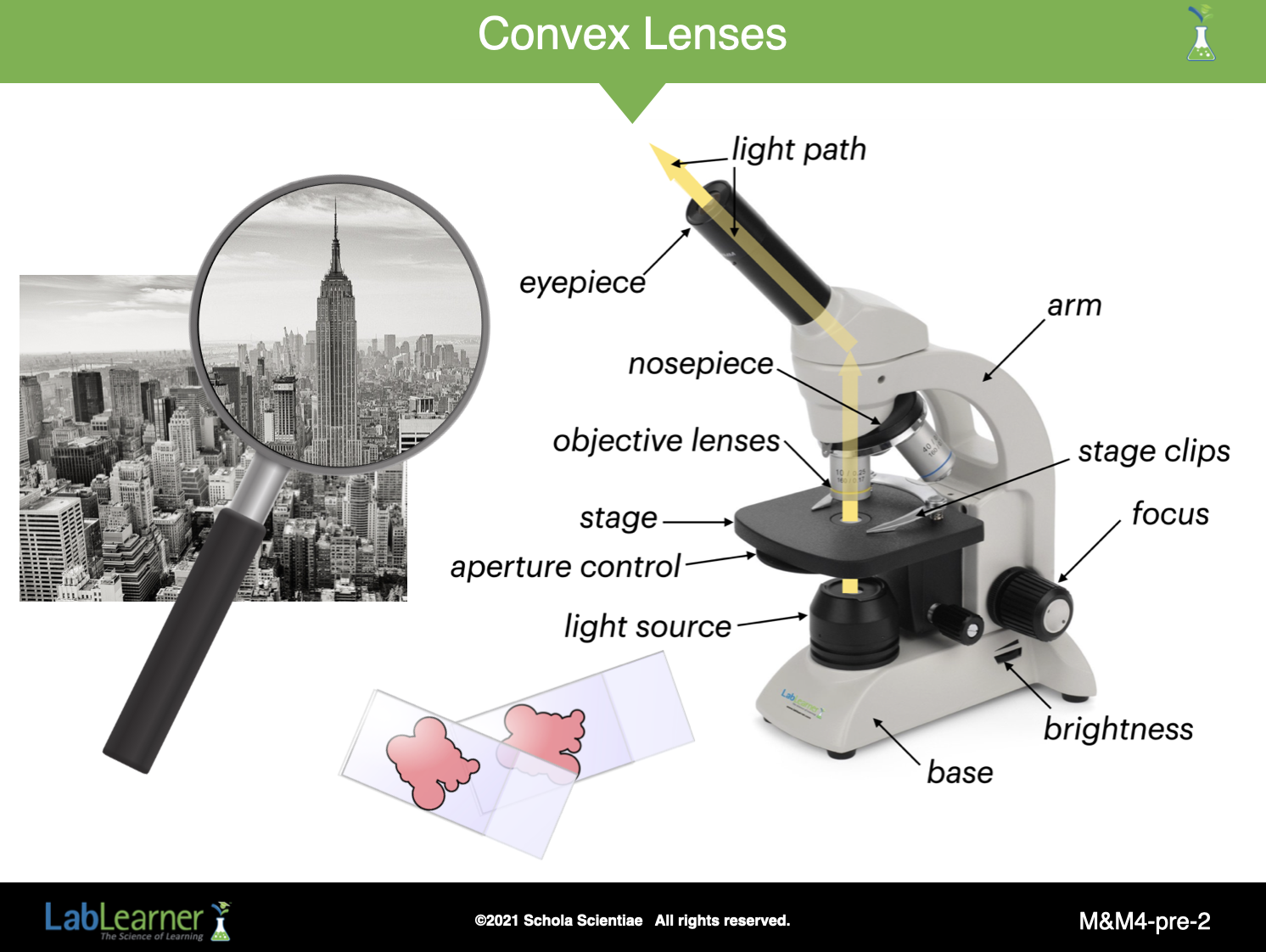
We begin with a quick review of previous Investigations.
What are some of the scientific tools that are used to magnify? A hand lens and a microscope are scientific tools that magnify.
What are some of their similarities and differences? Both the hand lens and the microscope magnify the image of an object. Both have at least one convex lens. They are different since a microscope has multiple lenses but a hand lens has only one. A microscope has greater total magnification than a hand lens.
How many lenses does the microscope contain? Where are they located? Four. One lens is located above the stage in each of the three objectives and one lens is located in the eyepiece.
What is a slide? A slide is a rectangular piece of transparent glass with a specimen to be viewed.
______________________________________________
SLIDE M&M4-pre-3
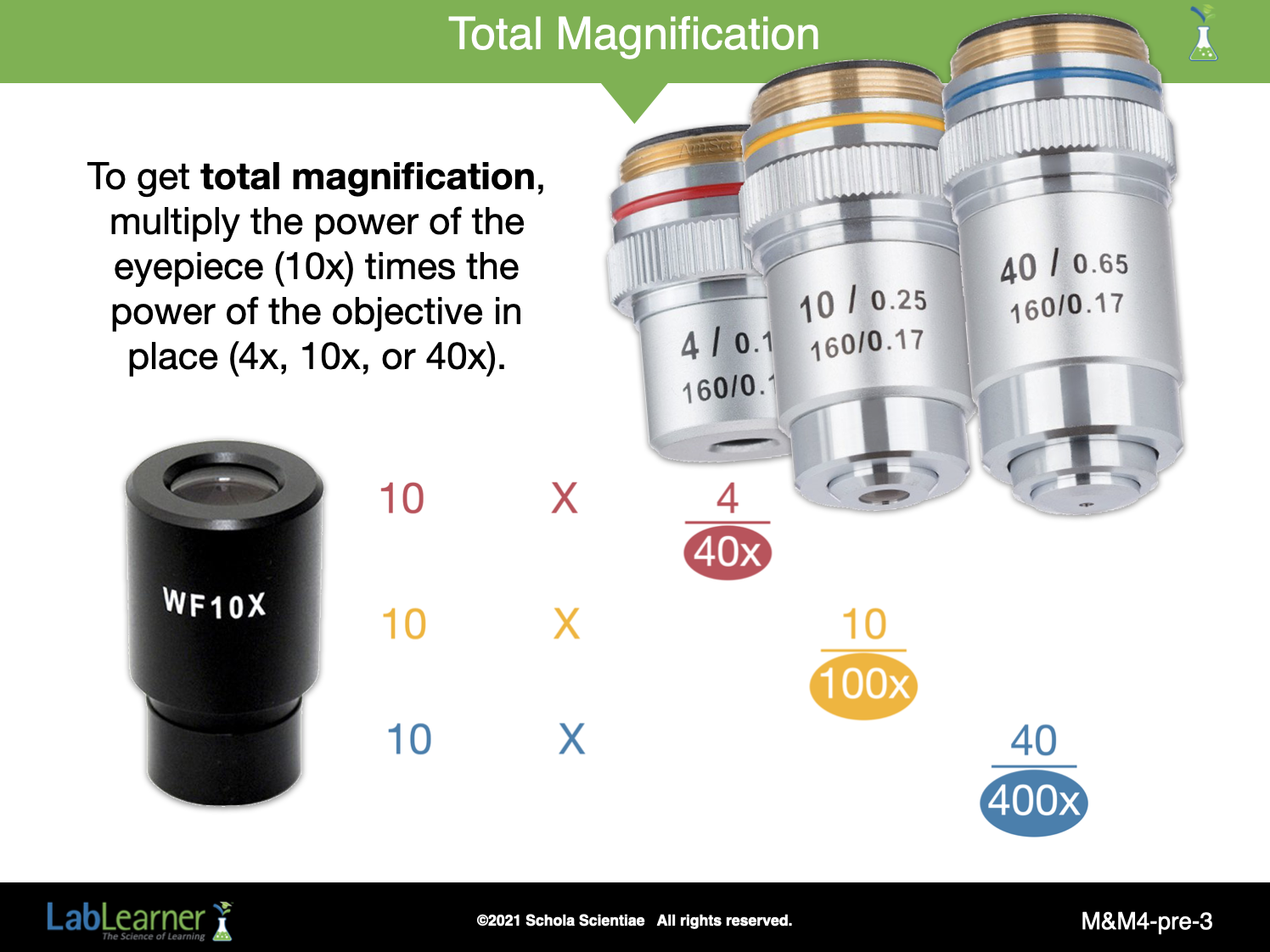
- Explain to students that magnification is defined as a comparison of the increased size of an object’s image to the actual size of the object.
- Inform students that each lens possesses a different power of magnification, so that the lens in a hand lens may have a different power of magnification than the lens in the objective of a microscope.
- Explain to students that when more than one lens is used to magnify an object’s image, the total magnification is a combination of the powers of magnification of both lenses.
- Discuss how to find the total magnification of a specimen’s image using the microscope. Multiply the power of the objective used (4X, 10X, or 40X) and the eyepiece (10X).
______________________________________________
SLIDE M&M4-pre-4
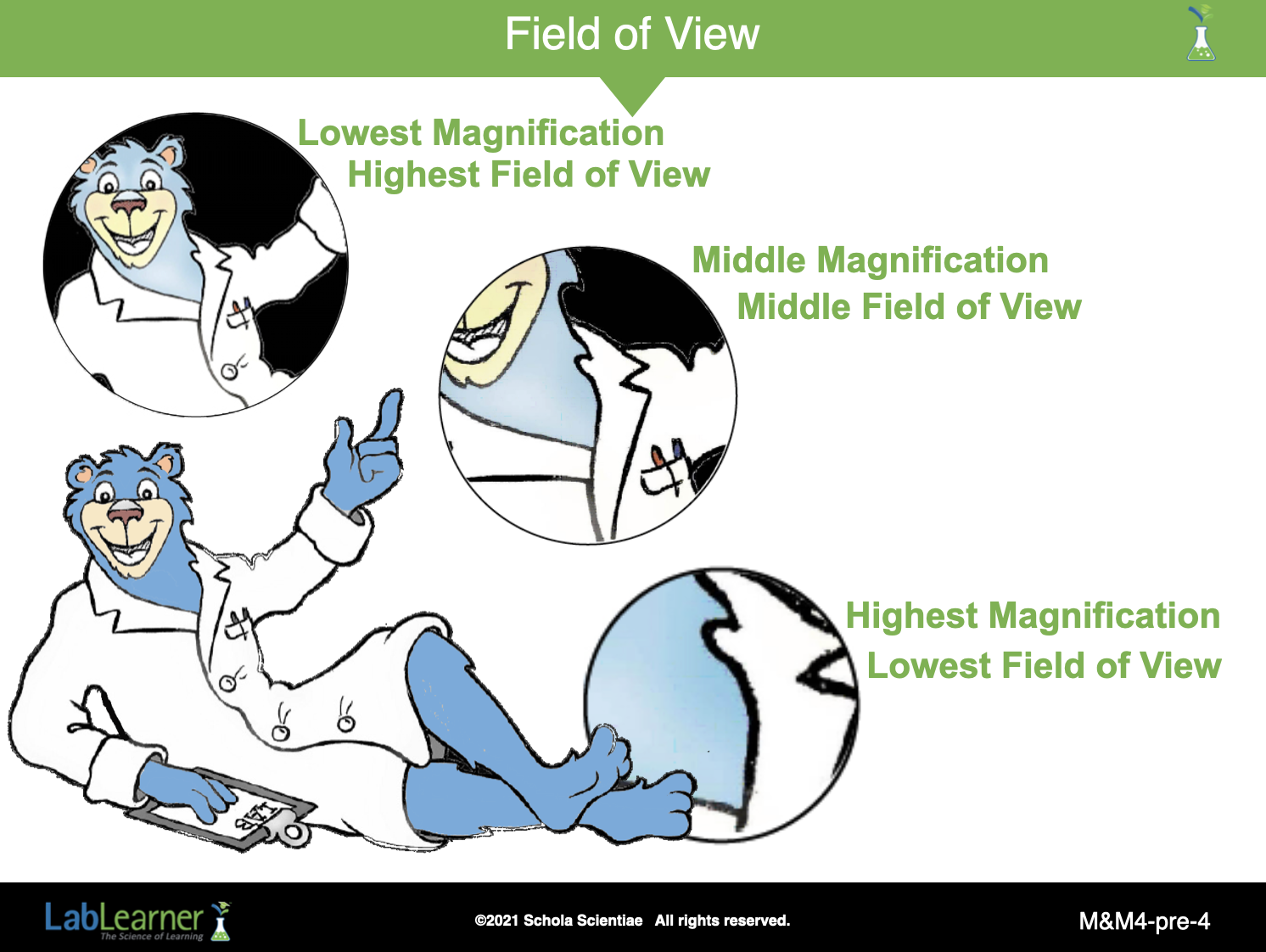
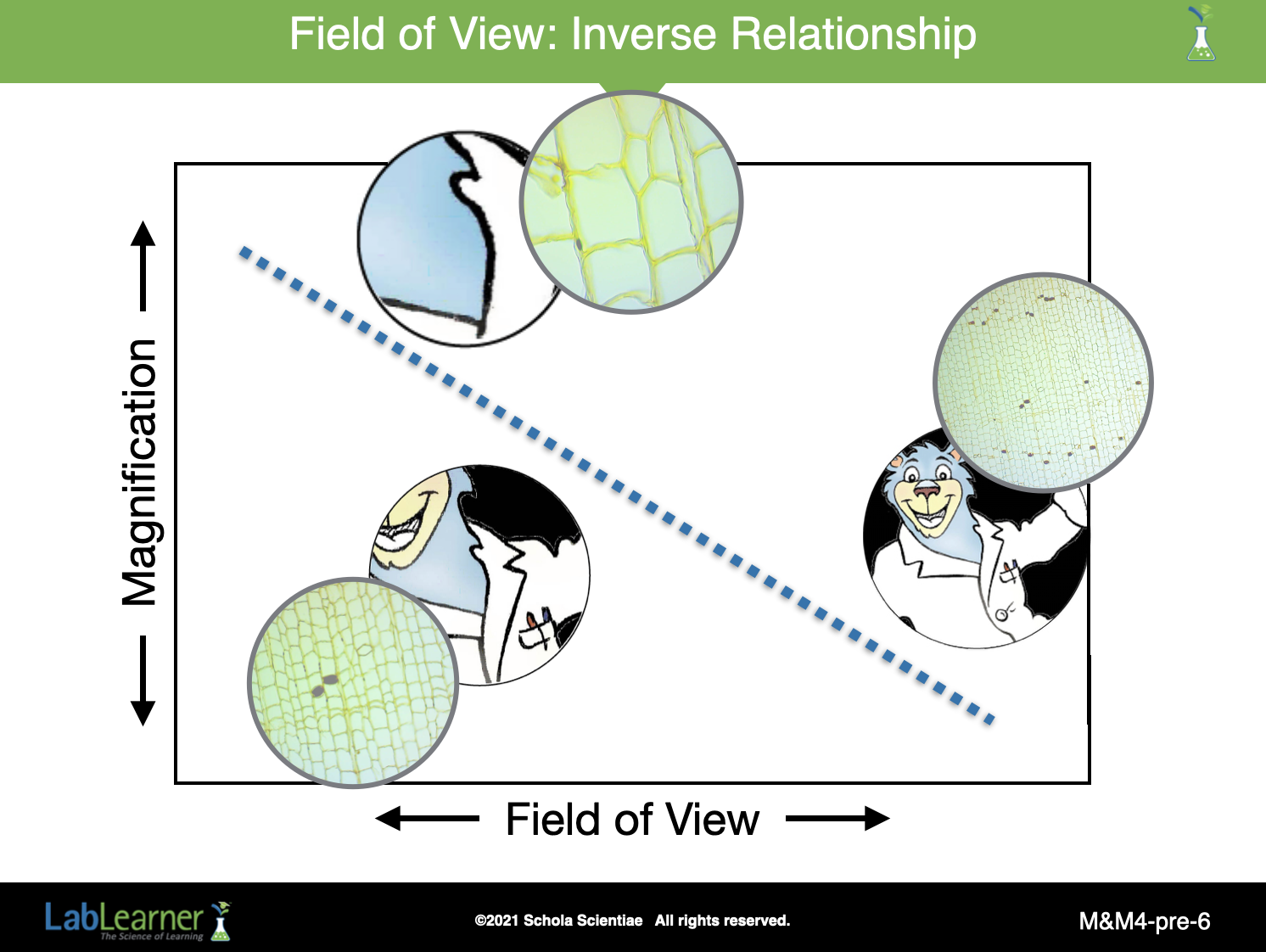
This slide shows the “inverse” relationship between magnification and field of view. Each of the circular images has the same diameter. However, notice that as the magnification goes up, the field of view goes down. In other words, you can see less of the object but in more detail as magnification increases.
Mathematically, a relationship in which one factor increases while another decreases is said to be inversely related.
______________________________________________
SLIDE M&M4-pre-5
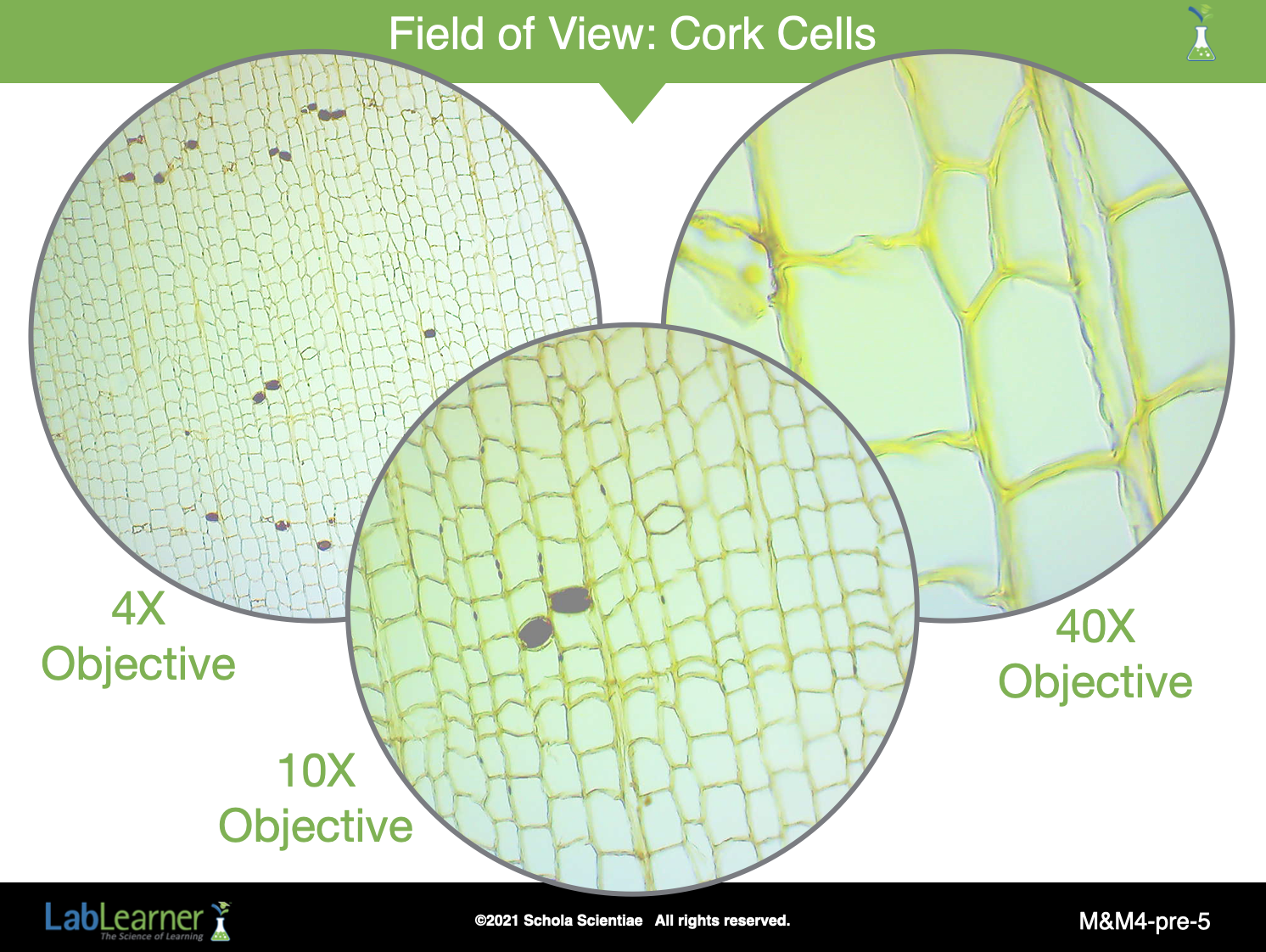
Notice the number of cork cells you can see at the magnifications provided by three different objective lenses. Using the 4X objective, one sees hundreds of cells in the field of view, whereas using the 40X objective, one can only see perhaps just over 10 cells.
Again, notice how magnification and field of view are inversely related.
______________________________________________
SLIDE M&M4-pre-6
- Explain to students that magnification is defined as a comparison of the increased size of an object’s image to the actual size of the object.
- Inform students that each lens possesses a different power of magnification, so that the lens in a hand lens may have a different power of magnification than the lens in the objective of a microscope.
- Explain to students that when more than one lens is used to magnify an object’s image, the total magnification is a combination of the powers of magnification of both lenses.
- Discuss how to find the total magnification of a specimen’s image using the microscope. Multiply the power of the objective used (4X, 10X, or 40X) and the eyepiece (10X).
______________________________________________
SLIDE M&M4-pre-7
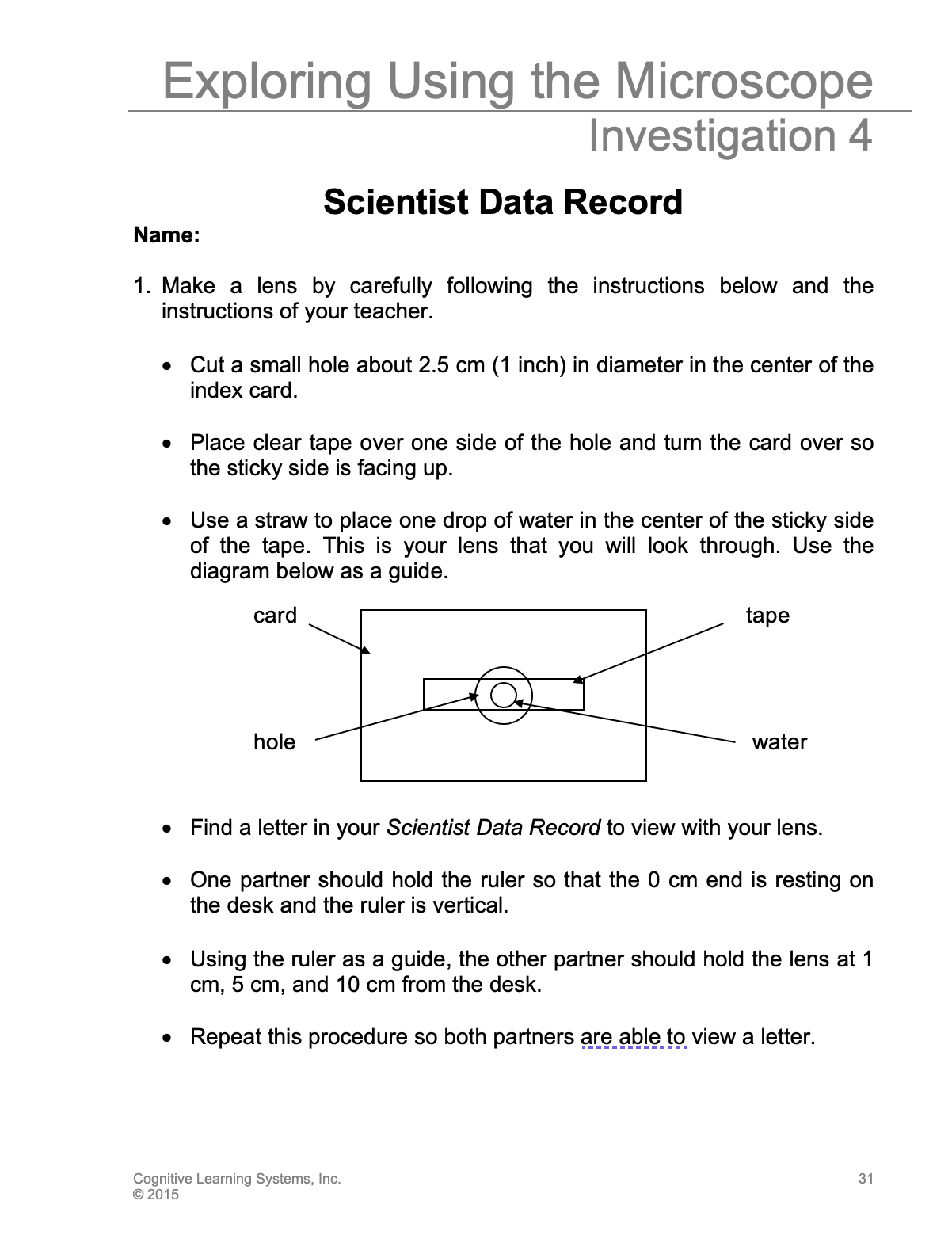
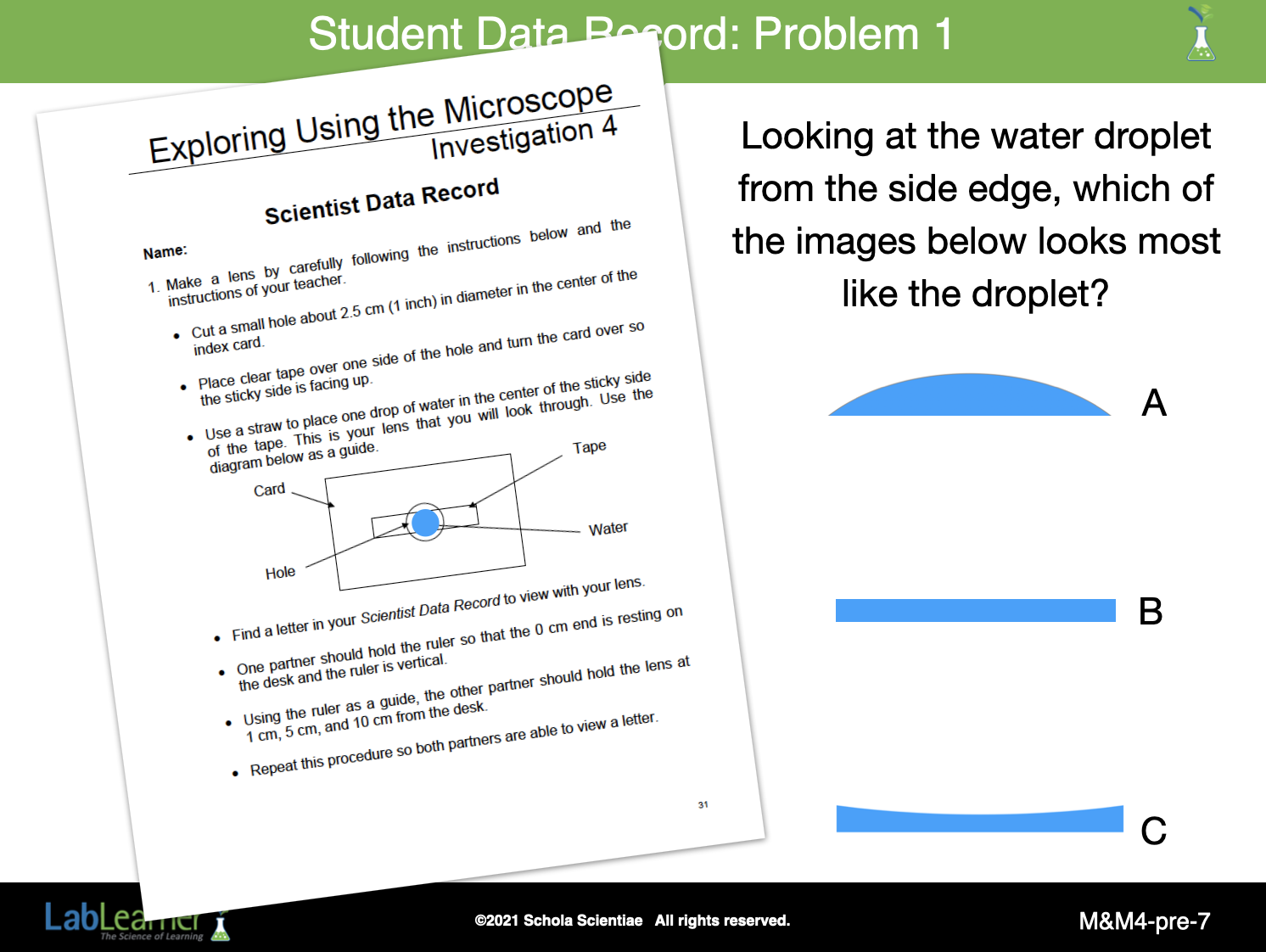
Divide the class into pairs and ask each pair to place one Student Data Record at the top of the desk.
1. Inform the class that they will be constructing a lens using the instructions in Problem 1 in their Student Data Record.
2. Each pair of students should repeat this procedure so both partners are able to view a letter.
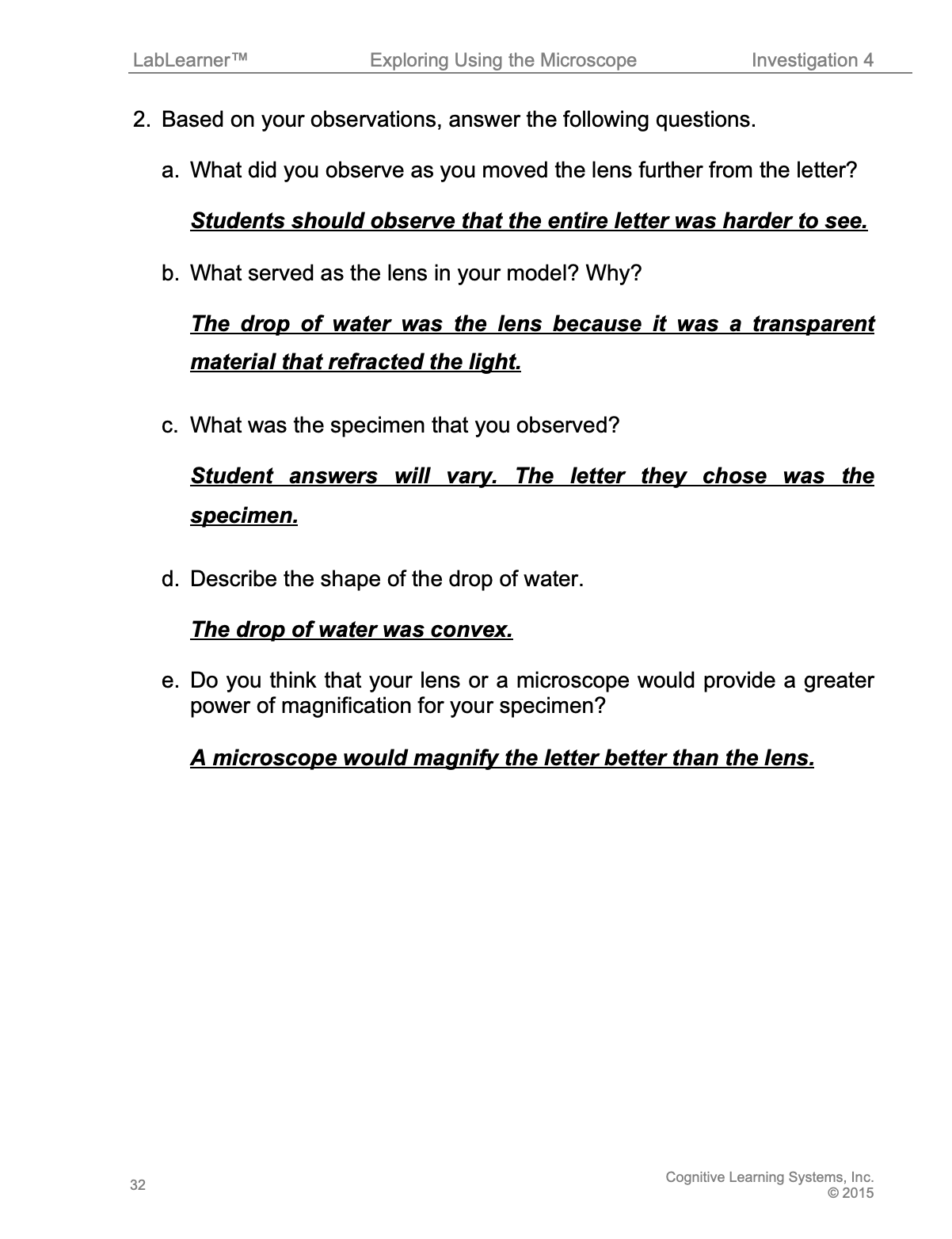
3. When finished, ask students to answer Problems 2a through e in their Student Data Record.
______________________________________________
SLIDE M&M4-pre-8
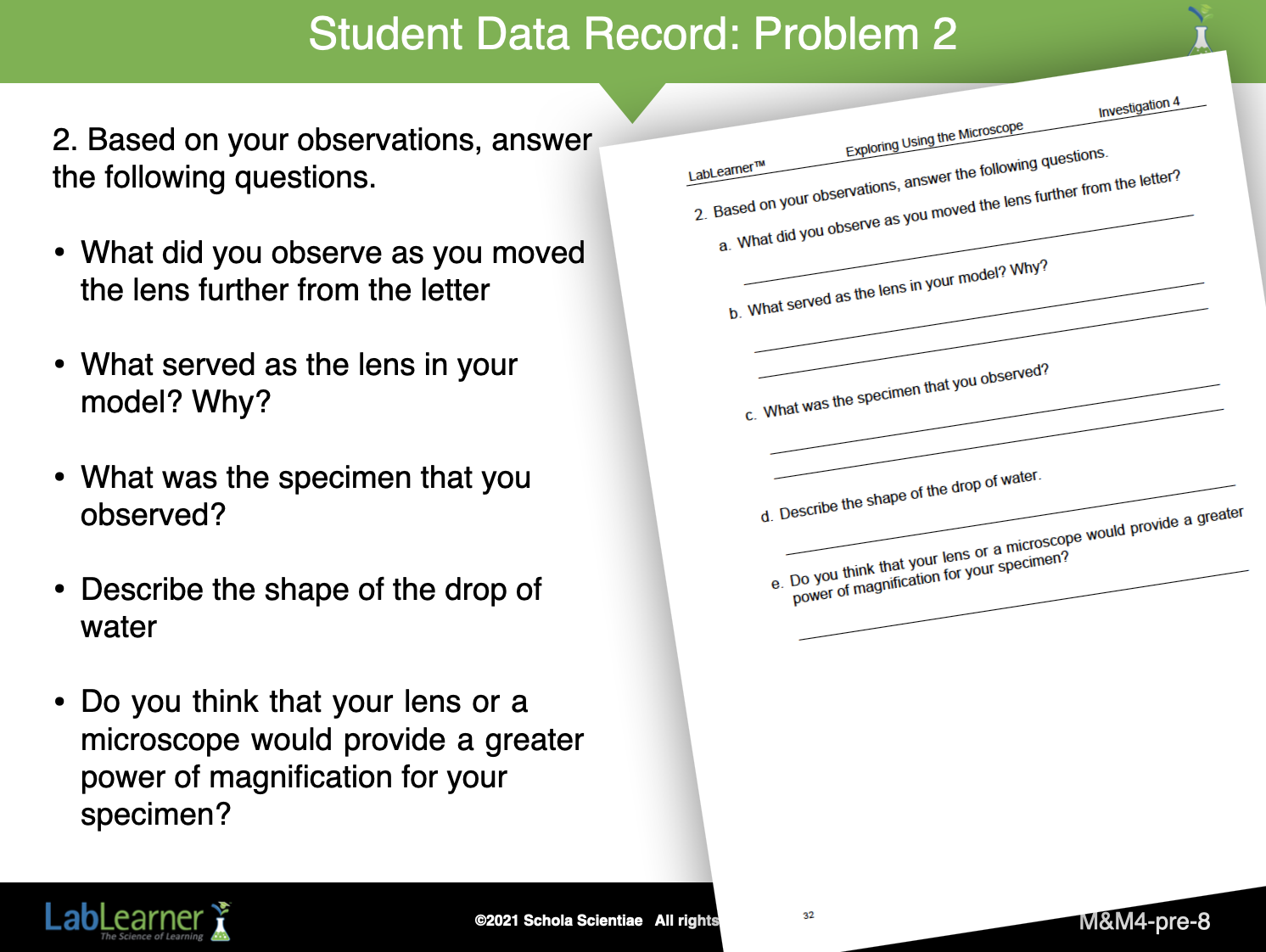
Tell students to answer Problem 2 in their Student Data Record and discuss it as a class.
______________________________________________

SLIDE M&M4-pre-9
On this final slide, notice how all droplets of water, with their convex surface, act as small lenses and magnify their surroundings.
Inform students that they will be investigating the following questions in the lab:
- What is meant by the power of magnification?
- How do you calculate the total magnification of each of the three objectives of the compound microscope?
- How does increasing the total magnification change the field of view?
______________________________________________
KEYS: PRELAB