Teacher Portal:
Watersheds
Performance Assessment
 ZERO-IN
The italicized font represents information to be shared orally or physically completed with the students at this time.
The non-italicized font represents additional information included supporting the teacher’s understanding of the content being introduced within the CELL.
MINDSET
This Investigation is designed to:
- allow students to solve a problem using the concepts with which they have become familiar during the previous Investigations, and
- allow students to solve a problem using the procedures used during the previous Investigations.
DOWNLOAD IT – PRINT IT
By clicking the link below, the Performance Assessment Grading Rubric may be downloaded as a PDF (Portable Document Format) and printed. It is suggested that the teacher uses the printed rubric as a guide and to make additional notes during the assessment.
BE PREPARED
Teacher Preparation for the Investigation includes the following. This preparation should be done prior to students arriving in the lab.
- If not prepared previously, prepare the salt solutions at least 24 hours before the Performance Assessment (see directions below). Salt solutions must be prepared in advance to be sure that any degassing caused by the addition of salt to the water does not interfere with the dissolved oxygen readings.
- Prepare 500 ml of 15% salt solution.
A. Fill a 1 L pitcher to the 300 ml mark with distilled water.
B. Add 750 grams of pickling salt to the pitcher.
C. Stir with a stir bar and hotplate/stirrer until all of the salt is in solution and most of the gas bubbles have dissipated.
D. Pour the solution into a 1 L graduated cylinder. Add distilled water to the 500 ml mark.
E. Cover the graduated cylinder with plastic wrap or aluminum foil and label it “15% salt.”
- Prepare 500 ml of 30% salt solution.
A. Fill a 1 L pitcher to the 300 ml mark with distilled water.
B. Add 150 grams of salt to the pitcher.
C. Stir with a stir bar and hotplate/stirrer until all of the salt is in solution and most of the gas bubbles have dissipated.
D. Pour the solution into a 1 L graduated cylinder. Add distilled water to the 500 ml mark.
E. Cover the graduated cylinder with plastic wrap or foil and label it “30% salt.”Soil Sample 2 consists of 25g of gravel, 20g of potting soil and 5g of sand.
- Prepare unknowns A, B, and C for each group.
A. Label five 100 ml beakers “A.” Add 80 ml of dissolved water to each beaker.
B. Label five 100 ml beakers “B.” Add 80 ml of 30% salt to each beaker.
C. Label five 100 ml beakers “C.” Add 80 ml of 15% salt to each beaker.
- If not prepared previously, prepare 200 ml of 50% glycerol solution:
A. Measure 100 ml of glycerin in a 250 ml graduated cylinder. Glycerin is very viscous and will stick to the walls of the graduated cylinder. Let it settle to get an accurate reading of the volume.
B. Pour the glycerin into a 400 ml beaker, transferring as much as possible.
C. Add 100 ml of water to the graduated cylinder. Swirl the water gently to rinse any remaining glycerin from the inside of the graduated cylinder.
D. Pour the water into beaker with the glycerin. Stir the solution with a glass stir rod or with a stir bar and stirrer.
- Fill five 15 ml centrifuge tubes with 6 ml of 50% glycerol. Label the tubes and place them at the distribution center. These will serve as blanks for the spectrophotometer.
- Add 0.5 g of flour to a beaker with 300 ml of water. Add a stir bar and stir the mixture until no flour is floating on the surface and no lumps are visible. Let the mixture stand for 5 minutes. Use a dropper to obtain samples of the mixture for Unknowns D, E, and F:
A. Label five 15 ml centrifuge tubes “E.” Add 5 ml of 50% glycerol to each tube. Add 1 ml of the mixture without stirring to each tube.
B. Label five 15 ml centrifuge tubes “D.” Add 5 ml of 50 % glycerol to each tube. Add 1 ml of the mixture stirring at 200 rpm to each tube.
C. Label five 15 ml centrifuge tubes “F.” Add 5 ml of 50% glycerol to each tube. Add 1 ml of the mixture stirring at 300 rpm to each tube.
- Turn the spectrophotometers on before class starts to allow the equipment to warm up.
- Place a box of Kim-wipes, a water bottle with water, a cuvette, and a beaker for waste next to each spectrophotometer.
- Place the remaining materials at the distribution center.
- Divide the class into five cooperative groups.
Student Preparation for the Investigation includes having students gather the following materials. This preparation takes place on lab day after student lab groups have settled at their assigned lab tables.
Note: The materials are NOT listed in students’ SDRs. They are listed below for your reference.
- (1) spectrophotometer
- (1) glass cuvette
- (1) water bottle with water
- (1) L pitcher for waste
- (1) box of Kim-wipes
- (4) plastic droppers
- (1) oxygen meter
- (1) hotplate/stirrer
- (1) 15 ml centrifuge tube with 50% glycerin
- (6) unknowns, labeled A-F
Direct one student from each lab group to collect the materials.
INVESTIGATE
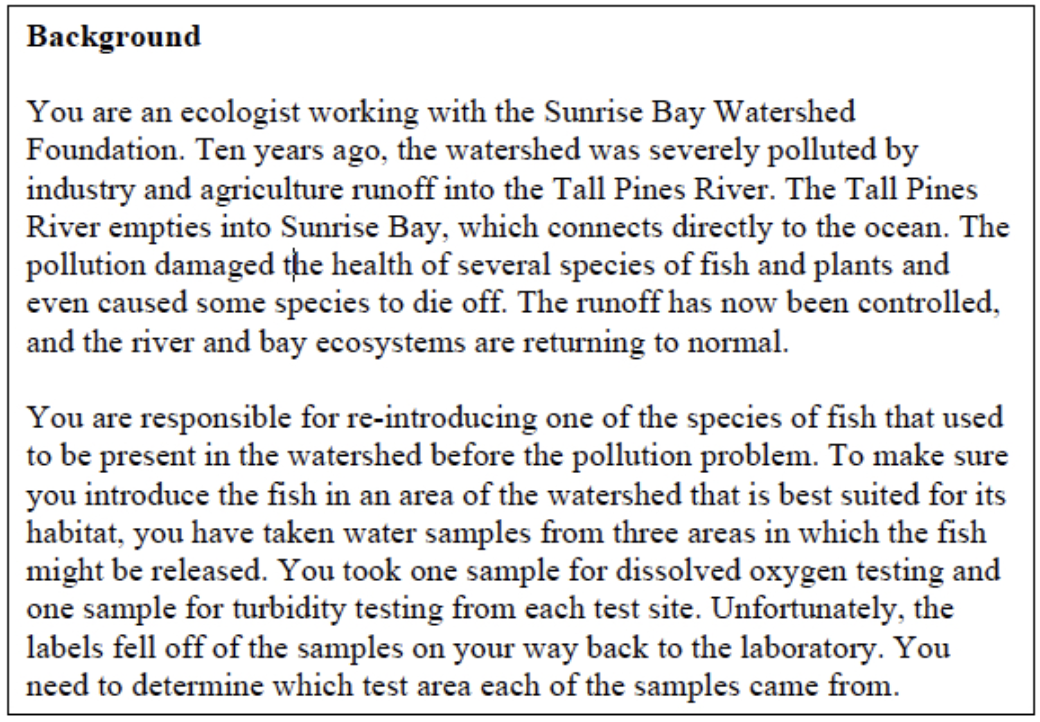
- Ask students to read the Background for the Performance Assessment, and discuss if necessary.
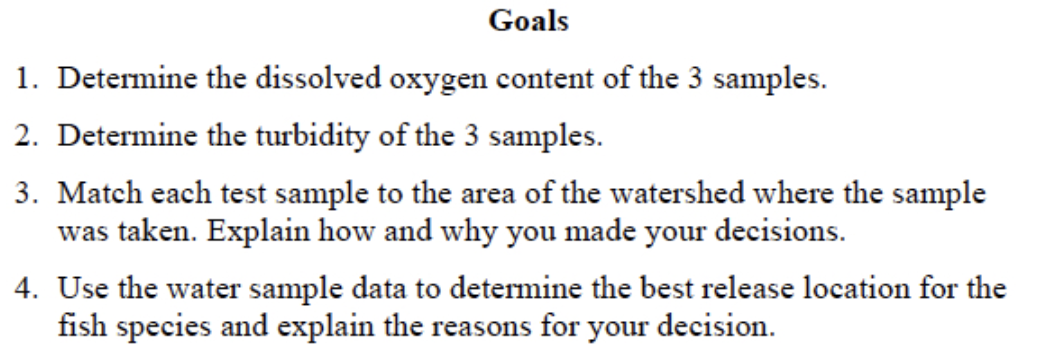
- Ask students to read the Goals of the Performance Assessment, and discuss if necessary.
- Explain to students that the Performance Assessment requires only those procedures and skills that they have used in the previous Investigations.
- Allow students to conduct their experiments and encourage them to record their data carefully.
CLEAN UP
Let students know your expectations for cleanup. Ask them to clean up.
ANALYZE IT
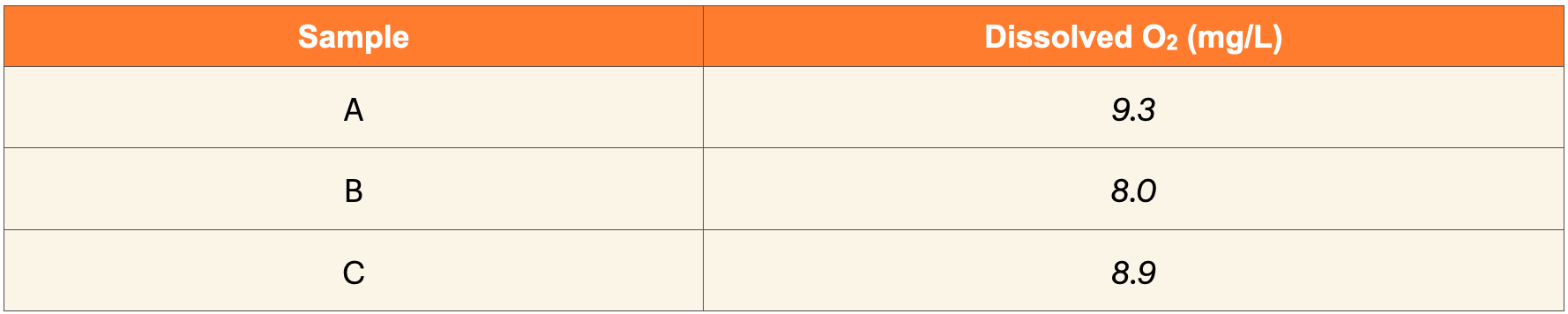
Discuss the results of the Performance Assessment as a class, including
- all possible solutions to the posed problem,
- whether each student group met the goals of the Performance Assessment, and
- any procedural difficulties student groups had in meeting the goals.
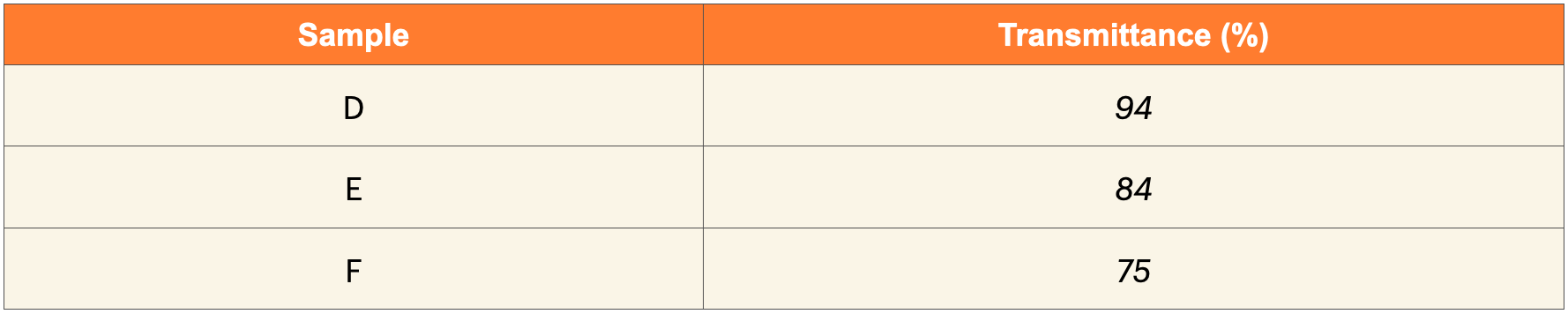
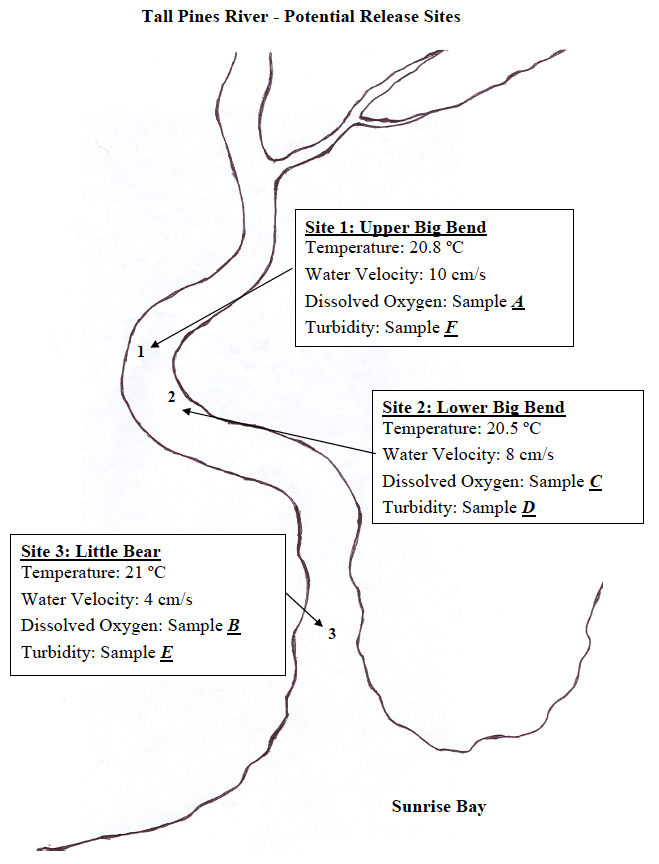
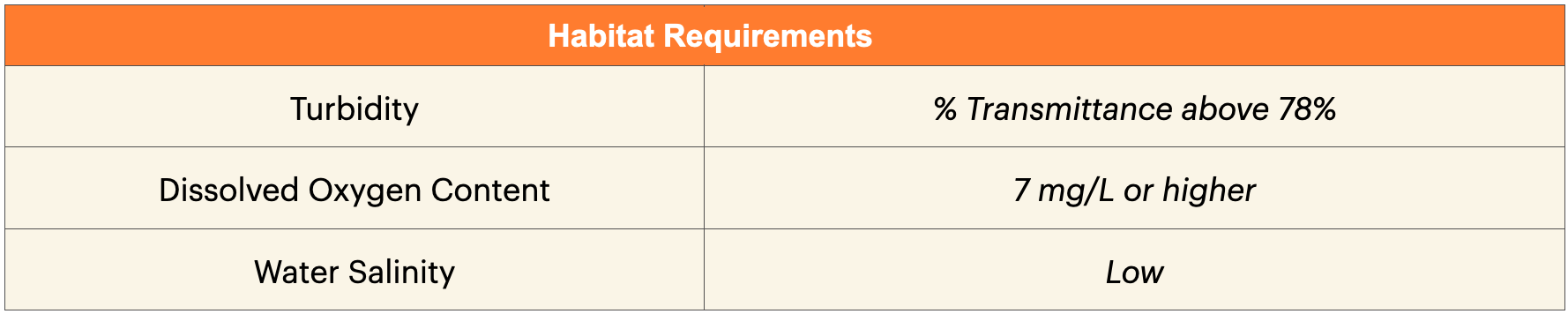
The species of fish you wish to reintroduce into the watershed has the following habitat water quality requirements: