
Teacher Portal:
Sound Waves and Pressure
Investigation 3 – Lab
ZERO-IN
Italicized font represents information to be shared orally or physically completed with the students at this time.
The non-italicized font represents additional information included to support the teacher’s understanding of the content being introduced within the CELL.
MINDSET
This Investigation is designed to:
- allow students to demonstrate that the speed of sound is different in different types of matter,
- allow students to demonstrate that in different types of matter, the frequency remains constant but the wavelength changes,
- allow students to use the equation relating the speed of sound to the frequency and the wavelength, and
- allow students to demonstrate the reciprocal relationship between the frequency and the wavelength of sound.
BE PREPARED
Teacher Preparation for the Investigation includes the following. This preparation should be done prior to students arriving in the lab.
- Cut (6) 3-meter lengths of string.
- Fill six 50 ml beakers with 25 ml of water.
- Place all materials at a central location.
- Divide students into five cooperative groups.
Note: Each student lab group will need the materials listed below.
Student Preparation for the Investigation includes having students gather the following materials. This preparation takes place on lab day after student lab groups have settled at their assigned lab tables.
Note: The materials are listed in students’ SDRs. They are also listed below for your reference.
- (1) 50ml beaker
- (1) 50ml beaker filled with water
- (1) iron electrode
- (2) meter sticks
- (1) calculator
- (1) one meter length of string
- (1) roll of masking tape
- (1) lab marker
Direct one student from each lab group to collect the materials listed in their SDRs.
INVESTIGATE
- Explain to students that because it is very difficult to measure the speed of sound in a liquid or a solid, they will model the speed of sound in water and iron.
- Inform students that they will also model the speed of sound in air.
- Inform students that they will perform three Trials during this Investigation. In each Trial, they will calculate the speed of sound in a type of matter.
- Inform students that they will analyze their data and identify which of the three types of matter is air, water, or iron.
- Ask students to read the Background before Trial 1 to remind them of the relationship among speed, frequency, and wavelength.
- Encourage students to reflect on the PreLab video as they move through the procedural steps.
- Explain to students that during the Experiment, every procedural step is important. If one step is skipped, data can become invalid. To help students keep on track, direct them to read each step thoroughly, complete the step, then check it off (Read it – Do it – Check it off).
- Direct students to complete the procedural steps in their SDRs.
Note: The procedural steps are listed below for your reference. Teacher “Notes” are inserted, as needed, to help facilitate the lab.
The Experiment includes the following:
- In this Investigation, you will model how different types of matter affect the speed of sound in each type of matter. You will assume that the pressure wave in each type of matter has a specific frequency but that the wavelength of the pressure wave in each type of matter is different. You will then calculate the speed of sound in each type of matter.
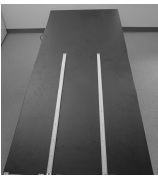
- Place the two meter sticks on the table so that the width of the table is divided into three equal sections.
- You will model the speed of sound in three types of matter, air, water, and iron. Observe the contents of the empty beaker, the water in the second beaker, and the iron electrode in the third beaker and answer the following questions.
- Describe the contents of the empty beaker. Student answers will vary. The beaker will be described as empty or the air in the beaker will be described as invisible.
- Describe the water filling the second beaker. Student answers will vary. The water may be described as wet.
- Describe the iron electrode. Student answers will vary. The electrode may be described as hard.
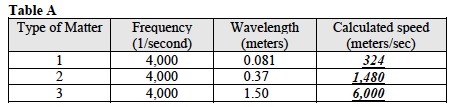
- For each of the three types of matter, refer to Table A for the frequency and wavelength of the pressure waves in each type of matter. Notice that the frequency of the sound wave in each type of matter is 4,000 Hertz but the wavelengths are different.
Trial 1:
- In this Trial, you will model the sound waves that travel through the first type of matter in the beaker.
- Refer to the wavelength in Table A. Use the meter sticks to measure the wavelength of the sound wave starting at the end of the meter sticks.
- Cut a piece of string equal to the wavelength. Tape one end at the end of the table. Arrange the string on the table to represent the sound wave of the correct wavelength. Tape the other end of the string to the table using a second piece of masking tape.
- Use the equation relating speed, frequency, and wavelength to calculate the speed of sound in the first type of matter. Use the space below for your calculations. Record the speed in Table A.
4,000 Hz x 0.081 m = 324 m/sec
Trial 2:
- In this Trial, you will model the sound waves that travel through the second type of matter in the beaker.
- Refer to the wavelength in Table A. Use the meter sticks to measure the wavelength of the sound wave starting at the end of the meter sticks.
- Cut a piece of string equal to the wavelength. Tape one end at the end of the table. Arrange the string on the table to represent the sound wave of the correct wavelength. Tape the other end of the string to the table using a second piece of masking tape.
- Use the equation relating speed, frequency, and wavelength to calculate the speed of sound in the second type of matter. Use the space below for your calculations. Record the speed in Table A.
4,000 Hz x 0.371 m = 1,480 m/sec
Trial 3:
- In this Trial, you will model the sound waves that travel through the third type of matter.
- Refer to the wavelength in Table A. Use the meter sticks to measure the wavelength of the sound wave starting at the end of the meter sticks.
- Cut a piece of string equal to the wavelength. Tape one end at the end of the table. Arrange the string on the table to represent the sound wave of the correct wavelength. Tape the other end of the string to the table using a second piece of masking tape.
- Use the equation relating speed, frequency, and wavelength to calculate the speed of sound in the third type of matter. Use the space below for your calculations. Record the speed in Table A.
4,000 Hz x 1.50 m = 5,980 m/sec
CLEAN UP
Let students know your expectations for clean up. Ask them to clean up.