
Teacher Portal:
Chemical Reactions
Investigation 1 – Lab
ZERO-IN
Italicized font represents information to be shared orally or physically completed with the students at this time.
The non-italicized font represents additional information included to support the teacher’s understanding of the content being introduced within the CELL.
MINDSET
This Investigation is designed to:
- illustrate to students that chemical reactions consume reactants and produce products,
- allow students to analyze data indicating that energy in the form of heat can be released from a chemical reaction, and
- allow students to measure the effect of increasing amounts of reactants on the heat produced by a reaction.
BE PREPARED
Teacher Preparation for the Investigation includes the following. This preparation should be done prior to students arriving in the lab.
- Prepare the diluted hydrochloric acid (HCl) solutions with distilled water according to the following table.

Note: Spilling the diluted solutions should pose no significant risk to students. Any spills should be rinsed with water. Goggles should be worn to prevent splashing into the eyes. If either diluted solution is splashed into the eyes, the eyes should be thoroughly rinsed with water.
- For each student group, pour 30 ml of each of the dilutions of HCl into labeled 100 ml beakers.
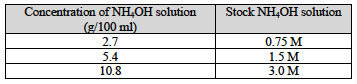
- For each student group, pour 30 ml of each of the concentrations of ammonium hydroxide into labeled 50 centrifuge tubes. The table below shows the concentration of the ammonium hydroxide solutions required and the molarity of stock ammonium hydroxide solutions.
- Put all materials at the distribution area.
- Divide the students into five cooperative groups.
Note: Each student lab group will need the materials listed below.
Student Preparation for the Investigation includes having students gather the following materials. This preparation takes place on lab day after student groups have settled at their assigned lab tables.
Note: The materials are listed in students’ SDRs. They are also listed below for your reference.
- (1) 400 ml beaker
- (2) 8 oz. insulated foam drinking cups
- (1) pair of scissors
- (1) thermometer
- (1) 100 ml graduated cylinder
- (1) 50 ml centrifuge tube filled with 30 ml of 2.7 g/100 ml ammonium hydroxide
- (1) 50 ml centrifuge tube filled with 30 ml of 5.4 g/100 ml of ammonium hydroxide
- (1) 50 ml centrifuge tube filled with 30 ml of 10.8 g/100 ml ammonium hydroxide
- (1) 100 ml beaker filled with 30 ml of 2.7 g /100 ml of hydrochloric acid
- (1) 100 ml beaker filled with 30 ml of 5.4 g/100 ml of hydrochloric acid
- (1) 100 ml beaker filled with 30 ml of 10.8 g /100 ml of hydrochloric acid
- (1) pair goggles per student
- (1) pair gloves per student
Direct one student from each lab group to collect the materials listed in their SDRs.
INVESTIGATE
-
- Inform students that they will perform three Trials during this Investigation. Each Trial uses different amounts of the two reactants, ammonium hydroxide (NH4OH) and hydrochloric acid (HCl).
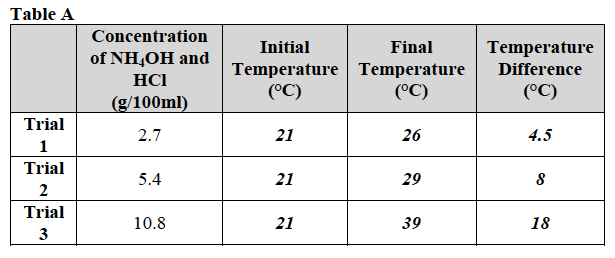
- Explain to students that they should carry out each of the three Trials and record their data in Table A which is located at the end of the Investigation 1 Student Data Record.
- Explain to students that as each Trial is completed, they should answer the questions within each Trial.
- Encourage students to reflect on the PreLab video as they move through the procedural steps.
- Explain to students that during the Experiment, every procedural step is important. If one step is skipped, data can become invalid. To help students keep on track, direct them to read each step thoroughly, complete the step, then check it off (Read it – Do it – Check it off).
- Direct students to complete procedural steps in their SDRs.
Note: The procedural steps are listed below for your reference. Teacher “Notes” are inserted, as needed, to help facilitate the lab.
- Construct a calorimeter by first placing one insulated foam cup in the 400 ml beaker.
- Use the scissors to cut off the rim of the second cup.
- Use the scissors to make a hole in the center of the cup. Push the thermometer through the hole and place the smaller cup in the larger cup and the larger cup in the 400 ml beaker.
Trial 1
- In this Trial, you will react 2.7 g/100 ml of ammonium hydroxide (NH4OH) and 2.7 g/100 ml hydrochloric acid (HCl).
- Add 30 ml of 2.7 g/100 ml of ammonium hydroxide (NH4OH) to the bottom cup of the calorimeter. This is the first reactant in the reaction.
- Place the thermometer in the liquid. Slide the cup down the thermometer until it rests inside the bottom cup of the calorimeter.
- Wait until the temperature reading on the thermometer no longer changes.
- Record: Write the temperature of the liquid in Table A in the column under “Initial Temperature.” Table A is located on the last page of the Student Data Record.
- Locate the 30 ml of the 2.7 g/100 ml hydrochloric acid (HCl). This is the second reactant in the reaction.
- Remove the top cup of the calorimeter and the thermometer. Pour the hydrochloric acid (HCl) into the bottom cup and quickly replace the top cup and thermometer.
- Mix the reactants by carefully holding the beaker and swirling the calorimeter. Mix until the temperature reading on the thermometer no longer changes.
- Record: Write the temperature of the liquid in the column under “Final Temperature” in Table A which is located on the last page of the Student Data Record.
- Calculate: Find the temperature difference by subtracting the initial temperature from the final temperature.
- Record: Write the temperature difference in the last column of Table A.
- Empty the calorimeter and rinse with water. Shake out any excess water.
Trial 2
- In this Trial, you will react 5.4 g/100 ml of ammonium hydroxide (NH4OH) and 5.4 g/100 ml hydrochloric acid (HCl).
- Refer to Table A. In Trial 1, the concentrations of ammonium hydroxide (NH4OH) and hydrochloric acid (HCl) were both 2.7 g/100ml.
- Add 30 ml of 5.4 g/100 ml of ammonium hydroxide (NH4OH) to the bottom cup of the calorimeter.
- Place the thermometer in the liquid. Slide the cup down the thermometer until it rests inside the bottom cup of the calorimeter.
- Wait until the temperature reading on the thermometer no longer changes.
- Record: Write the temperature of the liquid in Table A in the column under “Initial Temperature.”
- Locate the 30 ml of the 5.4 g/100 ml hydrochloric acid (HCl).
- Remove the top cup of the calorimeter and the thermometer. Pour the hydrochloric acid (HCl) into the bottom cup and quickly replace the top cup and thermometer.
- Mix the reactants by carefully holding the beaker and swirling the calorimeter. Mix until the temperature reading on the thermometer no longer changes.
- Record: Write the temperature of the liquid in Table A in the column under “Final Temperature.”
- Calculate: Find the temperature difference by subtracting the initial temperature from the final temperature.
- Record: Write the temperature difference in the last column of Table A.
- Empty the calorimeter and rinse with water. Shake out any excess water.
Trial 3
- In this Trial, you will react 10.8 g/100 ml of ammonium hydroxide (NH4OH) and 10.8 g/100 ml hydrochloric acid (HCl).
- Refer to Table A. In Trial 2, the concentrations of ammonium hydroxide (NH4OH) and hydrochloric acid (HCl) were both 5.4 g/100ml.
- Add 30 ml of 10.8 g/100 ml of ammonium hydroxide (NH4OH) to the bottom cup of the calorimeter.
- Place the thermometer in the liquid. Slide the cup down the thermometer until it rests inside the bottom cup of the calorimeter.
- Wait until the temperature reading on the thermometer no longer changes.
- Record: Write the temperature of the liquid in Table A in the column under “Initial Temperature.”
- Locate the 30 ml of the 10.8 g/100 ml hydrochloric acid (HCl).
- Remove the top cup of the calorimeter and the thermometer. Pour the hydrochloric acid (HCl) into the bottom cup and quickly replace the top cup and thermometer.
- Mix the reactants by carefully holding the beaker and swirling the calorimeter. Mix until the temperature reading on the thermometer no longer changes.
- Record: Write the temperature of the liquid in Table A in the column under “Final Temperature.”
- Calculate: Find the temperature difference by subtracting the initial temperature from the final temperature.
- Record: Write the temperature difference in the last column of Table A.
- Empty the calorimeter and rinse with water. Shake out any excess water.
CLEAN UP
Let students know your expectations for clean up. Ask them to clean up.