
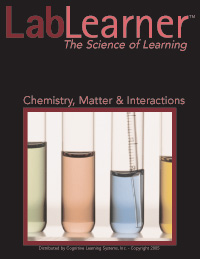
During this CELL, students will perform several investigations focused on physical and chemical properties of matter. By performing experiments and summarizing their results, students will begin to learn how to draw conclusions concerning the use of properties to identify and classify matter, how matter interacts and how interactions can lead to physical or chemical changes in matter that can be observed and measured.
Through investigations that center on the qualitative and quantitative properties of matter students will understand the importance of qualitative and quantitative descriptions in accurate identification of matter. Students will also learn that quantitative and qualitative properties are independent of one another, and that changing the quantity of matter often has little or no effect on changing the qualitative properties of that matter. In contrast, changing sample size may affect some quantitative properties of a sample, such as mass. In investigations that focus on combining matter, students will begin to build framework for future studies in chemistry by establishing an understanding of the fundamentals of solution chemistry. Through experimentation, students will explore the relationship between solute and solvent, a precursor to the study of chemical structures and bonds. In later investigations in the CELL, observation of chemical and physical changes will promote a basic understanding that combining substances can lead to the formation of new substances through chemical reactions. Finally, experimentation with acids and bases in one of the final investigations will promote the understanding that matter can be classified on the basis of chemical properties and behavior in solution.
Through performing experiments, observing chemical and physical changes, and participating in class discussion, students will begin to comprehend that the interactions and properties of matter are the basis for many of the life and physical processes that occur around them. This CELL will promote students’ awareness of chemical and physical interactions which occur in their daily lives, building continuity between laboratory investigations and real world applications and encouraging independent investigation.
___________________________________________________________________
Investigation 1: Identifying Matter
Investigation One introduces students to the science of chemistry as the study of properties of matter. Through observation and experimentation students will learn to differentiate between qualitative and quantitative properties. Students will discover that the pan balance can be used to compare the amount of matter in different samples, but that a new Procedural Tool, the triple beam balance, is preferred for determining the exact amount of matter in a sample and for quantifying differences in the amount of matter between samples.
Investigation 1: Teacher’s Video (7:29)
Investigation 1: Student’s Video (13:12)
___________________________________________________________________
Investigation 2: Measuring Matter
In Investigation Two, students continue their study of mass and properties of matter with experiments designed to demonstrate that mass is dependent upon sample size. Students will also learn how to account for the mass of a container when weighing substances. Students will discover through summarization of their results that changing a quantitative property such as mass has no effect on many of the qualitative properties of either solids or liquids.
Investigation 2: Teacher’s Video (9:27)
Investigation 2: Student’s Video (12:32)
___________________________________________________________________
Investigation 3: Combining Matter
Investigation Three introduces students to interactions between solids and liquids and between liquids. Through experimentation and observation students will explore the fundamentals of mixtures and solutions, and learn to identify the components of a solution based on their behavior in relation to each other. Students will also learn to recognize the similarities and differences of solubility and miscibility.
Investigation 3: Teacher’s Video (14:59)
Investigation 3: Student’s Video (16:01)
___________________________________________________________________
Investigation 4: Changing Matter
Investigation Four provides students an opportunity to expand their study of matter by exploring the differences between physical and chemical change. Students will learn that there are ten common signs of chemical change, and that these signs are often present during physical changes. Students will observe physical and chemical examples of three of the common signs, and through comparison and discussion examine the process by which scientists determine whether such signs are the result of physical or chemical changes in real world applications.
Investigation 4: Teacher’s Video (11:14)
Investigation 4: Student’s Video (15:12)
___________________________________________________________________
Investigation 5: Matter and pH
Investigation Five presents students with an introduction to pH, a method of classifying matter based on its acidity or basicity. Students will learn that pH can be quantified using a pH scale. Students will use the pH scale to explore and compare the relative acidity or basicity of a variety of common substances. Students will also practice making solutions and use these solutions to explore the effects of decreasing amounts of baking soda and increasing amounts of water on pH. An optional extension is provided to expand this exploration to an acidic compound, white vinegar.
Investigation 5: Teacher’s Video: Background (7:28)
Investigation 5: Teacher’s Video: Setup (14:21)
Investigation 5: Student’s Video: Trials 1-5 (14:34)
Investigation 5: Student’s Video: Trials 6-7 (3:24)
___________________________________________________________________
Investigation 6: Performance Assessment
Investigation Six consists of a performance assessment designed to evaluate students’ understanding of the science concepts addressed in the first five Investigations of the CELL. During this exploration, students will use the knowledge gained about properties of matter, solutions, physical and chemical changes and pH to identify which of four mixtures is made from two unknown substances.
Investigation 6: Performance Assessment – Teachers Only (13:31)